

Manual Can Opener Explainer
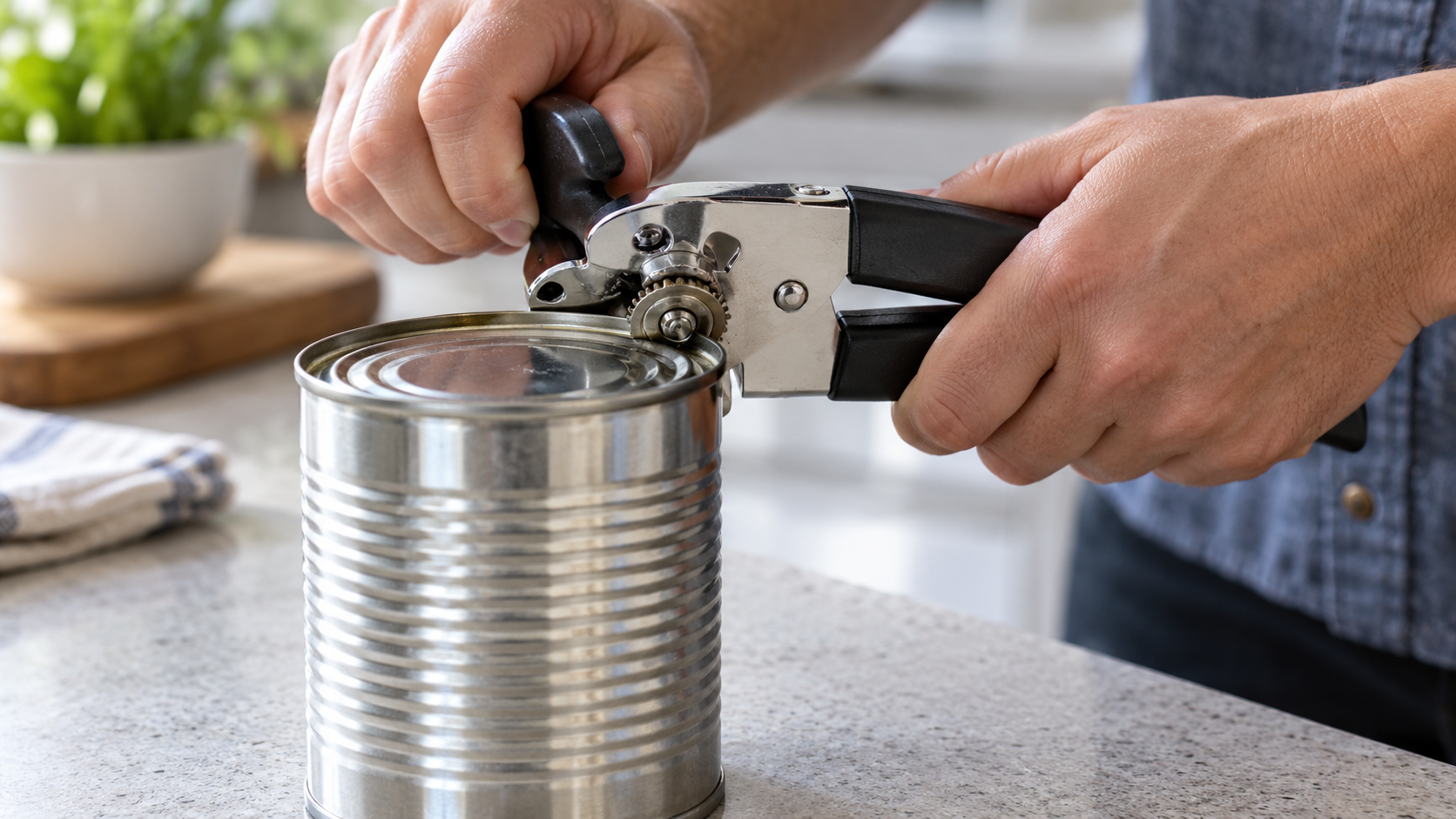
A manual can opener removes a lid by clamping two wheels around part of the can rim and driving them along a circular path. One wheel grips and feeds the metal; the other has a hardened cutting edge. Squeezing the handles creates the initial bite, and turning the crank rotates meshing gears. The feed wheel pulls the tool around the circumference while the cutter concentrates force into a very small contact area. That local stress exceeds the thin metal’s shear strength, producing a continuous cut without requiring the user to saw around the lid by hand.
In a traditional top-cut opener, the serrated drive wheel usually bears against the outside of the rim while the cutting wheel pierces the lid just inside it. The can’s rolled seam acts as a track that keeps the mechanism centered. Gear teeth make the crank, feed wheel, and cutter advance together at a controlled rate. The long handles provide leverage for clamping, and the crank provides a larger turning radius than the small wheel. Mechanical advantage trades longer hand motion for enough force to deform and separate steel or aluminum sheet.
Side-cut or safety openers use different geometry. They travel around the outer seam and separate the folded connection rather than cutting through the flat lid surface. This can leave a smoother upper edge and reduce contact between the blade and food, although the separated parts still need careful handling. Designs are not interchangeable in their placement: a top-cut model sits with the crank generally to the side, while a side-cut model engages the rim from above or around the edge according to its instructions.
The cut is controlled fracture, not melting. A sharp wheel creates high pressure and a clean shear line. A dull, bent, rusty, or food-coated wheel slips, crushes the seam, or leaves incomplete bridges of metal. Poor alignment can make the opener spiral off the track. Cleaning the mechanism promptly prevents residue from hardening near the blade and gears. If the manufacturer permits washing, the tool should be dried thoroughly; some gear assemblies are not intended for immersion or dishwashers.
Once nearly all the circumference is cut, the remaining connection supports the lid. Completing the cut can let it fall into food, while leaving a small hinge can make lifting easier but creates a sharp flexing edge. Some openers include a magnet or small gripping jaw to raise the lid without fingers. Hands should stay away from both cut surfaces, and a damaged can should be evaluated before opening. Bulging, leaking, deeply rusted, or spurting containers can signal spoilage or pressure and should not be tasted.
Can geometry and tool condition explain most failures. Very small, square, dented, or unusually thick rims may not fit a particular opener. Excessive squeezing adds friction and can distort the track; too little prevents the cutter from engaging. The efficient motion is firm alignment, one decisive clamp, and smooth cranking while the can rests stably. The opener succeeds through a coordinated chain: handles load the jaws, gears transmit rotation, a feed wheel maintains the path, and a sharp wheel focuses force until the lid or seam separates.
A manual can opener clamps a can rim, gears a crank to a feed wheel, and concentrates force at a cutting wheel to shear the lid or separate its seam. Key terms include rolled seam, feed wheel, cutting wheel, gear, leverage, mechanical advantage, shear, top-cut, side-cut, and hinge.
A dull or dirty cutter cannot concentrate enough pressure, while worn feed teeth lose traction on the rim. The mechanism then slips, crushes, or leaves uncut bridges.
They may have smoother edges than top-cut lids, but any separated metal part can still have sharp points or burrs. Handle the lid and can edge carefully.
Explore more "Explainers"
Discover additional explainers across politics, science, business, technology, and other fields. Each explainer breaks down a complex idea into clear, everyday language—helping you better understand how major concepts, systems, and debates shape the world around us.