

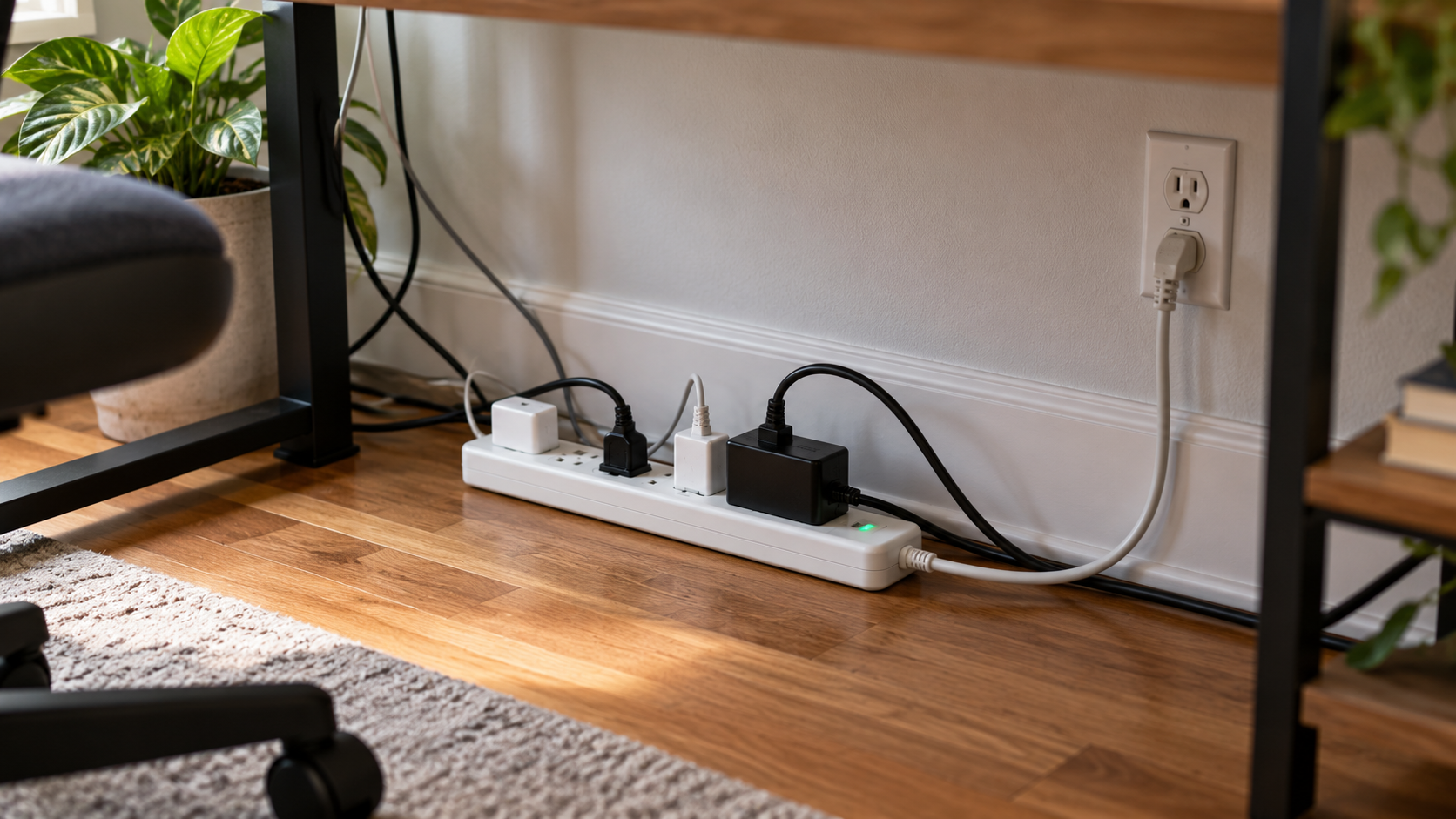
Surge Protector Explainer
A plug-in surge protector guards electronics from brief voltage spikes by providing a controlled path that conducts strongly when voltage becomes too high. During ordinary power, the protective components draw very little current and the outlets receive the normal waveform. During a surge, a component such as a metal-oxide varistor changes to a lower-resistance state and diverts current between electrical conductors, limiting—or clamping—the voltage presented to the load. The event is not erased; its energy is redirected and partly absorbed while the remaining voltage is kept within the device’s tested performance.
A metal-oxide varistor is a voltage-dependent resistor. Below its threshold it behaves almost like an insulator. Above that region, current rises sharply, so the excess is shunted away from the protected line. Products may place protective elements from line to neutral, line to ground, and neutral to ground. Some designs add gas-discharge tubes, filtering components, fuses, or thermal disconnects. Because the protective path can send current toward grounding conductors, a correctly wired grounded receptacle is important for many designs, and an indicator cannot correct missing or faulty building wiring.
Ratings describe different aspects of behavior. Clamping or voltage-protection ratings indicate how much voltage appears under specified test conditions; lower is not the only consideration because current capacity, safety design, and application also matter. A joule rating expresses energy absorption under defined conditions and is often used as a rough endurance comparison. Maximum surge current uses a particular waveform and does not predict unlimited service. Certification to a relevant safety standard verifies tests and construction, but no compact protector can make equipment immune to every magnitude or duration of disturbance.
Protective elements wear because each substantial event changes them slightly. Repeated surges or one large surge can raise leakage, reduce protection, or trigger a thermal disconnect that prevents overheating. Some products have a separate “protected” light showing that the suppression circuit remains connected and a “grounded” light reporting a wiring condition. These indicators must be interpreted according to the instructions; an illuminated power switch alone says only that the strip supplies power. A protector that is damaged, hot, discolored, buzzing, or missing its protection indication should be unplugged and replaced safely.
A power strip is not automatically a surge protector. Both can provide multiple outlets, but an ordinary strip may contain only a switch and circuit breaker. The breaker protects the strip from sustained overload current; it does not necessarily clamp a fast voltage spike. Neither device should be daisy-chained, placed where heat is trapped, used with damaged cords, or loaded beyond its rating. High-power appliances may require a direct wall connection under their instructions. Communications, antenna, and network paths can also carry surges and may need coordinated protection.
Large lightning currents and utility disturbances require layers of defense. A service-entrance or panel surge-protective device can reduce energy before it reaches branch circuits, while point-of-use protectors address remaining transients near equipment. Proper bonding, grounding, wiring, and lightning protection matter to the entire system. The safest response to an imminent severe storm may include unplugging equipment when that can be done well before the storm, never while lightning is nearby. A surge protector is a sacrificial, limited device: it manages short overvoltage events, not sustained high voltage, outages, or every direct strike.
A surge protector uses voltage-sensitive components to divert brief excess current and limit voltage at connected outlets. Key terms include transient, clamp, metal-oxide varistor, shunt, joule, surge current, thermal disconnect, grounding, status light, and layered protection.
No. An ordinary strip may only add outlets and an overload breaker. Look for an identified surge-protection function, appropriate ratings, safety certification, and a protection-status indicator.
No. Protective components degrade with surge exposure and can disconnect after a severe event. Replace the unit when instructed, when its protection indicator goes out, or when damage appears.
Explore more "Explainers"
Discover additional explainers across politics, science, business, technology, and other fields. Each explainer breaks down a complex idea into clear, everyday language—helping you better understand how major concepts, systems, and debates shape the world around us.