

Faucet Aerator Water-Saving Explainer
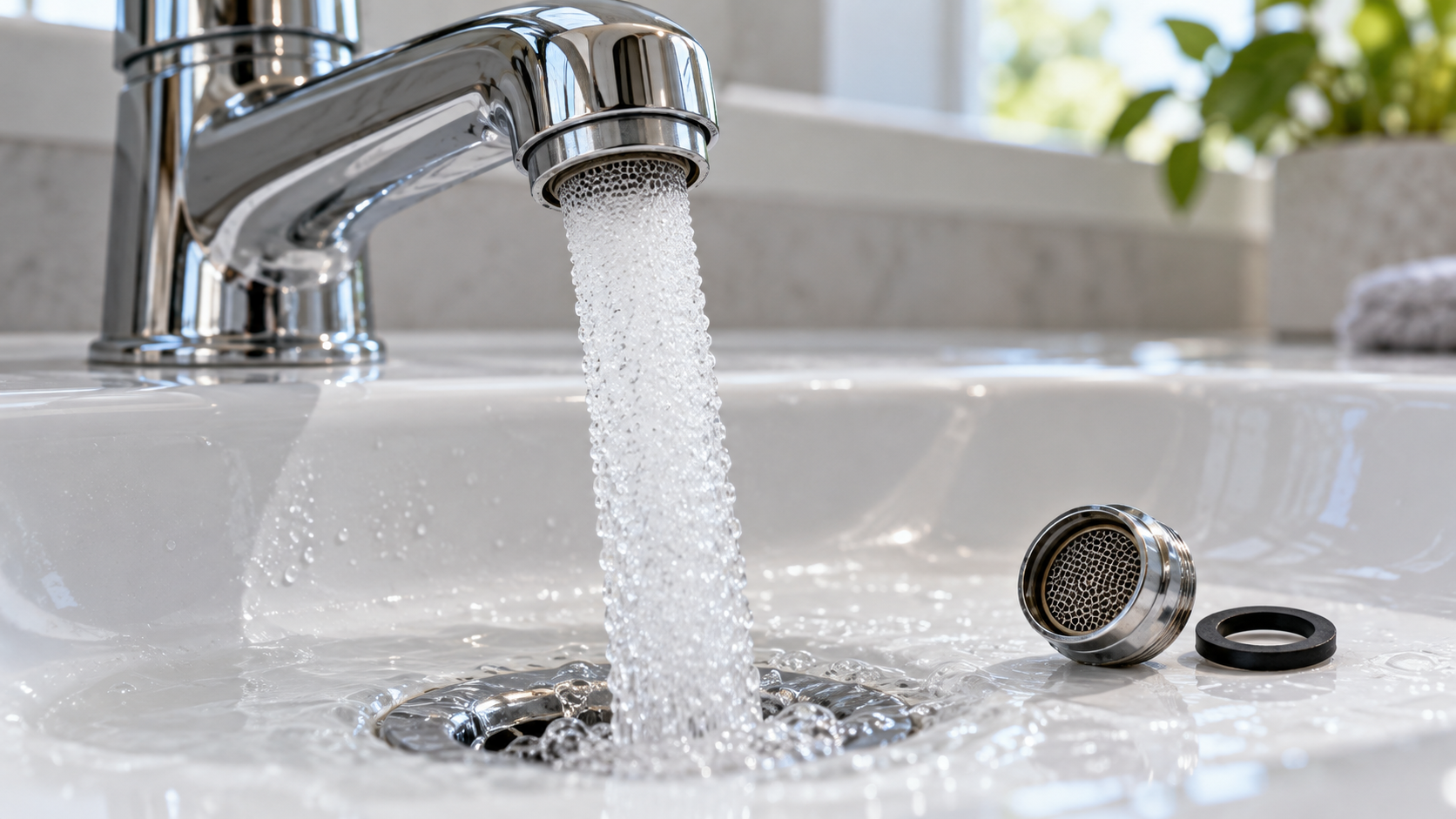
A faucet aerator is the small fitting threaded onto the end of many sink spouts. It controls the flow through a precisely sized passage and then directs the water through screens or molded channels. A standard aerating design draws air through side openings and mixes it with many small water streams. The result looks whiter and feels fuller than the same amount of water flowing as a narrow solid jet. The device saves water by limiting the actual volume while preserving useful coverage for handwashing and routine rinsing.
Inside the housing, a washer seals the connection, a flow-control element meters the water, and one or more screens straighten and divide it. As water accelerates through narrowed passages, local pressure falls and air can be entrained through vent openings. Turbulence breaks the liquid into small streams and bubbles before the mixture exits. Not every accessory adds air: laminar-flow devices organize water into a clear, smooth stream, while spray aerators create many separate jets. The correct pattern depends on the sink and task.
A fixed restrictor uses an opening whose flow changes with supply pressure. A pressure-compensating regulator uses an elastic or moving element that changes the effective opening as pressure varies, keeping flow closer to its rated value. The rating is commonly expressed in gallons per minute or liters per minute at specified test pressures. A very low rate can save more water but may extend filling time or cause splash in an unsuitable basin, so performance and end use matter as much as the number.
Bathroom sink products carrying the WaterSense label must meet both efficiency and performance requirements. EPA materials describe labeled bathroom faucets and accessories that use no more than 1.5 gallons per minute, reducing flow from the older 2.2-gallon standard while maintaining adequate performance. Kitchen sinks and specialized facilities may have different needs. Healthcare settings sometimes use laminar devices rather than air-entraining aerators because aerosol and hygiene considerations can change the preferred stream design.
Minerals, sediment, and small debris can accumulate on the screens, producing an uneven spray or reduced flow. The aerator can usually be unscrewed for cleaning after the drain is closed to prevent losing parts. Components should be removed in order, rinsed, and descaled only with materials compatible with the finish and instructions. Cross-threading, missing washers, or excessive tightening can create leaks. Some tamper-resistant models require a matching key and should not be forced with pliers that can damage the housing.
An aerator cannot correct every faucet problem. Low flow may come from closed valves, kinked supply lines, clogged cartridges, or building pressure, while dripping usually involves the faucet’s internal seal rather than the spout accessory. Still, the fitting is an efficient piece of fluid design: it meters water, organizes the stream, and often adds air so less liquid performs the same everyday task. Its effectiveness is most visible when the stream remains comfortable even though the measured bucket volume falls more slowly.
An aerator meters water through small passages and shapes it with screens; many designs also entrain air to make a lower-volume stream feel full. Key terms include restrictor, regulator, screen, entrainment, aerated stream, laminar flow, spray pattern, and flow rate.
No. Air changes the stream’s appearance and feel. The flow-control element limits the water volume, while bubbles make the stream broader and softer.
Mineral scale or trapped debris may block part of a screen. Removing and cleaning the parts in their original order often restores an even pattern.
Explore more "Explainers"
Discover additional explainers across politics, science, business, technology, and other fields. Each explainer breaks down a complex idea into clear, everyday language—helping you better understand how major concepts, systems, and debates shape the world around us.