

Ice Cream Texture Explainer
Ice cream is a frozen foam and emulsion, not a solid block of water. Its mix contains water, sugars, fat droplets, milk proteins, dissolved salts, and often stabilizers and emulsifiers. As the mix cools, only part of the water freezes. Sugar and other dissolved substances lower the freezing point, leaving a concentrated unfrozen liquid between ice crystals even at serving temperature. That liquid phase keeps the structure from becoming completely rigid and allows a scoop to cut through it.
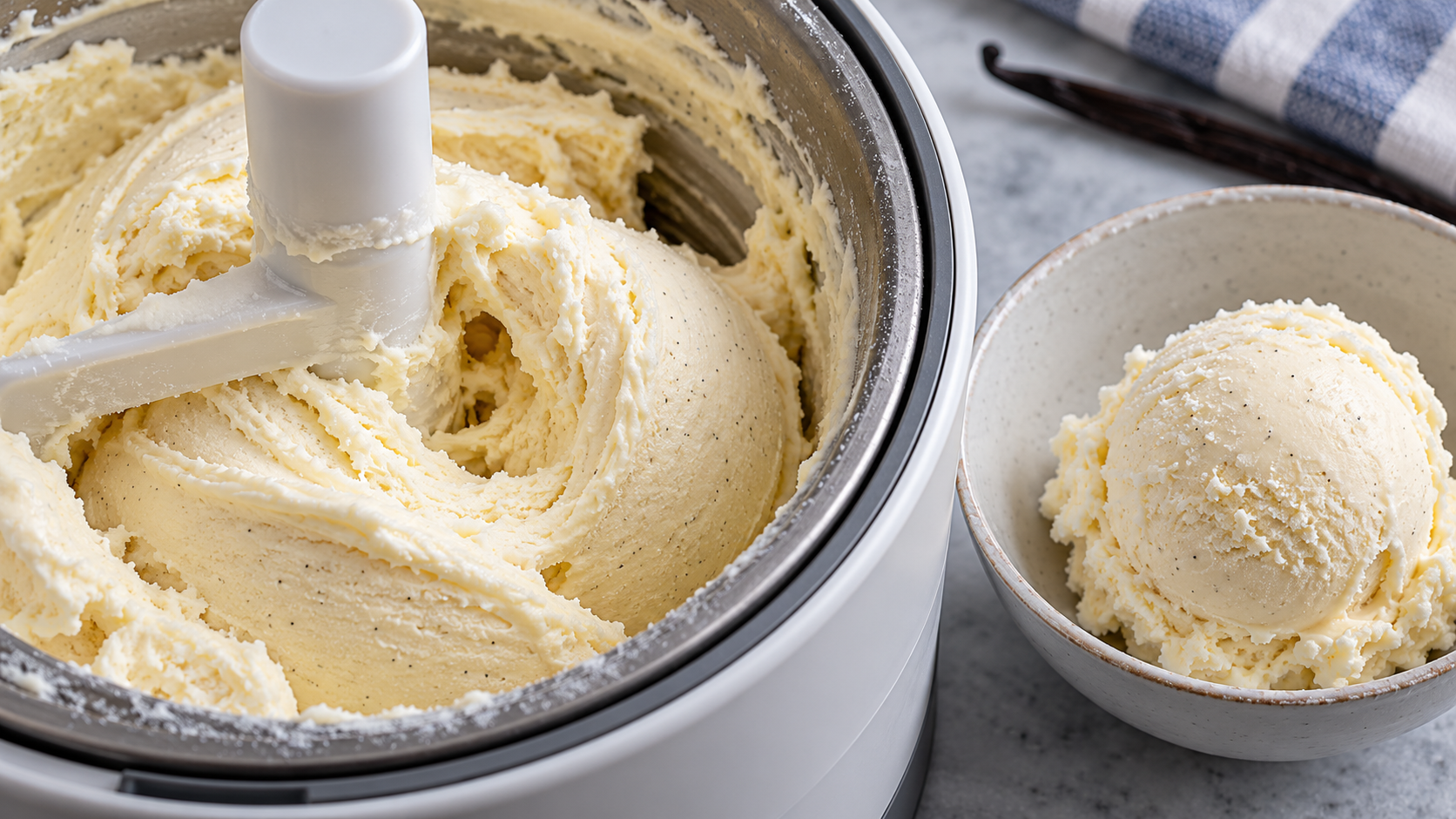
Rapid freezing creates many small ice crystals instead of fewer large ones. In a batch freezer, a chilled wall removes heat while a rotating dasher scrapes new crystals away and moves them through the mix. Constant motion prevents a thick ice layer from building on the wall and distributes crystals throughout the product. Slow freezing or temperature cycling lets water migrate and existing crystals grow, producing an icy texture. A cold stable freezer preserves quality by limiting that recrystallization.
Churning also incorporates air. The amount, called overrun, changes density, insulation, and texture. Too little air can make the product heavy and hard; too much can make it weak or foamy. Proteins help stabilize air bubbles and bind water. Fat droplets partly clump during freezing, forming a network that supports bubbles and gives body. Emulsifiers can help control that partial coalescence, while stabilizers slow water movement and reduce crystal growth during storage.
Sugar affects more than sweetness. Different sugars depress the freezing point by different amounts, so a formula can be equally sweet yet noticeably softer or harder. Fat adds richness and lubricates the palate but does not replace the role of dissolved solids. Low-fat or reduced-sugar recipes require other adjustments to avoid becoming icy or rock hard. Alcohol also lowers the freezing point strongly, which is why too much can prevent a dessert from setting.
Freshly churned ice cream is often soft because it leaves the machine with much of its water still unfrozen. A hardening stage in a very cold freezer removes more heat quickly while preserving small crystals. Serving it warmer than storage temperature softens the unfrozen phase and fat enough for scooping. Repeated melting and refreezing is unsafe and damages texture: melted regions lose air structure, and slowly refrozen water forms larger crystals. Soft or melted ice cream after unsafe warming should be discarded.
Scoopability is therefore a carefully chosen partial freeze. A rigid network of small ice crystals and fat surrounds air cells, while a concentrated syrup remains mobile between them. Temperature controls the fraction frozen from moment to moment. The recipe controls how low that freezing point is, and the freezer controls crystal size. Good texture comes from balancing all three rather than merely adding more cream or setting the appliance to its coldest possible temperature.
Sugar lowers the freezing point, rapid freezing keeps crystals small, and fat, protein, air, and stabilizers build a flexible structure. Key terms include ice crystal, freezing-point depression, overrun, emulsion, partial coalescence, stabilizer, hardening, and recrystallization.
Slow freezing or temperature fluctuations allow water to migrate and small crystals to grow into larger ones that feel coarse on the tongue.
Warmer temperature melts part of the ice and softens the fat and concentrated liquid phase. The structure becomes easier to cut even before it visibly melts.
Explore more "Explainers"
Discover additional explainers across politics, science, business, technology, and other fields. Each explainer breaks down a complex idea into clear, everyday language—helping you better understand how major concepts, systems, and debates shape the world around us.