

Ballpoint Pen Ink-Flow Explainer
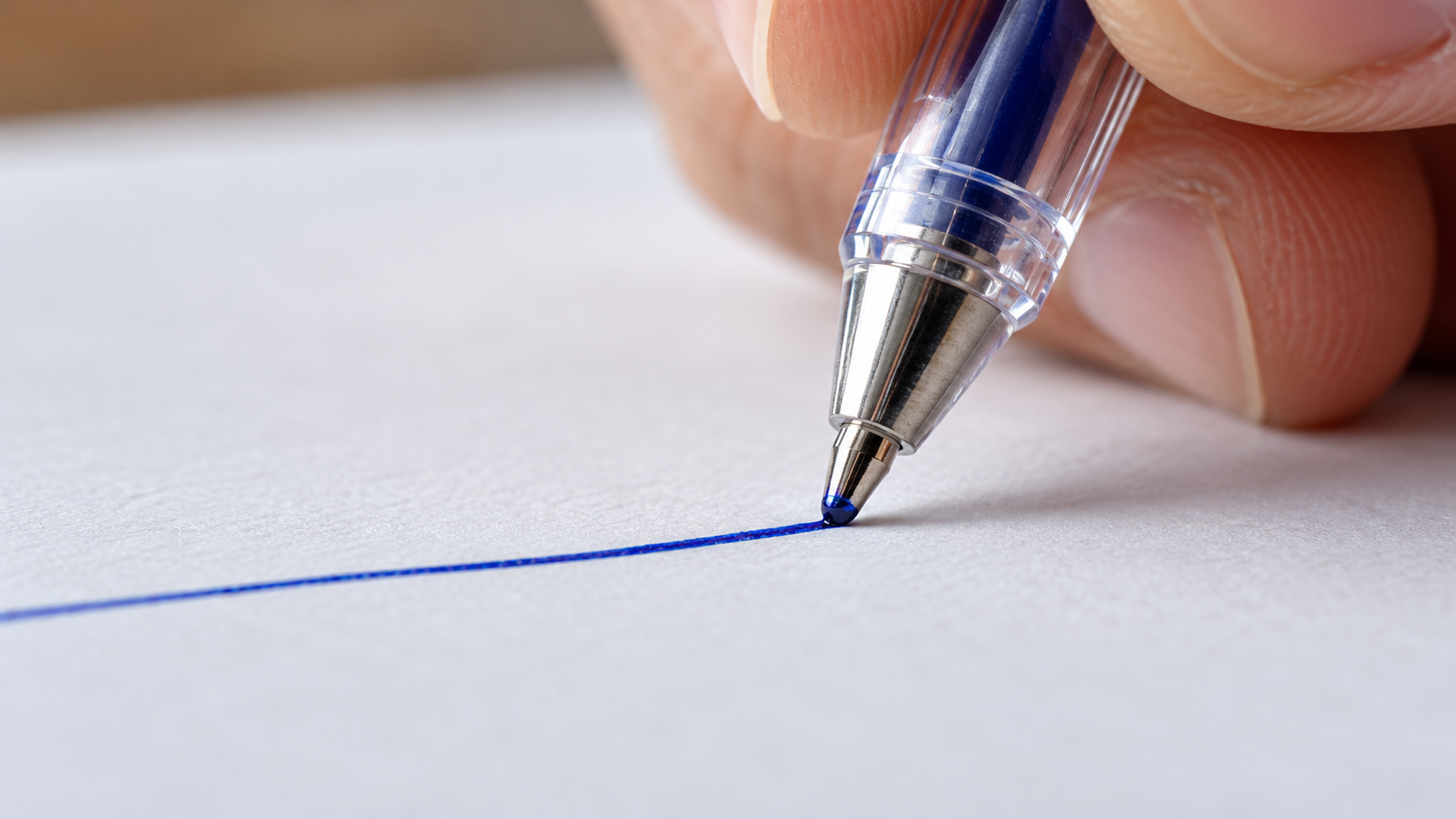
At the tip of a ballpoint pen, a tiny hard ball sits in a metal socket that holds it securely while allowing it to rotate. The inside of the socket connects to a tube of thick ink through narrow feed channels. When the ball rolls across paper, its rear surface passes through the ink supply and becomes coated. Rotation carries that thin film around the socket lip to the outside, where contact and friction transfer ink to the paper. The ball continually repeats that pick-up-and-deposit cycle.
Clearance between the ball and socket is extremely small. It must be large enough for the ball to turn and for ink to reach its surface, yet tight enough to prevent the ball from falling out or ink from pouring around it. Manufacturers form a seat behind the ball and crimp the socket rim around its equator. Capillary channels near the seat keep the feed connected even as the ball contacts the seat under writing pressure.
Ballpoint ink is much more viscous than typical fountain-pen ink. Its thickness reduces leakage and dries quickly after being spread in a very thin layer, but it requires pressure and rolling action to flow. Many formulas are shear-thinning, meaning they become easier to move when stressed at the rotating tip. Solvents, dyes or pigments, resins, and lubricants balance color, drying, adhesion, smoothness, and storage stability. Temperature changes viscosity, so extreme cold or heat can alter writing.
The ink reservoir also needs pressure control. As ink leaves, air must replace its volume or another follower system must move behind it. A simple open-ended refill admits air from the rear, while some pressurized pens use gas or a sliding plug to write in unusual orientations. In an ordinary pen, gravity and capillary action assist the feed, so writing upside down may interrupt delivery. A sealed cap or retracting mechanism keeps the exposed film from drying around the ball.
Skipping occurs when dried ink, paper fibers, oil, or damage prevents smooth rotation or blocks a feed path. Scribbling lightly on clean scrap paper can sometimes restart a sound tip by rotating fresh ink to the surface. Heating, solvents, needles, or crushing the socket can create leaks or injury and are not sensible repairs. Blobs may appear when excess ink accumulates around the rim and is later wiped onto paper; cleaner manufacturing and suitable viscosity reduce that effect.
A ballpoint controls liquid with precision rather than a valve the writer consciously opens. The rolling ball is simultaneously a bearing, seal, metering surface, and applicator. Its geometry exposes only a microscopic film at each turn, so a reservoir can write a long line without flooding. The design succeeds because the mechanical tolerances and ink chemistry are developed together: change the ball size, clearance, channel, surface, or viscosity, and the same pen may starve, drag, leak, or blot.
A captive ball rotates in a close-fitting socket, collects viscous ink from internal feed channels, and rolls a thin film onto paper. Key terms include ball, socket, seat, clearance, capillary channel, viscosity, shear thinning, and reservoir.
The ball nearly fills its socket, leaving only microscopic flow paths. Thick ink and surface tension further limit movement until rotation meters a film outward.
Dried ink, fibers, oil, cold thickened ink, or a damaged ball or socket can interrupt rotation and the narrow feed path.
Explore more "Explainers"
Discover additional explainers across politics, science, business, technology, and other fields. Each explainer breaks down a complex idea into clear, everyday language—helping you better understand how major concepts, systems, and debates shape the world around us.