

Breakaway Cat Collar Safety Explainer
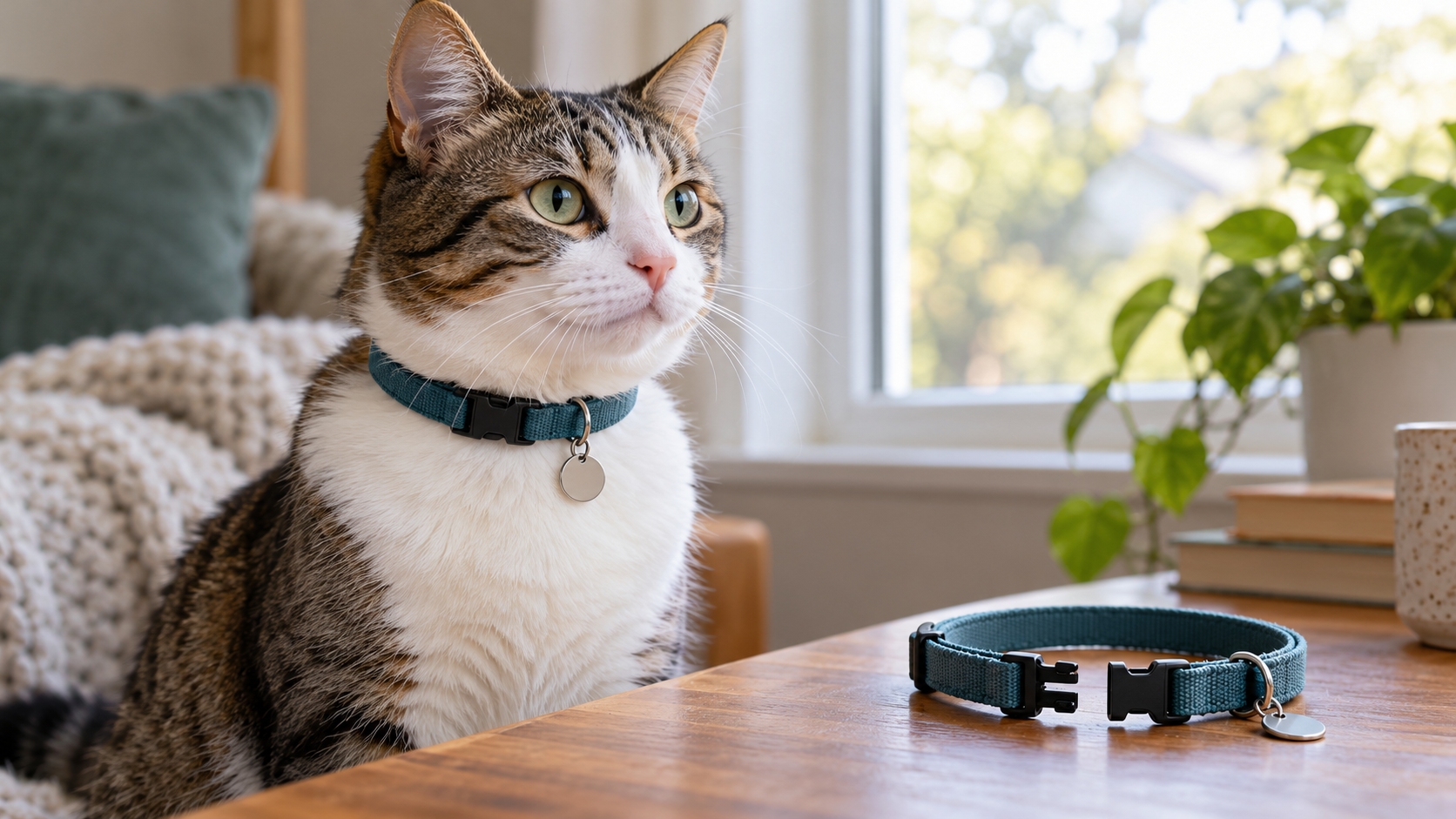
A breakaway cat collar is designed to stay closed during ordinary movement but separate when the collar becomes caught and tension rises. Its plastic buckle has flexible prongs or shaped tabs that snap into matching recesses. Under a sufficient straight pull, the prongs bend inward or the recesses spread, allowing the two halves to slide apart without opening a conventional latch. The retention force is deliberately lower than on a dog leash collar because escaping a snag is more important than keeping the collar attached at all costs.
Release force comes from geometry and material stiffness. Longer flexible arms bend more easily; deeper catches, thicker plastic, and different angles hold more strongly. Manufacturers choose a range intended to resist grooming and play yet release under hazardous loading. Real force can vary with direction, temperature, age, dirt, and how the collar twists around an object. A buckle tested by pulling straight may behave differently when one edge is loaded or fabric jams between the parts.
Fit affects both comfort and release. The collar should be snug enough that the cat cannot easily push a lower jaw or foreleg through it, but loose enough for the number of fingers specified by the product or veterinarian. A loose loop catches more objects and can trap a limb; a tight collar rubs skin and may restrict a growing cat. Kittens need frequent checks as their neck size changes. Long hair should not hide pressure points, matting, or an incorrectly adjusted slider.
Tags and accessories add weight and snag points. A light identification tag can help a found cat return home, while a microchip provides backup identification if the collar releases and is lost. Heavy ornaments, multiple tags, bells, trackers, or attached leashes can change the load on the buckle and interfere with the intended behavior. A breakaway collar should never be used as the sole restraint for walking; a properly fitted cat harness carries leash forces across the body.
The buckle should be opened and reclosed periodically to check that it is clean, undamaged, and neither welded shut by debris nor so worn that it falls apart constantly. Frayed webbing, cracked plastic, sharp tag rings, or a slider that slips are reasons to replace the collar. No design eliminates every entanglement risk, and published collar studies show that fit and individual behavior still matter. Indoor hazards such as hooks, narrow gaps, and unstable cords should be reduced independently.
The collar solves a tradeoff rather than maximizing strength. Ordinary collars are expected to resist separation; a breakaway model intentionally sacrifices retention when tension crosses a threshold. That means losing a collar can be evidence that the safety feature worked, not simply product failure. Correct size, minimal attachments, routine inspection, and microchip registration complete the system. The buckle provides an escape path, while responsible fitting and the environment determine how often that path is needed.
Flexible buckle prongs hold during normal activity but bend or slip free when snag tension exceeds the design threshold. Key terms include breakaway buckle, prong, recess, release force, fit, slider, snag, tag, harness, and microchip.
Follow the product or veterinary guidance: snug enough to prevent a jaw or leg entering, but loose enough to avoid pressure and rubbing. Check growing kittens often.
No. The buckle is meant to release under tension. Use a properly fitted cat harness for a leash and keep the collar for identification.
Explore more "Explainers"
Discover additional explainers across politics, science, business, technology, and other fields. Each explainer breaks down a complex idea into clear, everyday language—helping you better understand how major concepts, systems, and debates shape the world around us.