

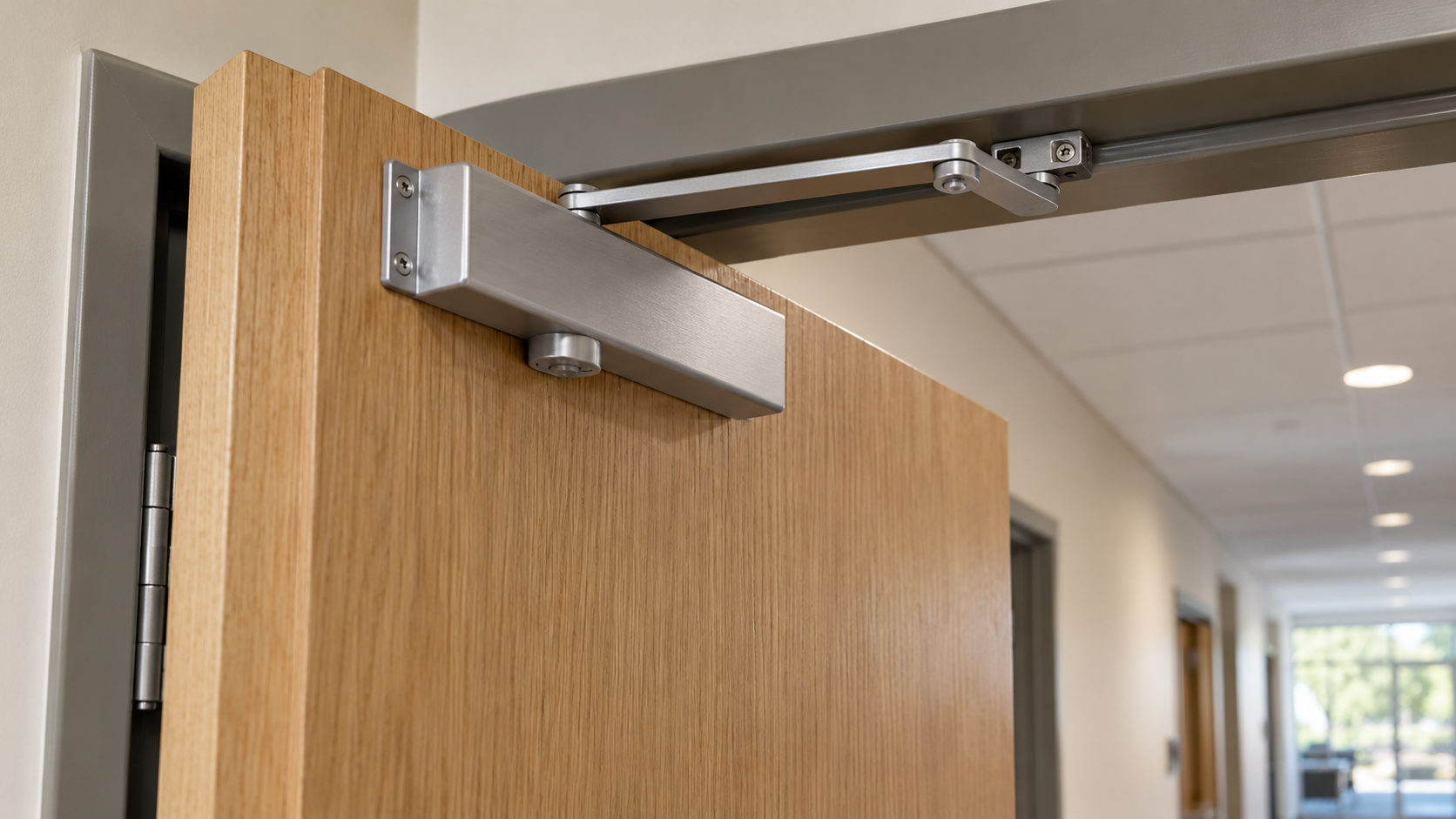
Hydraulic Door Closer Explainer
A hydraulic door closer turns the motion of an opening door into stored spring energy. The closer body is fixed to the door or frame, and a jointed arm connects that body to the other surface. As the door swings open, the arm rotates a pinion. Teeth on the pinion move a rack or piston through an oil-filled cylinder, compressing a coil spring. When the person lets go, the spring pushes the piston back and supplies the force that closes the door.
Oil makes the return controlled instead of abrupt. As the piston travels, it displaces hydraulic fluid from one chamber to another through narrow passages. Adjustable needle valves change the effective size of those passages. A smaller opening increases resistance and slows the motion; a larger opening lets oil pass more readily. Because the resistance comes from fluid flow rather than friction alone, the closer can produce a smooth, repeatable swing across much of the door’s travel.
Many closers separate the return into two ranges. The sweep valve controls most of the closing arc, while a latch valve controls the final few degrees so the latch has enough momentum to engage without a hard slam. Some models also provide backcheck, which adds resistance near the fully open position, or delayed action, which holds the door in a slow early phase. These features are hydraulic controls, not rigid stops, and their availability varies by closer.
The spring still has to overcome hinge friction, air pressure, seals, and the latch. Installers select a closer size or spring setting for the door’s width, weight, location, and expected wind. Too little force may leave the latch open; too much can make the door difficult to use. Fire-rated openings and accessible routes have additional requirements, so field adjustment must balance reliable closing with permitted opening force and timing rather than simply making the door shut as fast as possible.
Temperature affects oil viscosity. Cold fluid flows less easily and can slow a closer, while heat can reduce resistance. Modern units use stable hydraulic fluids and compensating designs, but seasonal adjustment may still be needed within the manufacturer’s range. Turning a valve too far can remove it and release oil, permanently disabling the closer. Leaks around the shaft or body, bent arms, loose fasteners, and doors that bind at the hinges should be repaired rather than masked with extreme valve settings.
The complete system therefore has two jobs: the spring provides energy, and the hydraulic circuit shapes how that energy is released. A correctly installed closer lets people open the door, prevents uncontrolled swinging, moves through the sweep at a predictable pace, and finishes with enough force to secure the latch. It cannot correct a warped door, misaligned frame, failing lock, or severe pressure imbalance, but it makes an ordinary hinged door behave consistently after every use.
Opening the door rotates a pinion, moves a piston, and compresses a spring. The spring closes the door while oil metered through valves controls speed. Key terms include arm, pinion, rack, piston, spring, sweep, latch, and backcheck.
Separate valves can control the main sweep and the final latching range. This allows a gentle return that still finishes firmly enough to engage the latch.
Hydraulic oil becomes more viscous in cold conditions, so it may flow through the metering passages more slowly. Temperature-compensating designs reduce, but may not eliminate, this effect.
Explore more "Explainers"
Discover additional explainers across politics, science, business, technology, and other fields. Each explainer breaks down a complex idea into clear, everyday language—helping you better understand how major concepts, systems, and debates shape the world around us.