

Air Fryer Cooking Explainer
An air fryer is a small high-velocity convection oven. An electric resistance element becomes hot while a fan drives air past it and around food in a perforated basket or tray. The moving air transfers heat to the food surface more quickly and evenly than still air. Moisture evaporates, surface temperature rises, and browning reactions create crisp texture and roasted flavors. Oil is not what powers the appliance, although a thin coating can improve heat transfer and browning on some foods.
The compact cooking chamber is important. Food sits close to the heater and air outlet, so a strong stream can repeatedly sweep across it before losing much heat. The basket’s openings let air reach the underside and allow drippings to fall into a lower pan. Designers shape ducts and fan guards to recirculate flow while keeping food away from the heater. Because airflow is never perfectly uniform, shaking the basket or turning larger pieces helps expose new surfaces.
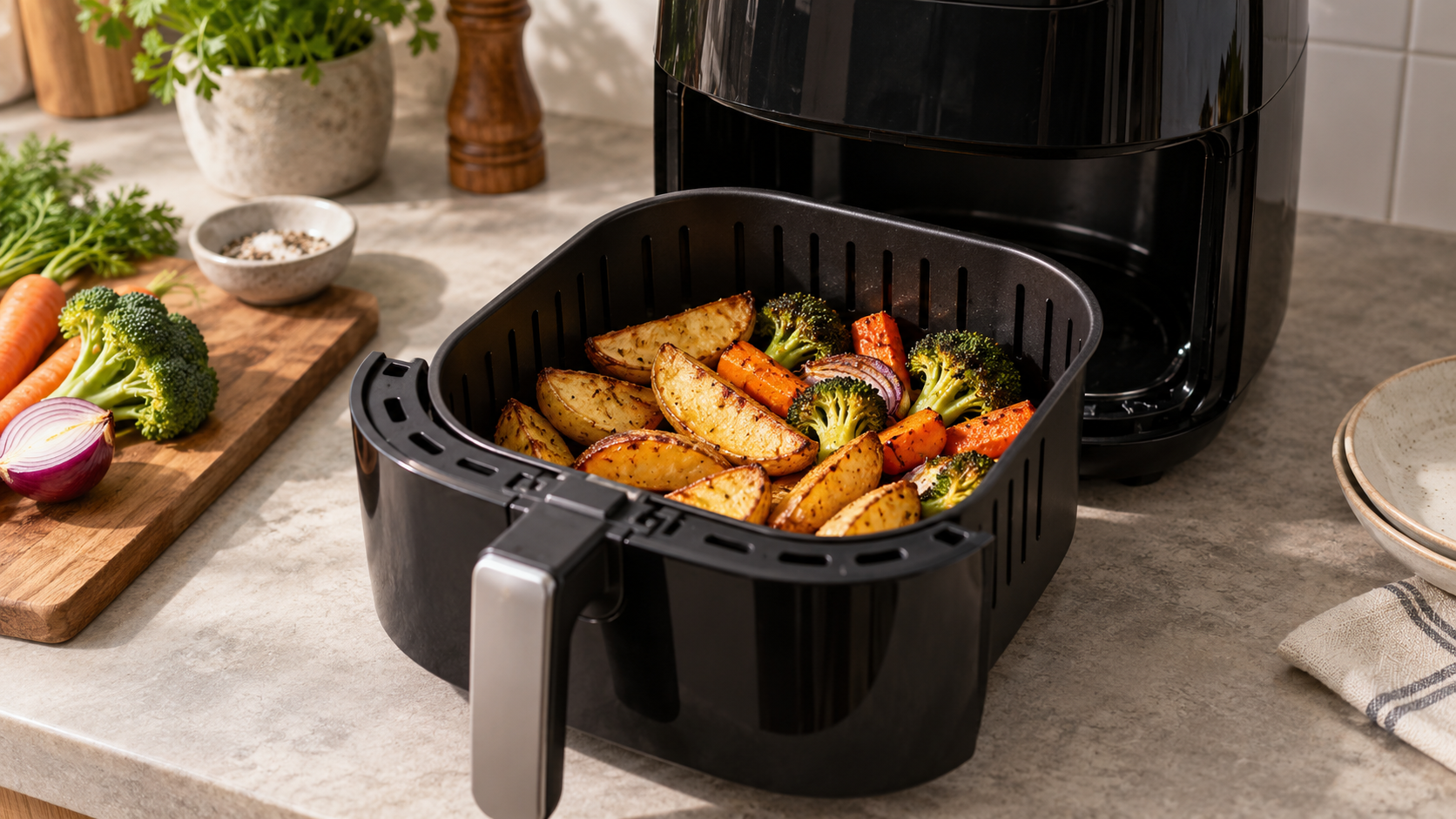
Crispness depends on removing surface water. As long as a wet surface remains near water’s boiling temperature, strong browning is limited. Hot moving air carries vapor away, allowing the outer layer to dry and become hotter. Breaded coatings, starches, and small amounts of fat can then form a firm crust. Crowding blocks circulation and traps steam, so a single loose layer usually browns better than a tightly packed basket, even if the crowded batch technically cooks through.
The controls cycle power to hold an approximate set temperature, but actual temperatures can vary by model, load, and position. Preheating may help when the recipe or appliance instructions call for it. Thin foods can overbrown before their centers heat, while dense frozen pieces need more time. The appliance does not make raw meat safe merely because the outside looks crisp. A food thermometer should confirm the safe internal temperature recommended for the specific food.
Air fryers use little oil compared with deep frying because food is not immersed in a hot liquid bath. The result can be crisp, but it is not identical: oil transfers heat differently and contacts every submerged surface. Aerosol cooking sprays may damage some nonstick finishes, and excess loose crumbs or high-fat drippings can smoke near the heater. The basket and drip pan should be cleaned after cooling, following the material and dishwasher guidance for that model.
Safe use requires space around vents, a stable heat-resistant surface, and no foil or paper that can lift into the heating element. The basket becomes extremely hot, so it needs a protected resting place and careful handling. Unplugging before cleaning and keeping the fan inlet clear protect the appliance. In practical terms, an air fryer trades the oil bath for concentrated convection: rapid air movement dries and heats the surface while ordinary conduction carries heat inward.
A heater warms air and a fan circulates it rapidly through a compact chamber and perforated basket. Surface drying enables browning. Key terms include convection, resistance heater, fan, airflow, evaporation, browning, basket, and drip pan.
Crowded pieces block moving air and trap moisture between them. Exposed surfaces dry faster, so arranging food loosely and turning it improves browning.
No. Browning shows surface changes, not necessarily a safe center. Use a food thermometer and the recommended internal temperature for raw meat or poultry.
Explore more "Explainers"
Discover additional explainers across politics, science, business, technology, and other fields. Each explainer breaks down a complex idea into clear, everyday language—helping you better understand how major concepts, systems, and debates shape the world around us.