

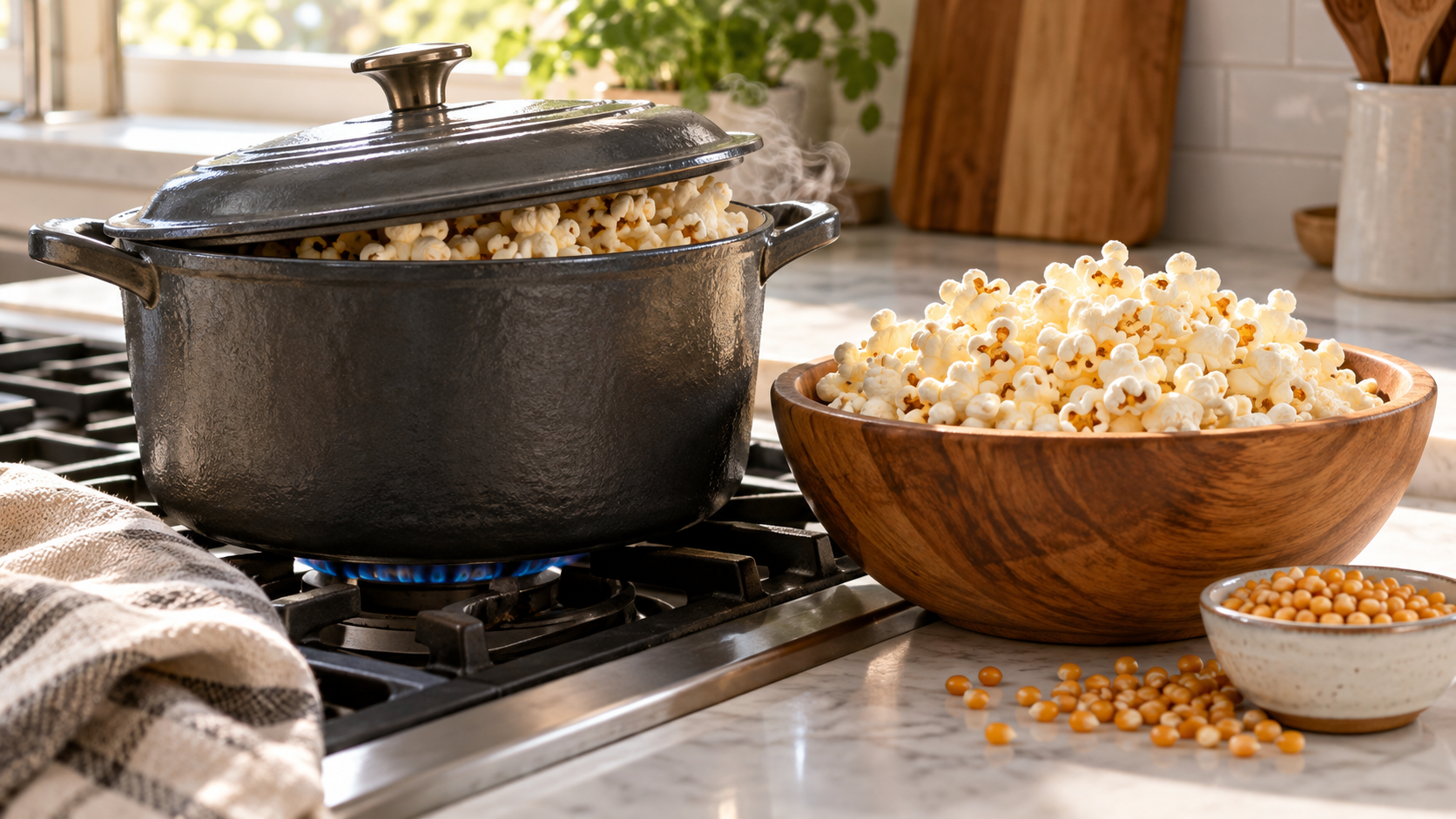
Popcorn Popping Explainer
Popcorn is a special type of flint corn whose kernels combine a hard, nearly sealed outer hull with a dense starchy interior and a useful amount of moisture. As a kernel heats, its internal water becomes steam. The tough hull prevents that vapor from escaping quickly, so pressure and temperature rise together. Meanwhile, heat softens and gelatinizes the starch, turning the interior into a hot, pressurized mass ready to expand when the shell can no longer contain it.
At the popping point, the hull fractures suddenly. Pressure around the starch falls toward atmospheric pressure, and the superheated water flashes into rapidly expanding vapor. The softened starch is driven outward, stretches into a foam, and cools almost immediately. The familiar white flake is not the hull turning inside out; it is expanded starch, while fragments of the brown hull remain attached. The whole transformation takes only a fraction of a second.
Moisture content is critical. A kernel that is too dry cannot build enough steam pressure and may remain an “old maid” or crack without full expansion. A kernel that is too wet can heat unevenly and produce a dense, chewy flake. Commercial popcorn is dried and stored to keep moisture in a useful range. A small defect in the hull can also leak vapor before pressure reaches the required level, even when the interior contains enough water.
Oil is a heat-transfer medium and flavor carrier, not the gas that inflates popcorn. It helps distribute heat around kernels in a pan, but hot air or microwave heating can supply the energy too. In a microwave bag, a susceptor may absorb microwave energy and become hot, while the kernels also absorb energy. Whatever the method, even heating raises the number of kernels that reach popping conditions without scorching flakes that have already expanded.
The sound comes from rapid pressure release and vibration as the hull breaks and the starch expands. Kernels do not all pop at exactly the same temperature because size, moisture, hull strength, and heating rate vary. Shaking a stovetop pan keeps unpopped kernels near the hot surface and moves finished flakes away. A lid must vent enough steam to preserve crispness while still safely containing hot kernels and oil.
Popping converts a compact seed into a low-density foam, which explains both the dramatic size increase and the tender crunch. The sequence requires the right material package: water supplies vapor, the hull acts as a pressure vessel, starch becomes deformable, and heat drives the transition. Ordinary sweet corn lacks the same combination of hard pericarp and internal structure, so drying any random corn kernel does not automatically make it behave like popcorn.
Heat turns moisture inside the kernel into pressurized steam. The hull ruptures, pressure drops, and softened starch expands into a foam. Key terms include hull, pericarp, moisture, steam, pressure, gelatinization, expansion, and old maid.
No. Water vapor inside the kernel provides the expansion. Oil mainly transfers heat and carries flavor; hot air can pop suitable kernels too.
They may be too dry, have a cracked hull that leaks vapor, or receive uneven heat. Without sufficient sealed pressure, the starch cannot expand fully.
Explore more "Explainers"
Discover additional explainers across politics, science, business, technology, and other fields. Each explainer breaks down a complex idea into clear, everyday language—helping you better understand how major concepts, systems, and debates shape the world around us.