

Disposable Diaper Absorption Explainer
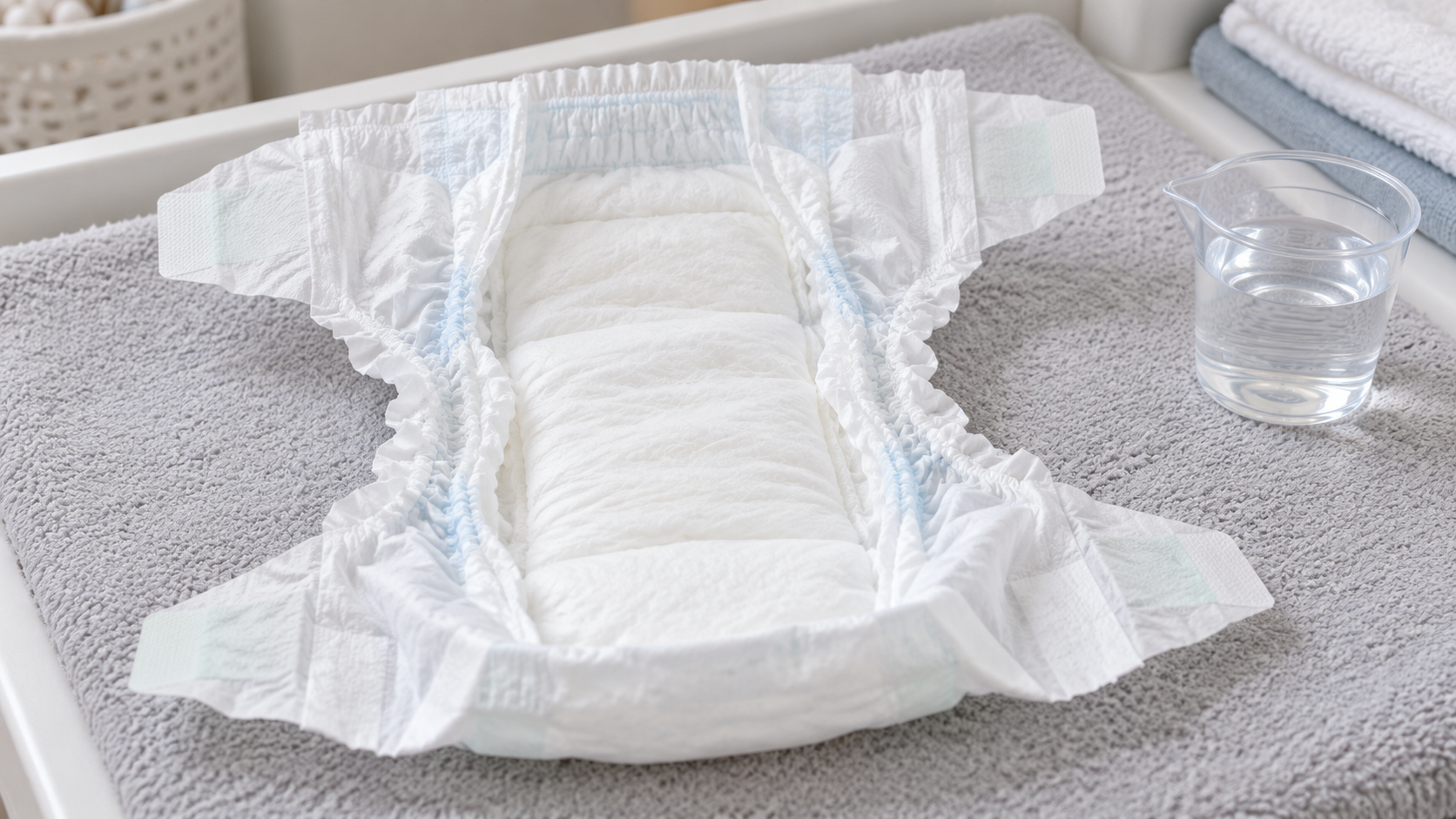
A disposable diaper is a layered fluid-management system. The soft top sheet next to the skin is porous and usually treated so liquid passes through quickly. Beneath it, an acquisition and distribution layer spreads a sudden wetting event over a larger area. The absorbent core then takes over. It combines cellulose fluff pulp, which draws liquid through a network of fibers, with particles of superabsorbent polymer that take in many times their own mass and swell into a gel.
The common superabsorbent material is a cross-linked form of sodium polyacrylate. Water and dissolved ions enter the polymer network because charged groups attract fluid and osmotic forces favor swelling. Cross-links keep the long chains from dissolving and flowing away, so each particle becomes a soft gel. Urine contains salts that reduce absorption compared with pure water, which is why dramatic classroom demonstrations using distilled water do not directly equal real diaper capacity.
Pulp gives the first liquid fast pathways and helps distribute it before swollen gel particles block local flow. Modern cores arrange materials in channels or zones to preserve flexibility and move moisture away from the entry point. Pressure from sitting or movement can squeeze ordinary wet fibers, but well-designed polymer gel retains much of its liquid. The product still has a finite capacity; loading faster than the layers can distribute or absorb can cause pooling and leaks.
Elastic leg cuffs and raised inner barriers control liquid at the edges, while fastening tabs adjust the fit around the waist. The outer back sheet resists liquid escape but may allow some water vapor to pass, improving comfort. Adhesives join the layers without creating bulky seams. A correct size matters because a very loose opening creates a direct leak path and an overly tight fit can distort barriers or irritate skin. No absorbent chemistry can compensate for a badly positioned cuff.
Absorption does not eliminate the need for prompt changing. Moisture, stool enzymes, friction, and prolonged contact can irritate skin, and a swollen product becomes heavy and less able to accept another rapid load. Cleaning and barrier-care choices should follow pediatric or medical guidance for the individual child. The polymer beads are contained inside the core during normal use; a torn product should be discarded so loose material is not mouthed or scattered.
The diaper succeeds by separating tasks across thin layers: the top sheet admits liquid, the acquisition layer handles speed, cellulose transports it, polymer locks much of it into gel, and elastic barriers manage the edges. The result feels far drier than a simple wad of cloth holding the same amount of free water. It is not an infinite sponge, but a carefully staged pathway that turns a brief liquid release into distributed, immobilized moisture.
Liquid passes through a porous top sheet, spreads through an acquisition layer and cellulose fibers, then swells cross-linked superabsorbent polymer into gel. Key terms include top sheet, acquisition layer, fluff pulp, sodium polyacrylate, cross-link, osmotic swelling, cuff, and back sheet.
Charged polymer chains attract water, while cross-links hold the network together. The material swells instead of dissolving into a liquid.
A fast local flow, poor fit, folded cuff, pressure, or blocked distribution path can let liquid reach an edge faster than the core absorbs it.
Explore more "Explainers"
Discover additional explainers across politics, science, business, technology, and other fields. Each explainer breaks down a complex idea into clear, everyday language—helping you better understand how major concepts, systems, and debates shape the world around us.