

Deadbolt Door Lock Explainer
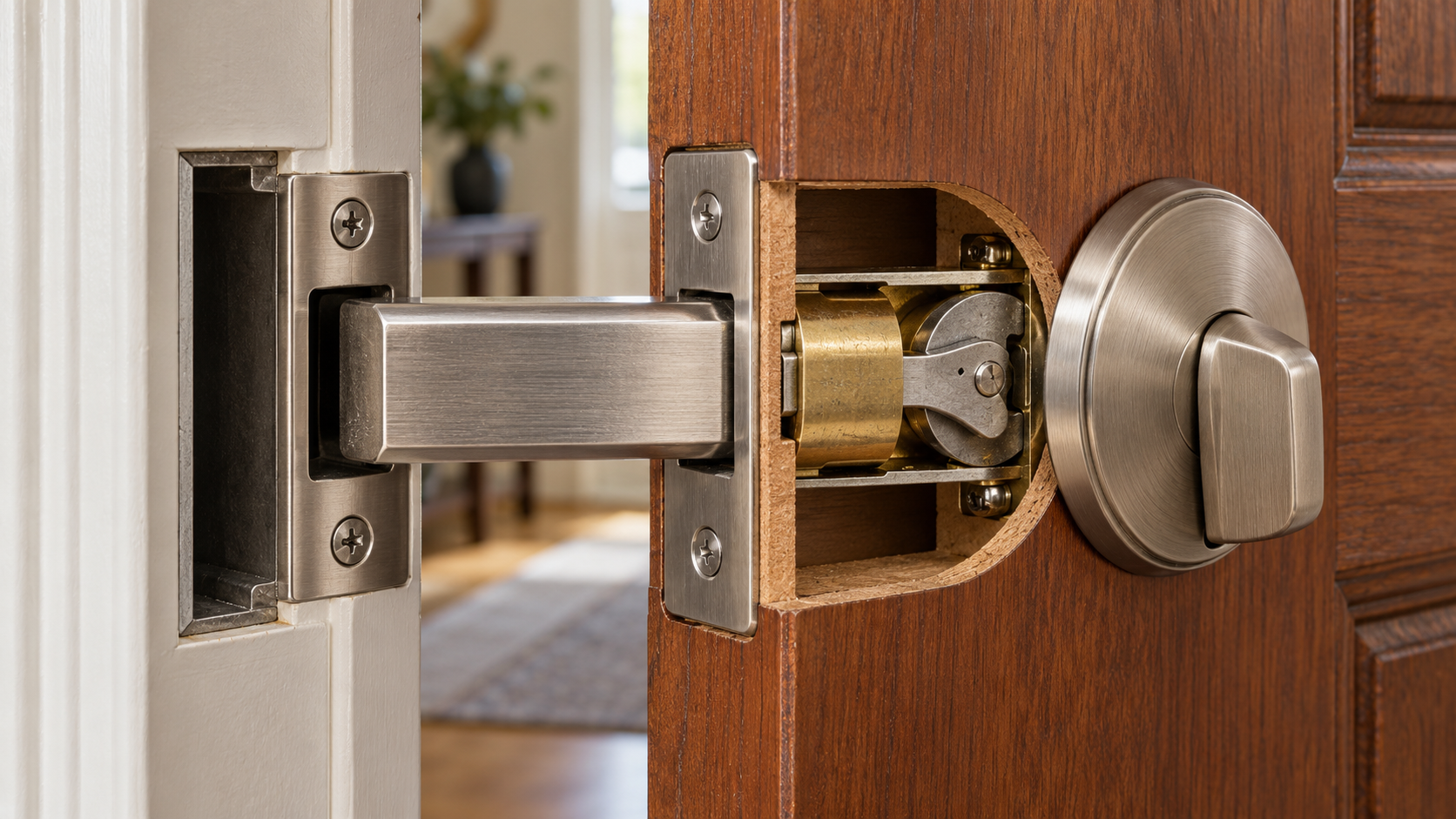
A deadbolt locks a door by sliding a solid metal bolt from the door edge into a matching opening in the frame. Unlike a spring latch, the bolt does not retract when its beveled face is pushed. It must be deliberately moved by a key cylinder, an interior thumbturn, or an approved powered actuator. Once extended, the bolt bridges the moving door and stationary jamb, so the door cannot swing until the bolt returns fully into its case.
Turning the key or thumbturn rotates a tailpiece inside the lock. That tailpiece drives a cam or crank connected to the bolt mechanism. During roughly a half turn, the cam converts rotation into straight-line travel and throws the bolt outward. Internal stops define the locked and unlocked positions, while an over-center geometry or detent helps the bolt remain where it was placed. The key pins control who can rotate the cylinder; the deadbolt mechanism controls what that rotation moves.
The receiving hardware matters as much as the visible lock. A strike plate surrounds the hole in the jamb and guides the extended bolt into the frame. Long screws and a reinforced box can transfer force beyond thin decorative trim into structural framing. The bolt needs clear alignment and enough depth to complete its designed throw. If weatherstripping, a sagging hinge, or seasonal wood movement makes the bolt rub the strike, the lock may appear turned without reaching its secure position.
Single-cylinder deadbolts use a key outside and a thumbturn inside. Double-cylinder versions require a key on both sides and can create an emergency-egress concern, so codes and local requirements govern where they are appropriate. Electronic deadbolts usually add a motor and gear train but still move a physical bolt into a strike. Batteries, sensors, and access codes change how the command arrives; they do not remove the need for accurate door alignment and sound frame construction.
A deadbolt should move smoothly with the door both open and closed. Resistance only when the door is closed points to alignment, not a need to force the key. Lubrication must be suitable for the lock manufacturer, and loose strike or hinge screws should be corrected before parts deform. A deadbolt is not a substitute for intact hinges, a solid door, or safe glazing, and no lock makes a weak frame invulnerable to sustained force.
The mechanism is therefore a simple motion converter with a demanding installation. A small rotation at the key or thumbturn becomes a measured linear throw, and the extended bolt couples the door to the frame. Security depends on the full system: authorized rotation at the cylinder, complete travel inside the case, a bolt that cannot be pushed back like a latch, and a strike anchored strongly enough to carry the load.
A key or thumbturn rotates a cam that slides a solid bolt into the frame. Key terms include cylinder, tailpiece, cam, bolt, throw, strike plate, jamb, and reinforcement.
A spring latch retracts when its beveled face is pushed during closing. A deadbolt has no such closing bevel and must be deliberately thrown or retracted.
The bolt is probably rubbing the strike because the door, hinges, weather seal, or frame has shifted. The mechanism needs alignment rather than extra force.
Explore more "Explainers"
Discover additional explainers across politics, science, business, technology, and other fields. Each explainer breaks down a complex idea into clear, everyday language—helping you better understand how major concepts, systems, and debates shape the world around us.