

Food Dehydrator Explainer
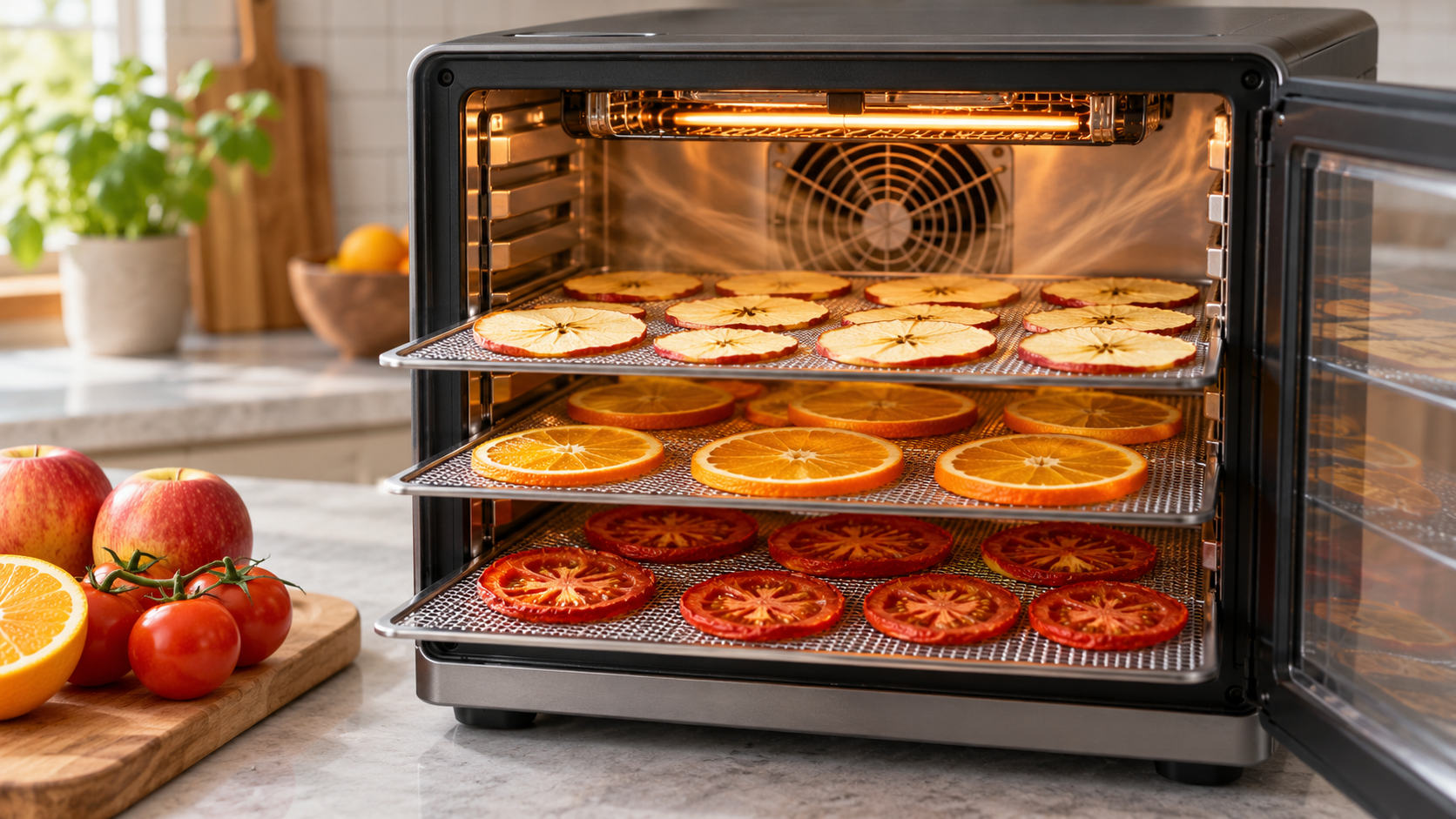
A food dehydrator preserves by removing enough water to make the food a poor environment for many spoilage organisms and chemical reactions. An electric heater warms incoming air, and a fan moves that air across trays of sliced food. Water inside the food migrates toward the surface, evaporates, and is carried out through vents. The goal is not simply to make the outside feel dry; moisture must continue moving from the center until the whole piece reaches a safe, stable condition.
Warm air can hold more water vapor than cool air, so heating increases its drying capacity. Air movement replaces the humid boundary layer around each piece with drier air, maintaining evaporation. Thin, evenly sized slices shorten the distance internal moisture must travel. Tray spacing and an unobstructed fan keep flow distributed. Some dehydrators push air vertically and may require tray rotation; horizontal-flow designs aim to deliver more similar conditions to each shelf.
Temperature is a balance. Too cool or too little airflow can keep food in a microbe-friendly condition for too long. Too hot can harden the surface rapidly, creating a dry shell that slows moisture leaving the center, a problem called case hardening. Heat can also darken color, alter flavor, or damage delicate nutrients. Different foods and pretreatments require different settings, and meat or poultry follows stricter safety procedures than ordinary fruit or herbs.
Drying does not sterilize food. Bacteria, molds, spores, or enzymes may survive even though their activity is greatly reduced. Clean hands, sound produce, sanitized equipment, and tested preparation methods are still important. Acid dips or blanching may control browning, texture, or enzymes for particular foods. Pieces should not overlap unless the instructions allow it, because hidden contact areas dry slowly. Checking several pieces gives a better picture than testing only the thinnest edge slice.
Conditioning and storage finish the process. Cooled dried fruit is often loosely packed and checked over several days so remaining moisture equalizes; condensation signals that further drying is needed. Airtight containers protect the product from humid air, insects, and odors. Light and heat accelerate quality loss. If mold appears, the food should be discarded rather than redried. Home-dried products have limits, so current extension or food-safety guidance should determine handling and storage time.
The dehydrator is therefore a controlled mass-transfer device. Heat supplies energy for evaporation, moving air carries vapor away, and small pieces expose more surface while shortening the internal route. Preservation comes from the final low availability of water, not from browning or warmth alone. Stable results depend on matching slice size, temperature, airflow, time, and packaging so the center finishes drying without the surface being scorched or sealed too early.
A heater and fan move warm, dry air across food so internal moisture reaches the surface, evaporates, and leaves through vents. Key terms include evaporation, airflow, diffusion, water activity, tray spacing, case hardening, conditioning, and storage.
Moving air removes the humid layer next to the food and replaces it with air that can accept more vapor, allowing evaporation to continue.
Excessive heat or poor conditions can dry the exterior too quickly, forming a firm layer that traps moisture in the center and delays safe, even drying.
Explore more "Explainers"
Discover additional explainers across politics, science, business, technology, and other fields. Each explainer breaks down a complex idea into clear, everyday language—helping you better understand how major concepts, systems, and debates shape the world around us.