

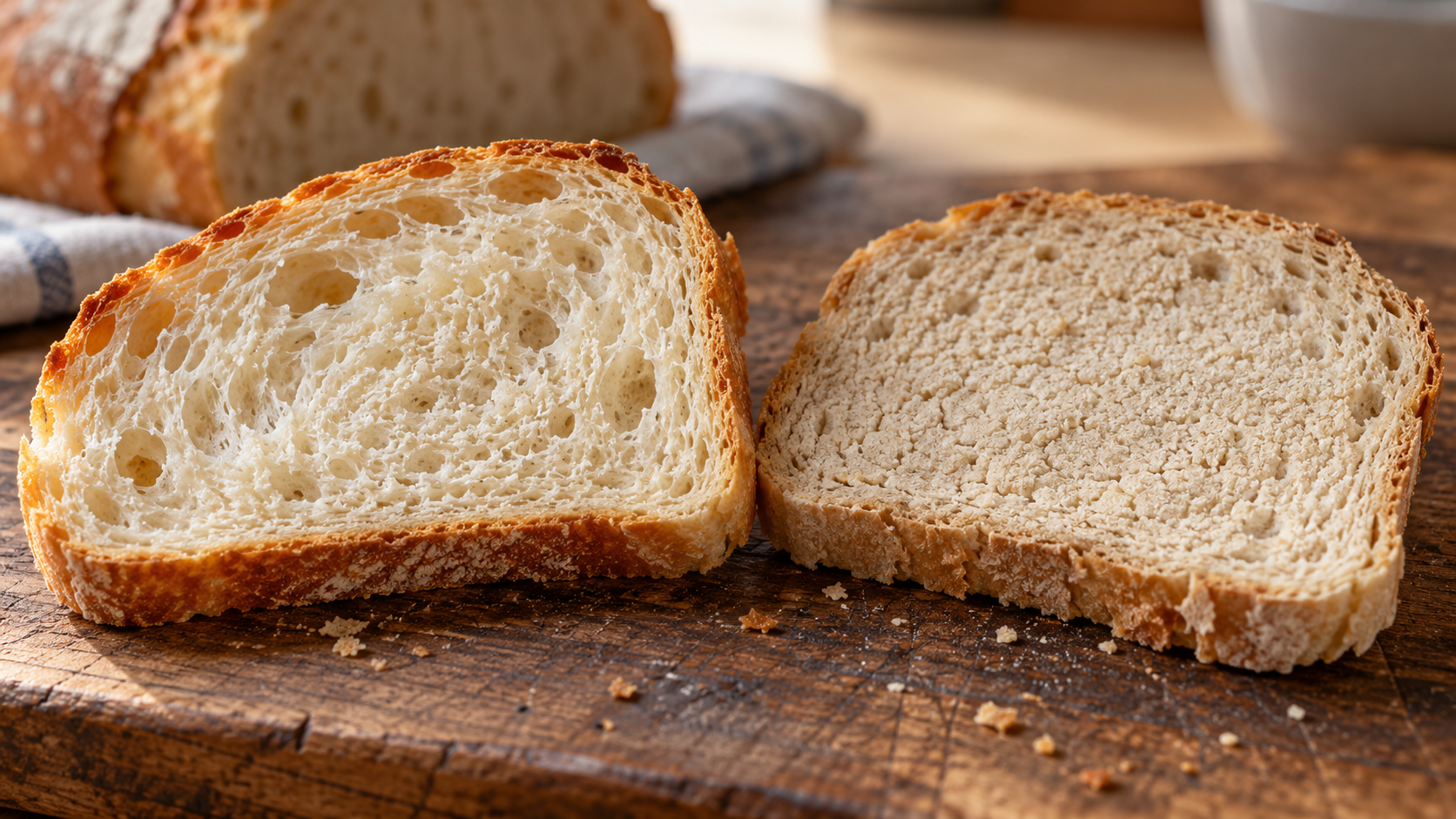
Bread Staling Explainer
Bread staling is not simply the loaf losing all its water. After baking, the crumb contains gelatinized starch dispersed through a gluten network. As the loaf cools and sits, portions of the starch chains gradually line up and form more ordered crystalline regions. This process, called retrogradation, makes the crumb firmer and less flexible. Water also redistributes among starch, gluten, crust, and the surrounding air, changing texture even when the total moisture of a wrapped loaf has fallen only modestly.
Amylopectin, the branched major component of bread starch, reorganizes over hours and days and is strongly associated with crumb firming. Amylose changes more quickly as bread cools. The growing ordered regions bind and exclude water differently from freshly gelatinized starch, so the crumb feels dry in the mouth even though water remains present. Meanwhile, a crisp crust absorbs moisture migrating from the crumb and loses its brittle structure, especially inside an airtight package.
Temperature has a surprising effect. Ordinary refrigerator temperatures often accelerate starch retrogradation, so a refrigerated loaf can stale faster than one kept briefly at room temperature. Freezing greatly slows molecular movement and is better for longer storage when the bread is well wrapped. Warm conditions may slow retrogradation but encourage mold and quality loss, so leaving bread hot is not a preservation strategy. The best storage choice depends on how soon the loaf will be eaten.
Reheating can temporarily soften stale crumb. Heat melts some of the ordered starch structures and increases molecular mobility, while steam restores flexibility at the surface. Toasting creates an appealing crisp layer and new aromas, but the softening is not permanent. As reheated bread cools, starch begins organizing again and the loaf may firm rapidly. Bread that has molded or spoiled is not made safe by heating and should be discarded.
Recipe and process change staling rate. Fats, emulsifiers, sugars, enzymes, hydrocolloids, sourdough acidity, baking conditions, and starch damage all influence water mobility and crystal formation. A thick intact crust and packaging alter moisture exchange. Slicing exposes more crumb, increasing drying and opportunities for contamination. Cool bread fully before wrapping to avoid condensation, then protect it from air for short storage or freeze portions promptly for later use.
A stale loaf therefore reflects a moving internal structure. The starch that absorbed water and swelled during baking does not remain frozen in that state; its molecules seek more ordered arrangements. Water follows those changes and migrates between regions, firming crumb while softening crust. Understanding retrogradation explains why a sealed loaf can feel stale, why the refrigerator is often disappointing, and why heat revives texture briefly without turning old bread back into fresh dough.
Starch molecules reorganize after baking, forming ordered regions that firm the crumb and redistribute water. Key terms include gelatinization, retrogradation, amylose, amylopectin, moisture migration, crumb, crust, and recrystallization.
No. Moisture loss contributes, but starch retrogradation can firm the crumb even in sealed packaging where much of the water remains.
Typical refrigerator temperatures favor amylopectin retrogradation. Freezing slows molecular rearrangement much more effectively for longer storage.
Explore more "Explainers"
Discover additional explainers across politics, science, business, technology, and other fields. Each explainer breaks down a complex idea into clear, everyday language—helping you better understand how major concepts, systems, and debates shape the world around us.