

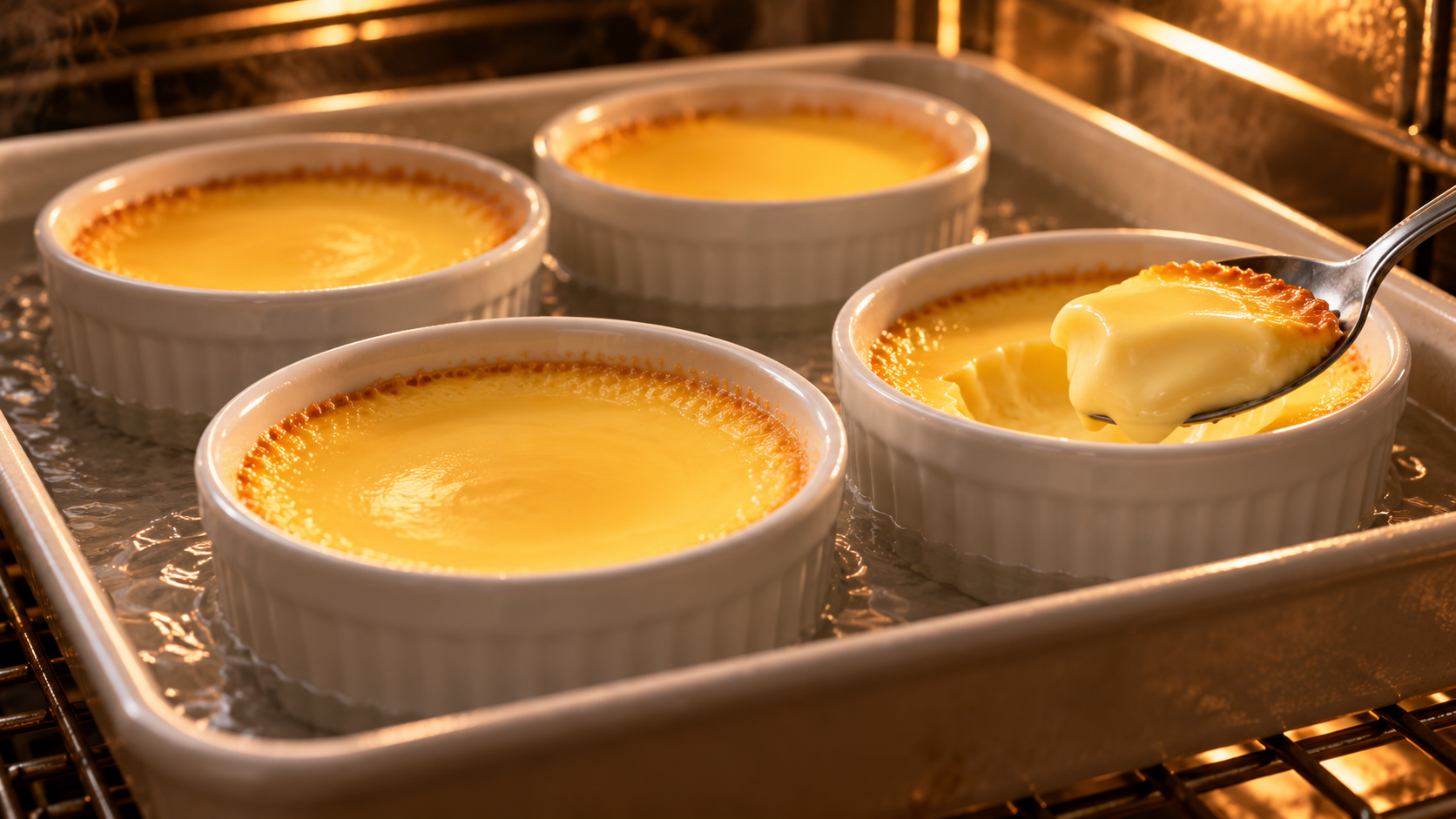
Custard Setting Explainer
Custard sets because heat changes the structure of egg proteins dispersed through milk, cream, or another liquid. In raw egg, long protein chains are folded into compact shapes. As temperature rises, those shapes loosen and unfold, a process called denaturation. Exposed sections then attract and link with neighboring proteins. A three-dimensional network gradually forms through the liquid, slowing its movement and trapping water and fat. The result changes from pourable mixture to thick cream or sliceable gel.
The network must be dense enough to support the liquid but not so tight that it squeezes water out. Gentle, even heating lets links form gradually. Excess temperature makes proteins bond too extensively, producing a grainy or rubbery texture and pockets of expelled liquid known as syneresis. Stirred custards are moved continuously so the bottom and sides do not overheat. Baked custards often sit in a water bath, which moderates heat around the dishes and reduces sharp oven gradients.
Ingredients alter the setting point and texture. Sugar competes for water and delays protein bonding, allowing a sweet custard to reach a somewhat higher temperature before thickening. Milk or cream dilutes the egg proteins and contributes fat, making the gel softer. Starch can thicken the continuous liquid phase and provide protection against curdling, which is why pastry cream is more heat tolerant than a simple stirred custard. Acids and salts can change protein interactions as well.
Residual heat continues moving inward after a custard leaves the stove or oven. Removing it at the desired stage, rather than waiting until it looks completely firm, helps prevent overcooking. A baked custard should show a controlled jiggle rather than liquid waves, while a stirred custard coats a spoon according to the recipe. A thermometer offers more repeatability than appearance alone, but the correct target depends on formulation and whether starch is present.
Egg dishes also require food-safety care. Raw ingredients should be refrigerated, cross-contamination avoided, and finished custard cooked and stored according to tested guidance. Large batches cool slowly, so shallow containers or an ice bath may be appropriate for stirred products. A water bath contains hot water and heavy dishes; it should be handled on a stable rack with protection from steam and splashing. Curdled custard may be texturally flawed even if its temperature is safe.
A tender custard is therefore a controlled protein network. Heat unfolds molecules, links develop, and the growing mesh immobilizes the surrounding liquid. Recipe ratios determine how much structure is possible, while sugar, fat, starch, agitation, and heating rate determine how that structure develops. Stopping before the network contracts too far preserves smoothness. What looks like simple thickening is a transition from dispersed proteins to a continuous gel spanning the entire dish.
Heat unfolds egg proteins and lets them join into a network that traps liquid. Key terms include denaturation, coagulation, gel, syneresis, dilution, water bath, residual heat, and starch.
Excess heat makes the protein network tighten too much. The clustered proteins form curds and squeeze out water instead of holding a smooth gel.
Surrounding water limits and evens the heat reaching the dishes, reducing overheated edges while the center catches up.
Explore more "Explainers"
Discover additional explainers across politics, science, business, technology, and other fields. Each explainer breaks down a complex idea into clear, everyday language—helping you better understand how major concepts, systems, and debates shape the world around us.