

Whetstone Knife Sharpening Explainer
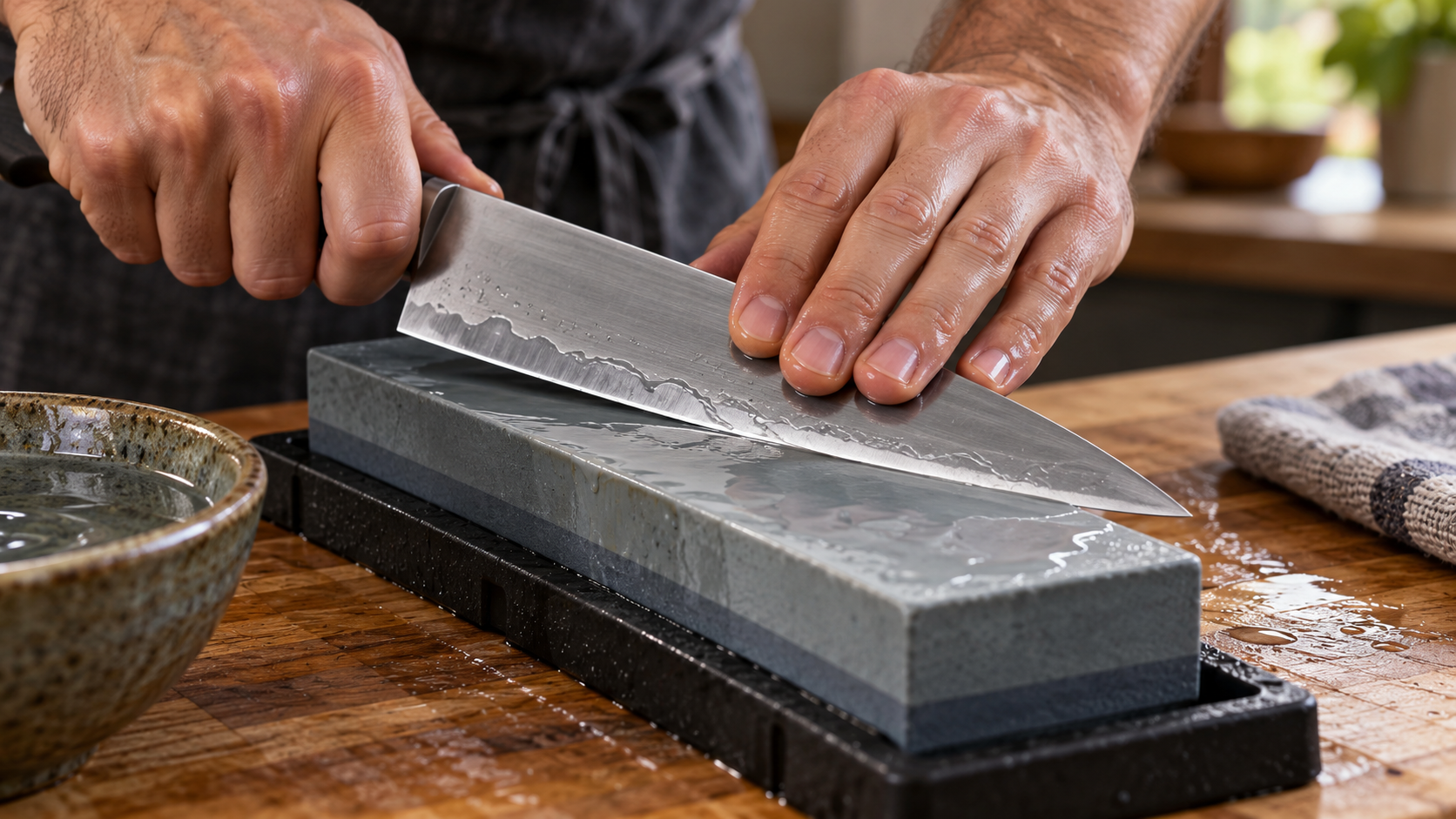
A whetstone sharpens by abrading steel from the two bevels that meet at a knife’s cutting edge. The stone contains hard particles that act like many tiny cutting tools. As the blade moves across the surface, exposed grains scratch away metal and gradually reshape the bevel. Sharpening continues until the newly ground plane reaches the very edge along the full length. Working the opposite side creates a second plane, and their intersection becomes the cutting apex.
Angle control determines the edge geometry. A lower angle makes a thinner edge that can cut easily but may be less durable, while a higher angle leaves more metal behind the apex. The appropriate angle depends on blade design, steel, and use. Consistency matters more than chasing a universal number: rocking the spine changes the bevel and can round the edge. Marker on the bevel or an angle guide can show whether the stone is contacting the intended region.
Coarse grit removes metal quickly for repairing chips or changing geometry. Medium grit establishes the main edge, and finer grit reduces scratch depth and refines the apex. Water or oil, as specified for the stone, carries swarf and prevents loose particles from clogging the surface. Some water stones release abrasive to create a slurry that continues cutting and polishing. Flattening is necessary because a dished stone makes it difficult to maintain a repeatable angle along a straight blade.
A burr often forms when grinding reaches the apex. This thin lip of metal bends away from the side being sharpened and can be felt carefully from spine toward edge, never by sliding a finger along the blade. Raising a consistent burr helps confirm that the bevel reached the edge, but the burr is not the final sharpness. Alternating light strokes, finer abrasive, or stropping removes weakened metal and leaves a cleaner, more stable intersection.
Pressure should decrease as the edge develops. Heavy force can gouge soft stones, flex thin blades, or create a large stubborn burr. The stone must be secured on a non-slip base with the edge directed safely. Fingers stay on the blade face and behind the cutting path. Serrated, single-bevel, ceramic, and heavily damaged knives need specialized methods. A honing steel may realign or maintain an edge, but it does not replace abrasive sharpening when the apex has worn away.
Sharpening is controlled geometry at a microscopic scale. Abrasive grains remove fatigued steel, steady angle creates matching bevels, and work from both sides brings those bevels together. Grit progression reduces the roughness left by the previous stone, while deburring exposes the true apex. The water seen on the stone mainly manages debris and cutting action; the sharpness comes from accurately removing metal until the edge is thin, continuous, and supported by suitable bevels.
Abrasive grains remove steel from both bevels until the planes meet at a thin apex. Key terms include bevel, apex, grit, abrasive, swarf, slurry, burr, and deburring.
It indicates that grinding on one side has reached the apex and pushed a thin lip of metal over. The burr must then be removed cleanly.
A hollowed stone changes the contact angle and can curve the bevel, making a consistent edge difficult along the blade’s length.
Explore more "Explainers"
Discover additional explainers across politics, science, business, technology, and other fields. Each explainer breaks down a complex idea into clear, everyday language—helping you better understand how major concepts, systems, and debates shape the world around us.