

Snap Fastener Explainer
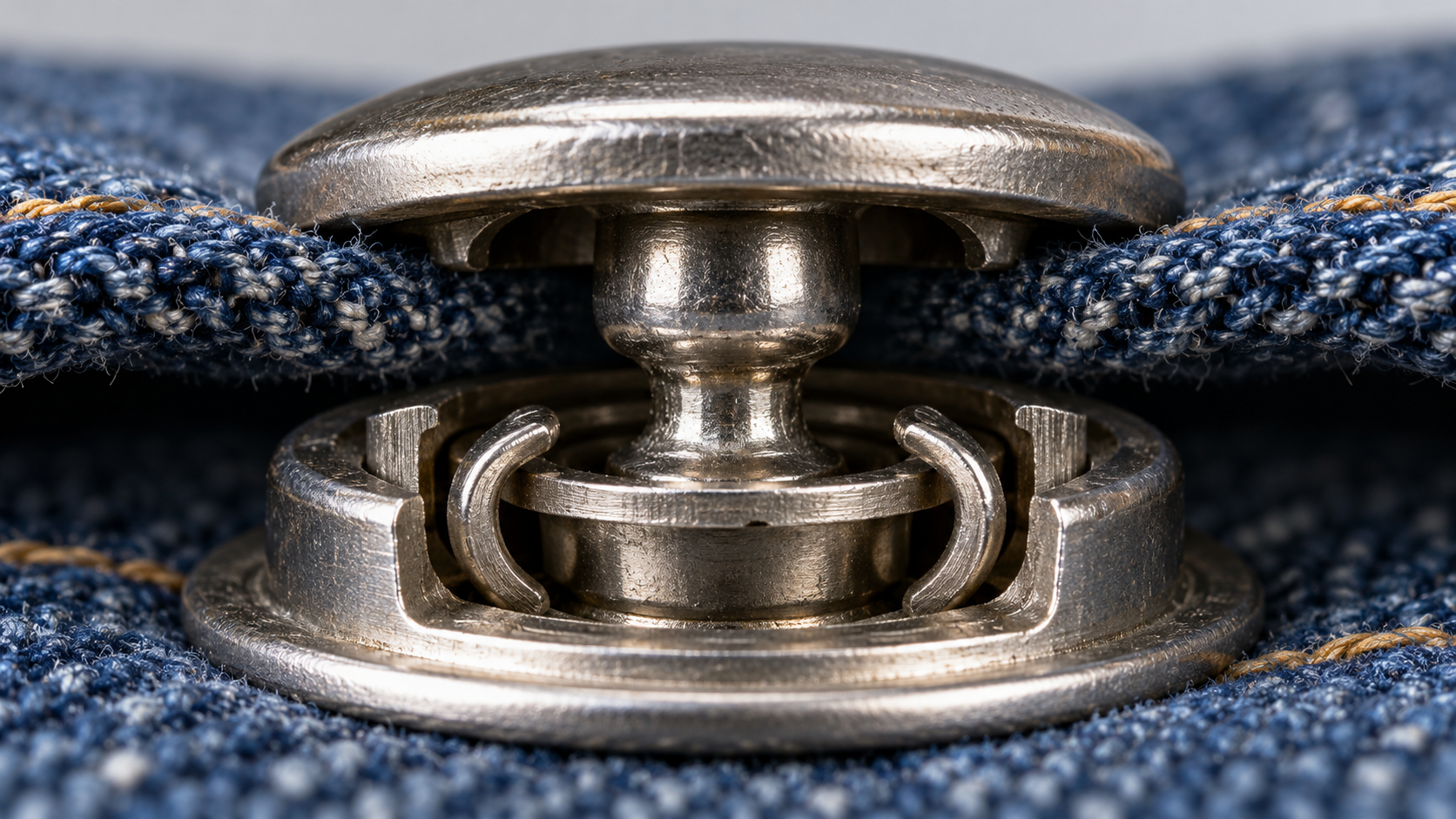
A snap fastener joins two flexible layers with a male stud and a female socket. The stud has a rounded head above a narrower neck. Inside the socket, a spring ring or several resilient fingers project into the opening. Pushing the halves together makes the head spread that spring outward. Once the widest part passes, the spring contracts into the neck. The sudden movement into the lower-energy position creates the familiar click and resists straight separation.
Pulling the fastener apart reverses the sequence. Force on the fabric and hardware draws the stud head against the retaining spring until it flexes open enough to let the head pass. The required release force depends on stud shape, spring stiffness, friction, wear, and direction of pull. One-way snaps add geometry that releases readily from a chosen side but resists force from others, while ordinary garment snaps are intended for repeated opening from a range of angles.
A typical four-part metal snap includes a decorative cap and socket on one fabric layer, plus a stud and post on the other. Hollow posts are rolled, flared, or crimped during installation so the pieces capture the material between them. The setting tool must match the snap size and shape. Too little forming leaves loose hardware; too much can crush the spring, deform the socket, cut the fabric, or prevent the halves from engaging.
The fabric around a snap carries concentrated load. Reinforcement patches, interfacing, or washers spread that force so repeated pulling does not tear a hole. Alignment matters because an offset stud enters the socket at an angle and loads only part of the spring. Corrosion, lint, paint, and bent components change the fit. A light cleaning may restore action, but a distorted socket or loose post normally requires replacement rather than squeezing the assembled fastener at random.
Snaps are selected for material thickness, desired holding force, corrosion environment, and skin contact. Small parts are a choking hazard, and a loose snap on children’s clothing needs prompt repair. Nickel-containing alloys may bother sensitive users. Snaps are not structural anchors or safety connectors. When opening one, pull close to the fastener rather than yanking distant fabric, which increases leverage and can tear the surrounding material before the spring releases.
The snap is a reusable elastic latch. Its stud converts pushing motion into outward spring deflection, and the neck gives the spring a place to recover. That recovery traps the stud until a deliberate pull supplies enough energy to flex the spring again. The click is both sound and feedback that the parts reached engagement. Durable performance depends on accurate metal shapes, correct setting, reinforced material, and a spring that remains resilient through many cycles.
The stud head spreads a spring in the socket; after it passes, the spring contracts into the narrow neck and holds. Key terms include stud, head, neck, socket, spring ring, cap, post, and setting tool.
The flexed spring rapidly contracts into the stud neck after the widest part passes, producing a sudden movement and audible click.
The hardware concentrates pulling force into a small area. Thin or flexible materials often need interfacing or another reinforcement to spread the load.
Explore more "Explainers"
Discover additional explainers across politics, science, business, technology, and other fields. Each explainer breaks down a complex idea into clear, everyday language—helping you better understand how major concepts, systems, and debates shape the world around us.