

Telescoping Drawer Slide Explainer
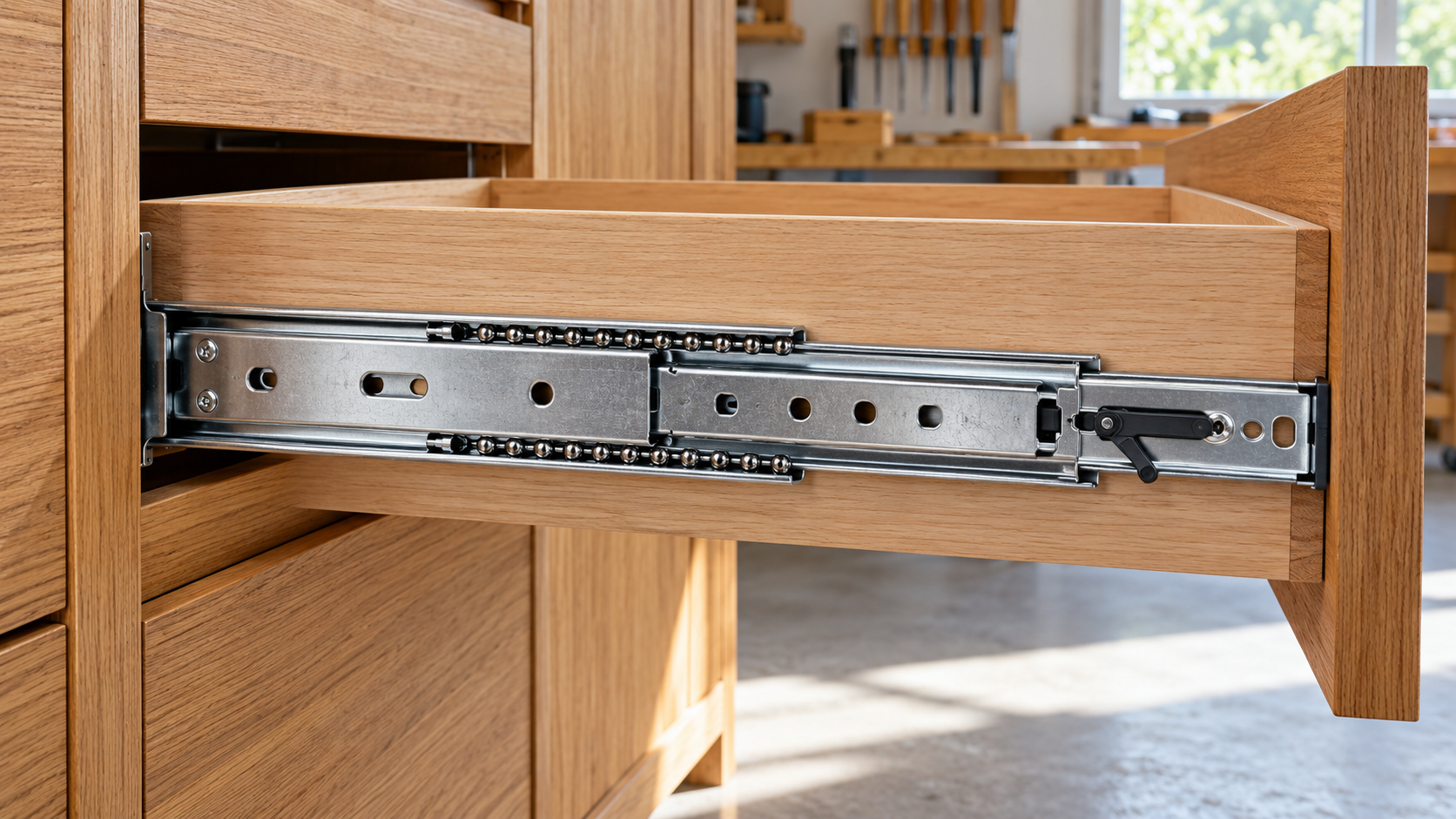
A full-extension drawer slide is a compact telescoping structure mounted between the drawer and cabinet. It commonly has an outer rail fixed to the cabinet, an inner rail fixed to the drawer, and an intermediate rail between them. Steel balls roll in shaped raceways where the rails overlap. Rolling contact creates far less friction than broad metal surfaces sliding directly against each other.
The balls sit in retainers or cages that keep them evenly spaced. As one rail moves, contact on opposite sides makes the balls roll and carries the cage along at a related speed. The intermediate member allows two overlapping stages of travel, so the drawer can move roughly its full depth rather than stopping after only one rail length. Stops coordinate extension and keep the members from separating accidentally.
Load travels from the drawer into the inner rails, through the bearing contact points, into the outer rails, and finally into the cabinet. Pairs of slides resist both weight and the twisting moment created when the drawer is open. Accurate parallel mounting matters: if the cabinet opening is too narrow, wide, or out of square, the raceways squeeze or spread and rolling resistance rises.
Many slides include a flexible release lever so the inner rail and drawer can be removed. Soft-close versions add a catch, spring, and damper near the end of travel. The catch engages the moving rail, the spring pulls it closed, and the damper controls speed. These extras change the final few inches, while the basic load support still comes from telescoping rails and bearings.
Dirt, bent channels, loose screws, and overloaded drawers cause roughness or uneven movement. Grease and bearing design are selected by the manufacturer, so random oil can attract grit or damage plastic parts. A drawer that leans, drops unexpectedly, or allows balls to escape needs repair. Both sides should have compatible load ratings and lengths; mismatched slides can rack the drawer and concentrate force.
The mechanism works by preserving overlap while extending reach. Nested rails divide the total motion into stages, bearing balls carry compression loads while rolling through hardened tracks, and cages keep those balls positioned. Stops define safe travel and releases permit deliberate separation. With parallel installation and balanced loading, the drawer remains guided horizontally even when most of its length projects beyond the cabinet.
Nested rails telescope while steel balls roll in shaped raceways and cages, supporting the drawer with low friction. Key terms include outer rail, intermediate rail, inner rail, raceway, ball bearing, cage, stop, and release lever.
The intermediate rail creates a second stage of telescoping travel, allowing the drawer to extend about its full depth while useful overlap remains.
The two slides must remain parallel. Misalignment applies sideways load to the raceways and bearings, increasing friction and twisting the drawer.
Explore more "Explainers"
Discover additional explainers across politics, science, business, technology, and other fields. Each explainer breaks down a complex idea into clear, everyday language—helping you better understand how major concepts, systems, and debates shape the world around us.