

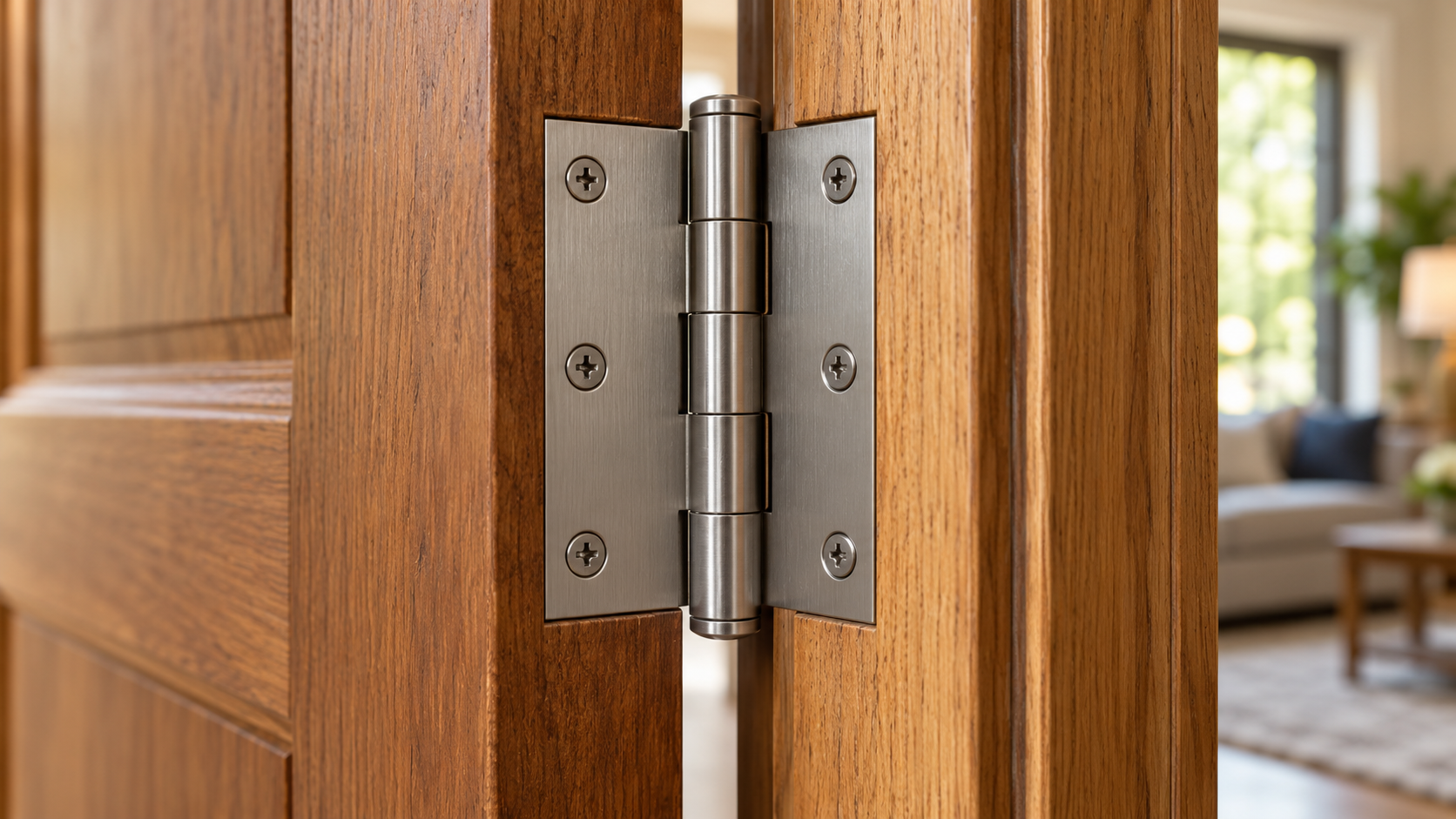
Butt Hinge Load and Motion Explainer
A common butt hinge connects a door to its frame with two flat leaves. Rolled knuckles along the leaf edges alternate and surround a vertical pin. The pin defines the axis, so the door can rotate while remaining attached. Weight travels from the door into its hinge screws, across the leaf and knuckles, through the pin, and into the frame-side leaf and building structure.
The hinge carries more than straight downward weight. Because the door’s center of mass sits far from the hinge line, gravity also creates a turning moment that tries to make the outer edge sag. The top hinge is often pulled away from the jamb while the lower hinge is pushed toward it. Multiple hinges spread those forces along the door height and help keep the swinging panel aligned.
Inside each knuckle, the pin and bearing surfaces slide or roll against one another depending on the design. Plain residential hinges usually rely on smooth metal surfaces and suitable lubrication. Ball-bearing hinges place small bearings between knuckle sections to reduce friction under heavier loads. The leaf mortises keep the hinge faces flush so the gap is controlled and the door can close without binding.
Screws are crucial load paths. Short screws may hold only thin jamb material, while properly specified longer fasteners can reach structural framing. Loose screws allow the leaf to shift, magnifying sag and causing the latch to miss its strike. Replacing a screw with an oversized or poorly placed fastener can split wood or prevent the leaf from seating. Hinge rating, door mass, width, and fire requirements guide hardware selection.
Squeaking suggests friction or contamination, but lubrication should match the manufacturer and must not mask looseness. Dark metal dust, a rising pin, cracked knuckles, bent leaves, or repeated rubbing at the top corner deserve inspection. A heavy door should be supported before a hinge is removed. Shimming or bending hinges without understanding the load can worsen alignment or damage the frame.
The hinge is therefore both a bearing and a structural bracket. Its pin grants one controlled degree of freedom, while interleaved knuckles block separation in other directions. Leaves and screws transfer the door’s weight and leverage into the jamb. When the axis is straight and the attachment remains tight, a large rectangular panel can swing with modest hand force yet stay precisely located in its opening.
Interleaved knuckles rotate around a pin while leaves and screws transfer the door's weight and leverage into the frame. Key terms include leaf, knuckle, pin, axis, mortise, bearing, moment, jamb, and fastener.
The door's weight acts away from the hinge line, creating a moment that tends to pull the top of the door outward and push the lower area inward.
They reduce sliding friction between loaded knuckle sections, helping heavy or frequently used doors move smoothly with less wear.
Explore more "Explainers"
Discover additional explainers across politics, science, business, technology, and other fields. Each explainer breaks down a complex idea into clear, everyday language—helping you better understand how major concepts, systems, and debates shape the world around us.