

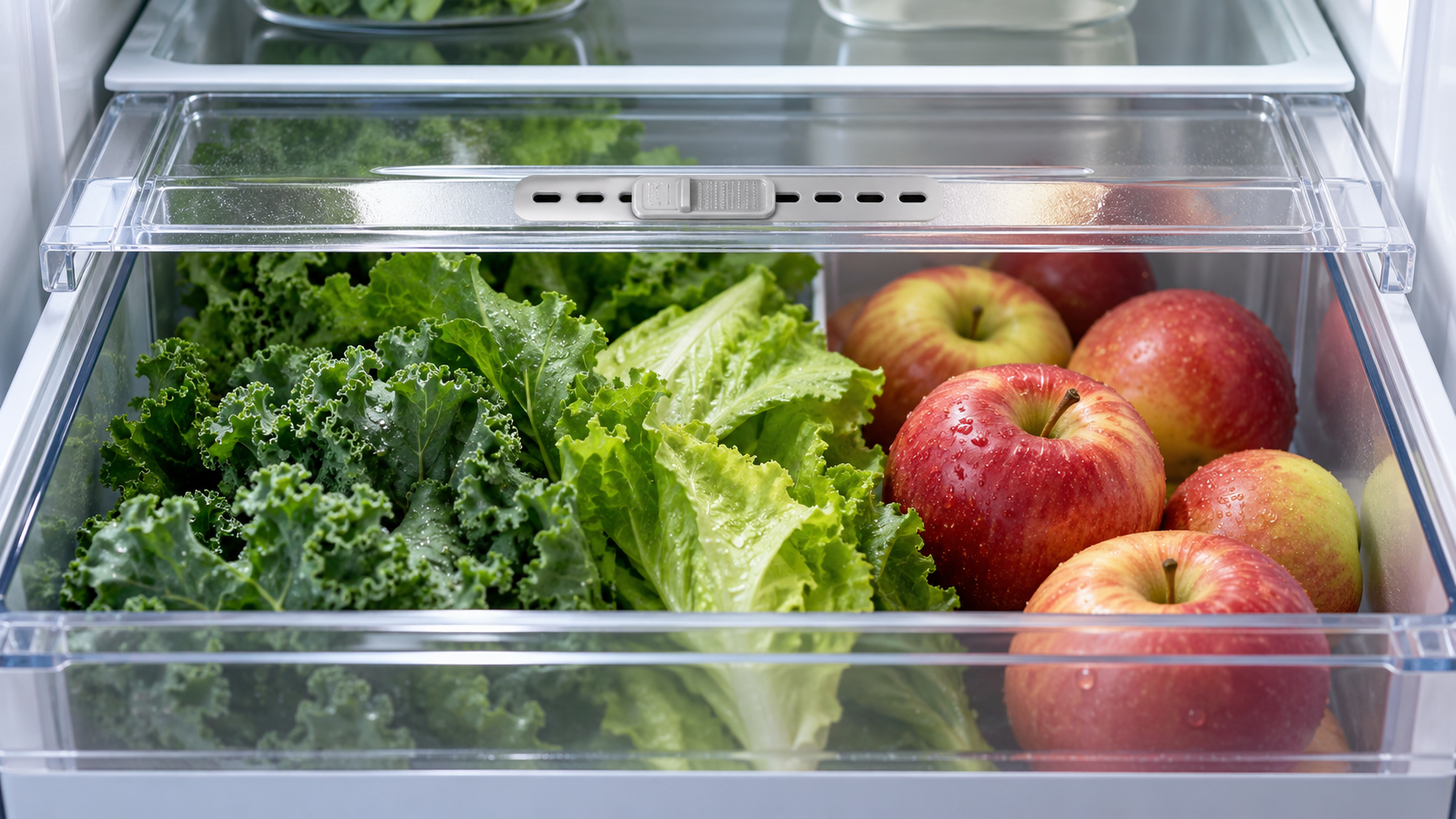
Crisper Drawer Humidity Explainer
A crisper drawer is a partly enclosed compartment that slows air exchange with the rest of the refrigerator. Fresh produce continues to lose water through transpiration and to exchange gases through respiration after harvest. In a relatively closed drawer, some released water vapor remains nearby, raising relative humidity and reducing further moisture loss from leafy vegetables and other foods that wilt easily.
The humidity slider usually operates a simple vent. Moving it toward high humidity closes or restricts openings, so moist air escapes slowly. Moving it toward low humidity opens a larger path to the dry circulating refrigerator air. The control does not create water or remove it with a sensor; it changes ventilation, while the produce itself is usually the main moisture source inside the compartment.
A full drawer often maintains humidity better than a nearly empty one because it contains more moist plant tissue and less free air to exchange. However, excessive condensation can wet surfaces and encourage decay. Damaged produce releases more moisture and microorganisms. Some fruits also produce ethylene, a plant hormone that can speed ripening or deterioration of sensitive vegetables, so separation can matter as much as humidity.
High humidity is commonly useful for leafy greens, carrots, and similar produce that loses crispness when water evaporates. Lower humidity and more ventilation may suit many fruits, especially when gas and excess moisture should escape. Actual labels, airflow, and recommendations vary by refrigerator, so the appliance manual and produce guidance take precedence over a universal slider rule.
The drawer cannot correct warm settings, blocked cabinet vents, spoiled food, or unsafe storage time. Produce should be cleaned and stored according to current food-safety guidance, and the drawer should be washed when spills occur. Standing water suggests excessive moisture or drainage trouble, not an invitation to close the vent further. Cracked seals, a warped drawer, or an obstructed cover also defeats the intended airflow control.
A crisper is therefore a passive microclimate. Its walls and cover reduce mixing, the adjustable vent sets how quickly water vapor and gases leave, and the food load determines much of what accumulates. By matching ventilation to the produce, the drawer can slow wilting without trapping so much moisture that condensation and decay dominate. It is a controlled leak, not a miniature independent refrigerator.
An adjustable vent changes how quickly moist air from produce mixes with drier refrigerator air. Key terms include crisper, relative humidity, ventilation, transpiration, respiration, condensation, ethylene, and microclimate.
It closes or restricts the drawer vent, retaining more of the water vapor released by produce and slowing moisture loss from the food.
More produce releases more water vapor and leaves less free air, so humidity can rise quickly; crowding can also restrict circulation and hide spoiled items.
Explore more "Explainers"
Discover additional explainers across politics, science, business, technology, and other fields. Each explainer breaks down a complex idea into clear, everyday language—helping you better understand how major concepts, systems, and debates shape the world around us.