

Wet-Dog Shake Physics Explainer
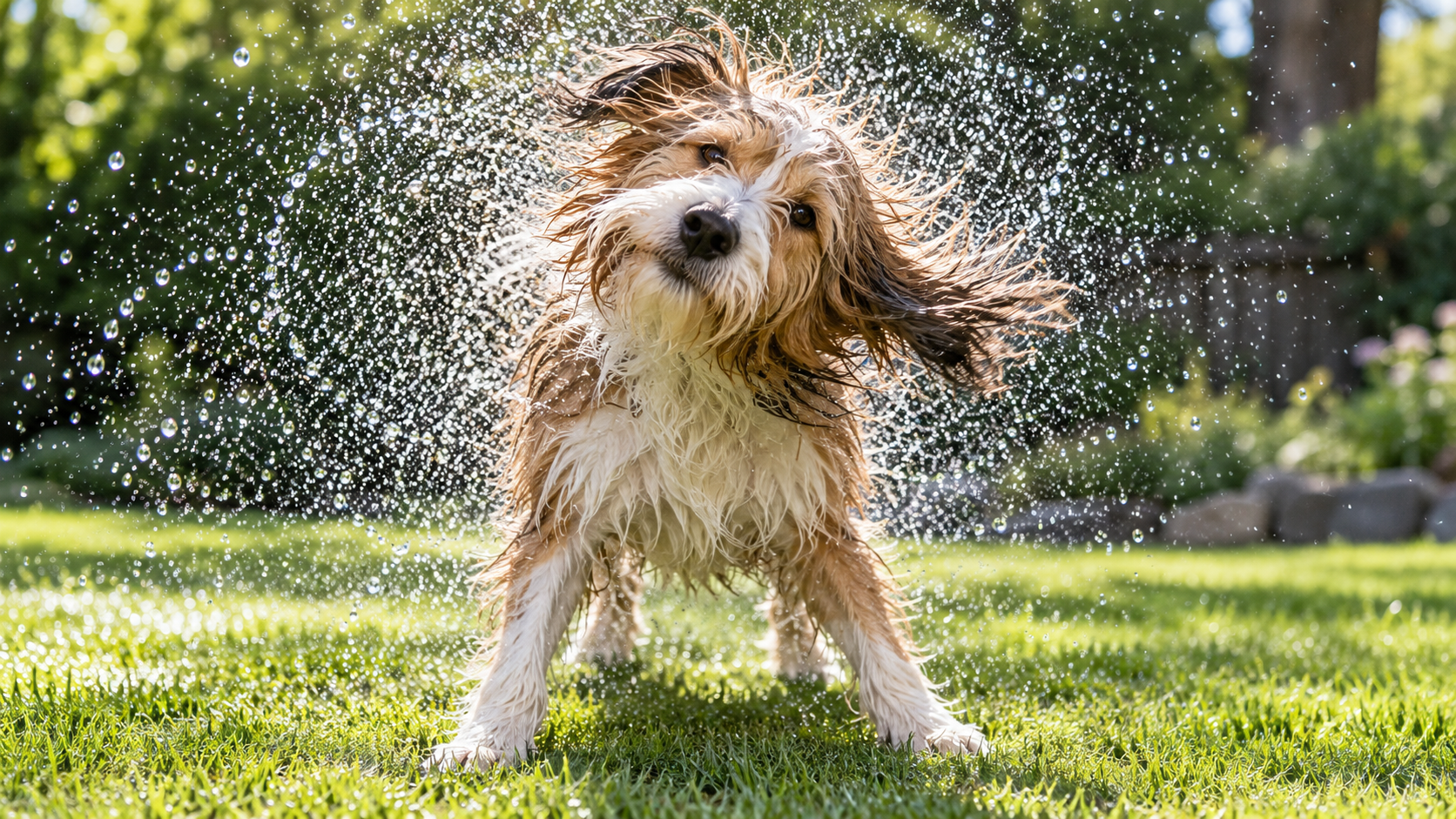
Water clings to fur because surface tension and wetting forces hold droplets against individual hairs. Waiting for that water to evaporate would consume heat and time. A wet dog instead plants its feet and rotates the head and torso rapidly from side to side. The skeleton turns through a modest angle, but loose skin and fur lag and then sweep through a much larger arc.
That motion gives droplets strong outward acceleration. Their inertia resists following the sharply reversing hair path, while the hair supplies the inward force needed to keep them attached. When the required force exceeds capillary adhesion, droplets detach and fly away. The effect is often described with centrifugal force in the rotating frame, but the physical competition is between droplet inertia and the surface-tension forces holding water to fur.
High-speed studies across mammals found that smaller animals shake faster than larger ones. Body size changes the radius of motion and the acceleration available at a given frequency, so each animal must use a suitable rate. Loose skin amplifies motion at the fur surface without requiring the spine to twist through the same extreme angle. The oscillation begins at the head and travels along the body.
The behavior is triggered by sensory input from hairy skin. Recent research in mice identified low-threshold mechanoreceptors and a neural pathway that promotes wet-dog shakes when small droplets or irritants move hairs on the neck and back. The action is therefore not merely an accidental consequence of being wet; it is a coordinated, stereotyped motor response used by many furry mammals.
People should give a wet dog space rather than restraining a shake mid-motion. Slippery floors, nearby objects, and ear problems deserve attention. Frequent head shaking when the coat is dry, scratching, odor, redness, imbalance, or pain can indicate an ear or skin condition and warrants veterinary advice. Drying towels and a warm environment help with the water that remains after the shake.
The wet-dog shake is an efficient mechanical drying strategy. Muscles create rapid alternating rotation, flexible skin increases the fur’s travel, and droplet inertia overwhelms capillary attachment. Instead of supplying the large latent heat required to evaporate all that water, the animal ejects much of it as liquid in seconds. The familiar spray is the visible result of tuned motion overcoming microscopic adhesion.
Rapid twisting makes fur and skin reverse direction so strongly that droplet inertia exceeds surface-tension adhesion and water flies off. Key terms include oscillation, angular acceleration, inertia, surface tension, capillary force, loose skin, mechanoreceptor, and motor pattern.
Their smaller motion radius requires a higher oscillation frequency to generate enough acceleration to overcome the forces holding droplets to fur.
Loose skin lags behind and continues moving as the body reverses, amplifying the arc and acceleration experienced by the outer fur.
Explore more "Explainers"
Discover additional explainers across politics, science, business, technology, and other fields. Each explainer breaks down a complex idea into clear, everyday language—helping you better understand how major concepts, systems, and debates shape the world around us.