

Oscillating Lawn Sprinkler Explainer
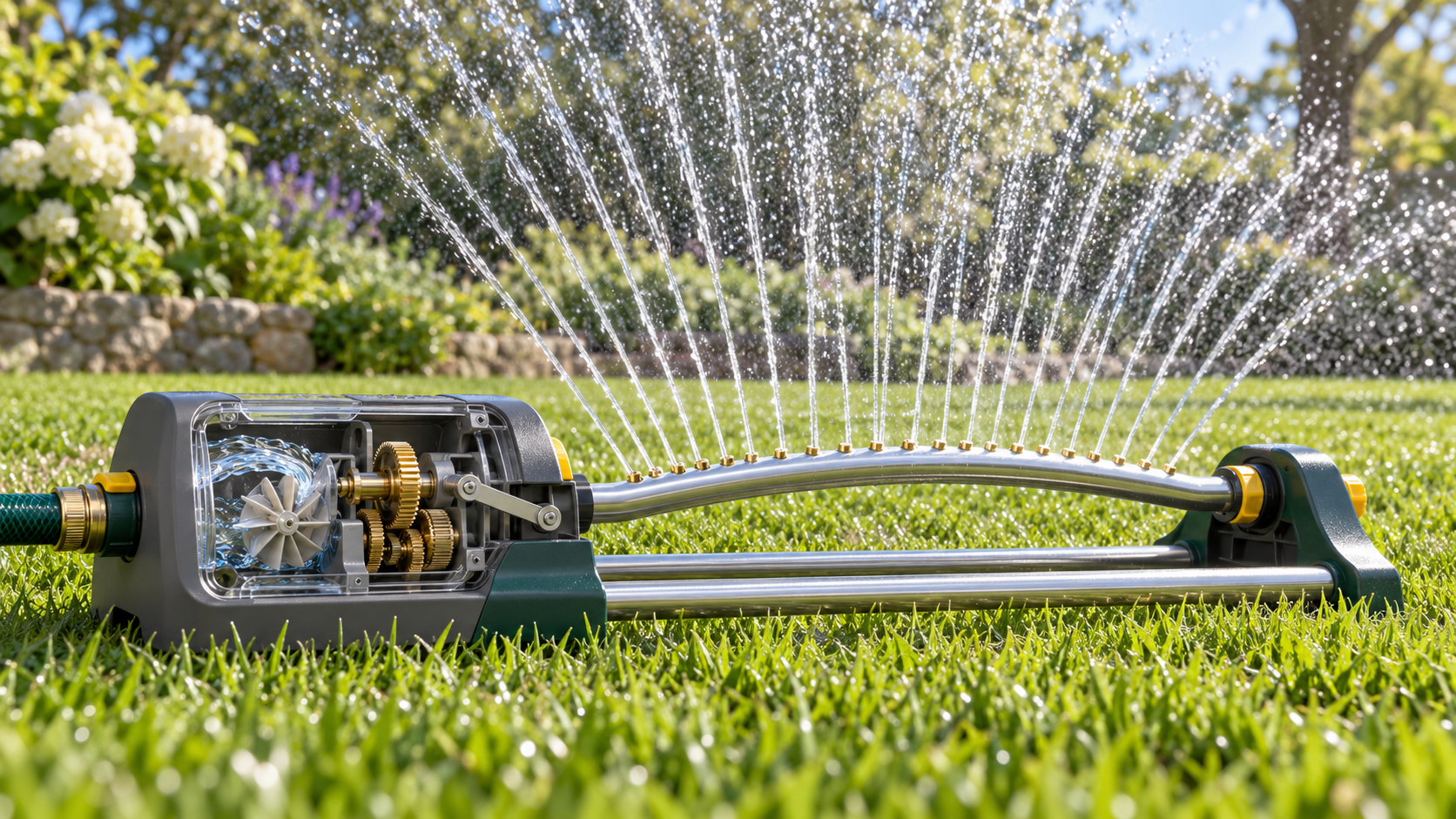
An oscillating sprinkler sends water through a row of small openings in a long tube, producing a fan of parallel jets. The same incoming water also powers the tube’s motion. A portion of the flow strikes a small turbine or impeller inside the end housing. The fast-spinning turbine provides rotary power without electricity, while the remaining flow continues toward the spray tube.
A reduction gear train slows the turbine and increases usable torque. Its final shaft turns a crank or eccentric connected to a link on the spray tube. As the crank completes each circle, the link first pushes and then pulls, converting continuous rotation into back-and-forth angular motion. The tube rocks around its long axis, causing the fan of water to traverse a roughly rectangular lawn area.
The ends of the stroke need controlled reversal. Simple crank geometry naturally slows near each extreme, which can deposit extra water there. Some designs use cams, shaped or elliptical gears, or flow controls to make coverage more even. Adjustable stops change the arc, and selectors may block part of the tube or shift its resting position so water reaches one side rather than the full span.
Jet pattern depends on pressure, hole size, spacing, and tube shape. Low pressure shortens the throw and may also slow or stall the drive because the turbine receives less energy. Excess pressure can create mist, increase wear, and send water beyond the target. Dirt or mineral scale changes individual jets, leaving dry stripes. A fine inlet screen protects the small passages and gear housing from debris.
The sprinkler should sit level and stable so its reaction forces do not walk it across the ground. Hoses should not kink or create trip hazards. Clearing nozzles and screens follows the maker’s instructions; hard wire can enlarge holes and distort the pattern. Freezing water can crack the housing or tube, so the unit should drain before cold storage. Persistent clicking without movement may indicate a jammed turbine or worn gears.
The device is a water-powered motion converter. Pressure and flow spin a turbine, gears trade speed for torque, and a crank translates rotation into oscillation. At the same time, the water exits through carefully spaced nozzles. The shared energy source makes the sprinkler self-contained: connecting a hose supplies both the moving fan of droplets and the mechanical work needed to sweep that fan across the lawn.
Incoming water spins a turbine; reduction gears turn a crank that converts rotation into back-and-forth motion of the nozzle tube. Key terms include turbine, impeller, gear reduction, torque, crank, linkage, oscillation, nozzle, and arc stop.
A simple crank moves its linkage least per degree near dead-center positions, naturally decelerating before reversing direction.
The turbine receives too little power to overcome gear friction and nozzle reaction, even though some water may still dribble from the tube.
Explore more "Explainers"
Discover additional explainers across politics, science, business, technology, and other fields. Each explainer breaks down a complex idea into clear, everyday language—helping you better understand how major concepts, systems, and debates shape the world around us.