

Elastic Waistband Recovery Explainer
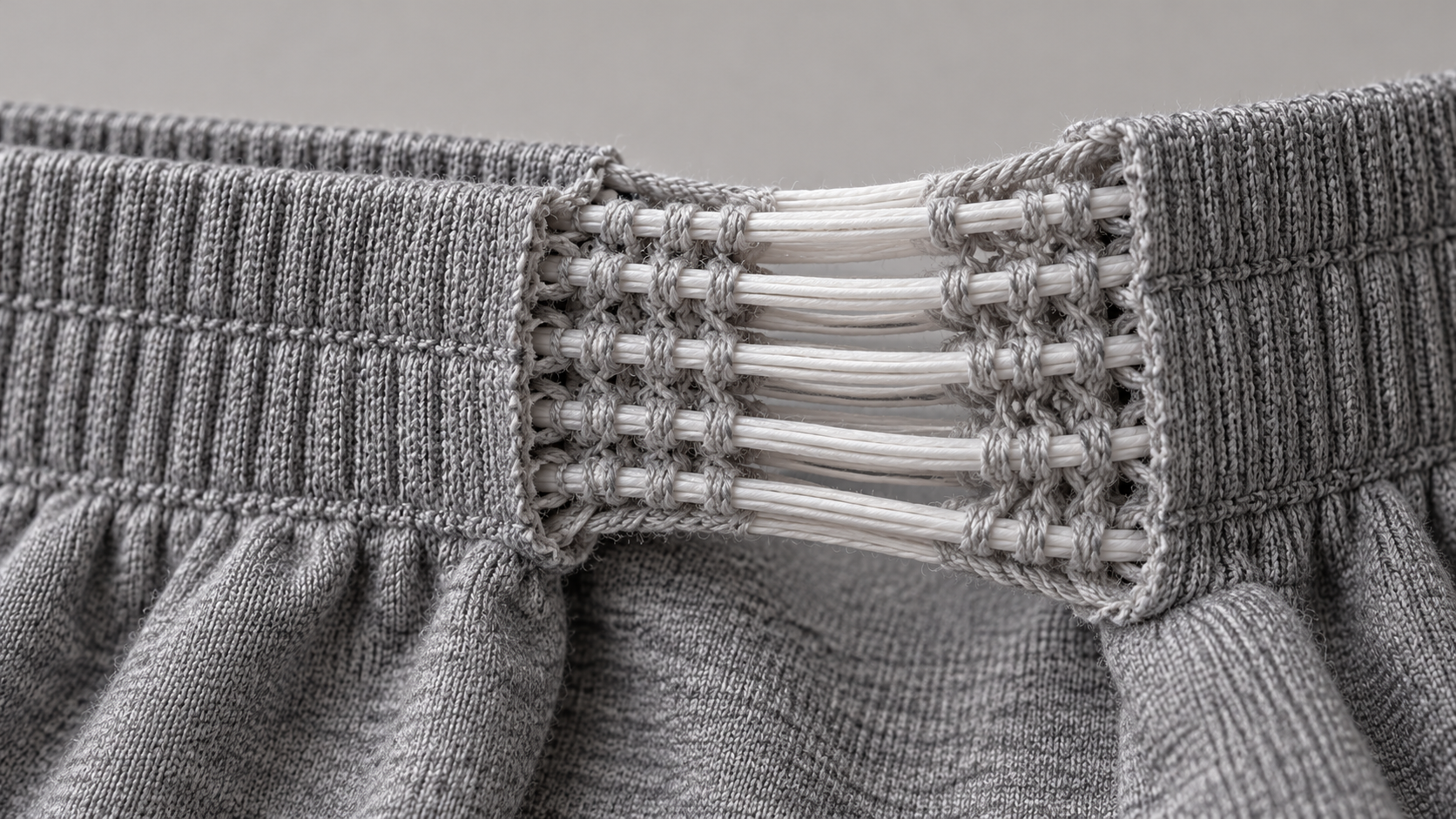
An elastic waistband contains long elastomeric filaments made from rubber, elastane, or a related material. In a relaxed filament, flexible molecular chains are coiled and disordered. Pulling the band straightens and aligns many chain segments, allowing large extension without ordinary fibers breaking. When the load is removed, thermal motion and crosslinks favor the more coiled state, creating a force that shortens the filament.
The elastomer rarely works alone. It is covered or combined with polyester, nylon, or cotton yarn in a knitted, woven, or braided structure. That textile controls width, surface feel, and the maximum safe stretch. Loops and crimps open as the band extends, while the elastic core supplies recovery. The surrounding yarn protects it from abrasion and helps distribute force around the body.
A good waistband produces useful force across a range of sizes without feeling like a hard cord. Designers choose filament count, thickness, spacing, fabric construction, and initial tension. The band is often sewn into a casing or directly knitted into a garment. Seams must stretch too; a rigid stitch can snap or concentrate load even when the elastic material itself remains within its working range.
Recovery is not perfectly immediate or complete. Some energy is lost internally as heat during each stretch-and-return cycle, a behavior called hysteresis. Holding the band extended can produce creep, and repeated cycles can leave permanent set. Heat, chlorine, body oils, ultraviolet light, and aggressive drying may degrade elastomer chains, making the waistband wavy, brittle, sticky, or permanently loose.
Care labels reflect those material limits. High dryer heat and ironing can shorten elastic life, while bleach affects some formulations. Replacing a band requires matching width, stretch direction, and intended recovery; simply choosing the strongest elastic may make a garment uncomfortable. An elastic that shows exposed broken filaments or no longer retracts consistently has lost structure and is unlikely to be restored by washing.
The waistband is a composite spring in fabric form. Molecular coils provide reversible extension, textile loops organize and limit that extension, and garment construction spreads the returning force. Comfort comes from tuning the force curve rather than maximizing tightness. With suitable strain and care, millions of tiny chain segments change configuration together, letting the garment open for movement and then follow the body again.
Elastomer chains uncoil under tension and recoil when released, while a knitted or woven cover controls shape and load. Key terms include elastomer, elastane, crosslink, filament, knit, recovery, hysteresis, creep, and permanent set.
Repeated strain, heat, chemicals, and time can break chains or allow permanent rearrangement, reducing the recovery force that once shortened the band.
The textile cover improves comfort and abrasion resistance, controls width and maximum stretch, and helps distribute elastic force through the garment.
Explore more "Explainers"
Discover additional explainers across politics, science, business, technology, and other fields. Each explainer breaks down a complex idea into clear, everyday language—helping you better understand how major concepts, systems, and debates shape the world around us.