

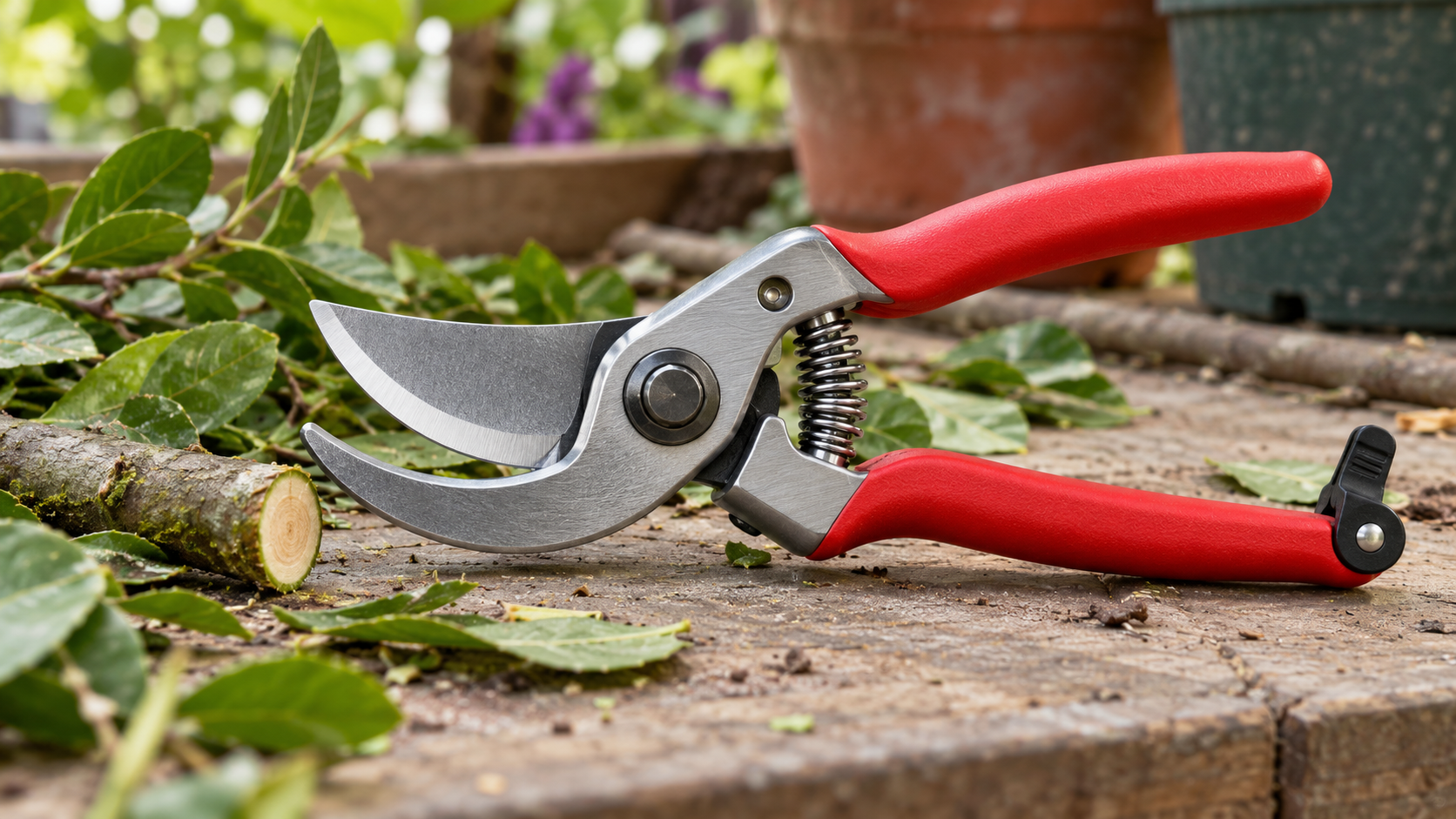
Bypass Pruning Shears Explainer
Bypass pruning shears work like a specialized pair of scissors. A sharp curved blade moves past a thicker unsharpened hook or counter-blade instead of closing onto a flat anvil. The stem rests in the hook, which supports it and keeps it from sliding away. As the handles close, the sharpened blade draws through the plant material with a slicing motion, leaving a cleaner surface than a crushing cut when the tool is sharp and adjusted.
The central pivot turns the handles into crossed levers. The user applies force far from the pivot, while the cutting edges act much closer to it. That difference in lever arms multiplies force at the stem, although the blade moves a shorter distance than the hands. Curved geometry also draws the branch inward toward the strong part of the jaws. Cutting capacity is limited because thicker wood demands rapidly increasing force and can spread or damage the tool.
The blades must pass closely without colliding. Pivot tension sets the clearance: too loose and a thin stem can wedge between the blades; too tight and friction makes the handles difficult to move. A return spring opens the handles after each cut, reducing fatigue during repeated work. A small latch holds the closed tool for storage. These parts improve use, but the edge, hook, pivot, and handle structure carry the main cutting load.
For living stems, the sharp blade is commonly placed toward the portion of plant that will remain, so any slight compression from the hook affects the removed side. The tool is aligned for one deliberate cut rather than twisted through the branch. Anvil pruners, loppers, saws, and powered tools have different strengths, so a branch beyond the rated diameter is not made suitable by squeezing harder or extending the handles with improvised pipes.
Sap and grit increase friction and can corrode metal. After use, the blades are cleaned, dried, and lubricated as the manufacturer directs. Sharpening preserves the original bevel instead of changing the blade profile. A chipped blade, cracked handle, loose pivot that cannot be adjusted, or damaged lock warrants repair or replacement. Gloves and eye protection help, while the free hand stays well outside the closing jaws and branch path.
Bypass pruners produce a clean cut through coordinated geometry. The handles multiply hand force, the pivot directs it, the hook captures and supports the stem, and the curved edge slices past that support. Close clearance prevents fibers from folding between the blades. The design is efficient within its capacity, but sharpness, alignment, stem placement, and correct tool choice determine whether the cut is smooth or the branch and pruner are both damaged.
Long handles multiply force around a pivot while a sharp curved blade slides past a supporting hook and slices the stem. Key terms include bypass, pivot, lever arm, hook blade, bevel, clearance, return spring, and cutting capacity.
The thin sharpened blade slices, while the thicker hook supports and captures the branch without needing a second delicate edge.
The blades separate under load, allowing fibers to wedge and tear between them instead of being cleanly sheared.
Explore more "Explainers"
Discover additional explainers across politics, science, business, technology, and other fields. Each explainer breaks down a complex idea into clear, everyday language—helping you better understand how major concepts, systems, and debates shape the world around us.