

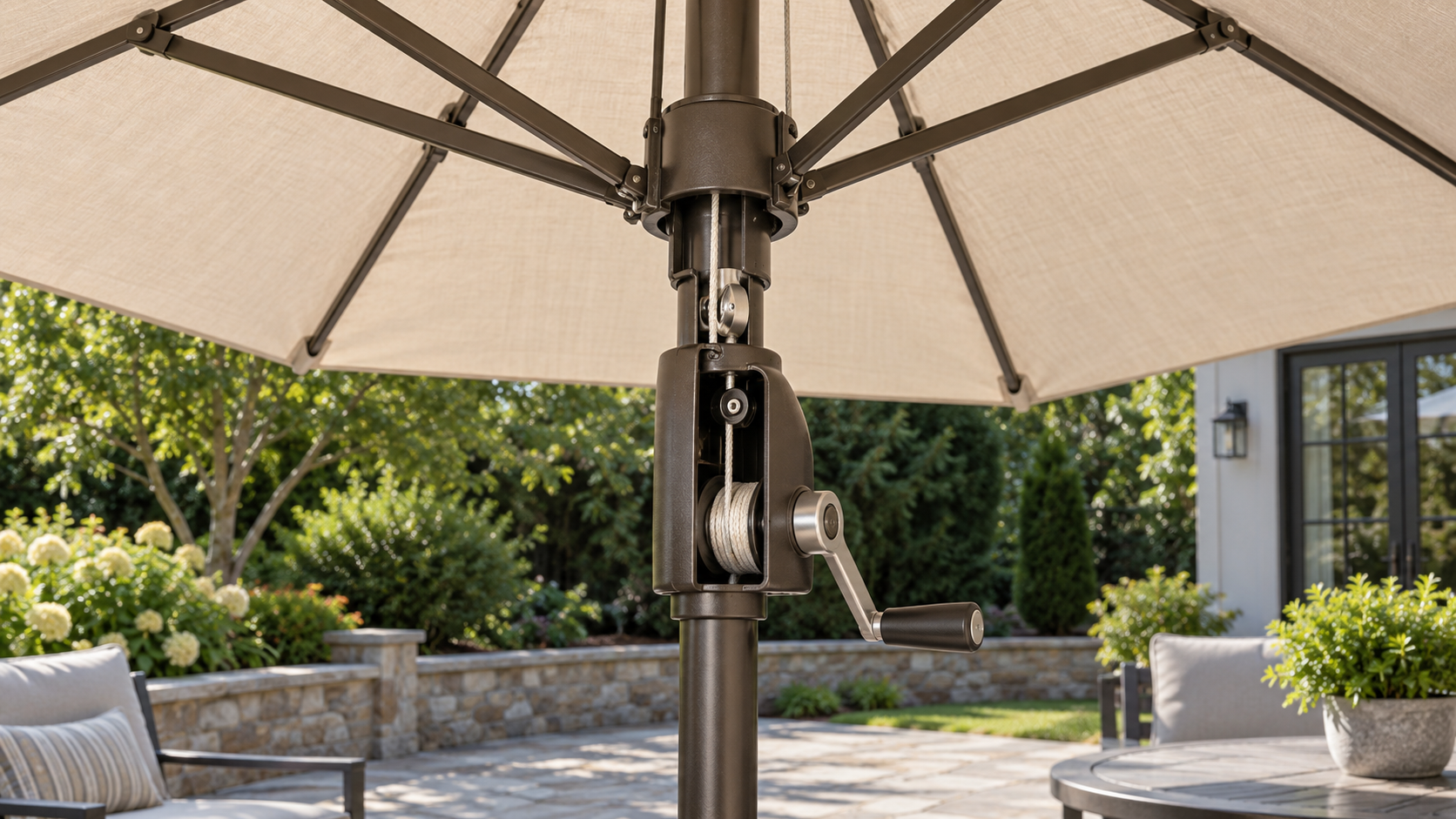
Crank Patio Umbrella Mechanism Explainer
A crank patio umbrella opens by converting handle rotation into tension on a cord. The crank turns a small spool or winch inside the pole, winding the cord around it. The cord passes over one or more pulleys and connects to a sliding hub called the runner. As the cord shortens, the runner rises along the center pole. Hinged stretchers between the runner and ribs then push the canopy framework outward and upward.
The ribs pivot near the top hub and support the fabric from the center toward the edge. Each stretcher forms a linked triangle with a rib and the runner. Raising the runner changes the angles of those links until the ribs approach their open position and the canopy becomes tensioned. The cord carries the lifting force during movement, while stops, detents, the winch, and the geometry help hold the umbrella after the handle is released.
A tilt mechanism adds a hinge to the upper pole or canopy support. In one design, continued crank motion after opening pulls a separate link through pulleys, compressing a spring and rotating the upper pole around the hinge. Other umbrellas use a push button, collar, or independent actuator. The mechanism must support the off-center canopy load while preventing the hinge from folding unexpectedly, so its lock and stated operating sequence are important.
The system trades force for distance. The crank handle provides leverage, and pulleys can change the direction or amount of cord force, making a large canopy manageable. Small crank movements may move the runner only a short distance. Friction in the pulleys and pole guides prevents perfect efficiency, while worn cord, a bent runner, corroded joints, or fabric caught between ribs can make the handle feel unusually heavy.
An umbrella is opened only in suitable weather and secured in the base specified by its maker. A wide canopy creates large wind loads, especially when tilted. The fabric is not forced open against resistance, and the crank is not continued past its stop. Fingers stay clear of runner, stretcher, and hinge pinch points. Frayed cord, loose hardware, cracked ribs, or a lock that will not hold requires service before the umbrella is used.
The opening sequence is a compact linkage system: the crank stores cord on a spool, the cord lifts the runner, and the runner drives multiple stretchers and ribs in unison. Tilting redirects additional movement through a controlled hinge. The canopy appears to unfold directly from the handle, but the real work is shared among leverage, cord tension, pulleys, sliding guides, and joint geometry. Reliable operation depends on those parts moving freely without carrying wind beyond their design.
The crank winds a cord that lifts a sliding runner; stretchers push the ribs open, and a separate or continued motion can operate a locked tilt hinge. Key terms include crank, spool, cord, pulley, runner, rib, stretcher, and tilt joint.
Each stretcher connects the common runner to one rib, so the runner’s upward movement changes all of their angles at nearly the same time.
The broad canopy creates large aerodynamic forces that can overload the ribs, tilt joint, pole, base, or mounting surface.
Explore more "Explainers"
Discover additional explainers across politics, science, business, technology, and other fields. Each explainer breaks down a complex idea into clear, everyday language—helping you better understand how major concepts, systems, and debates shape the world around us.