

Reusable Gel Ice Pack Explainer
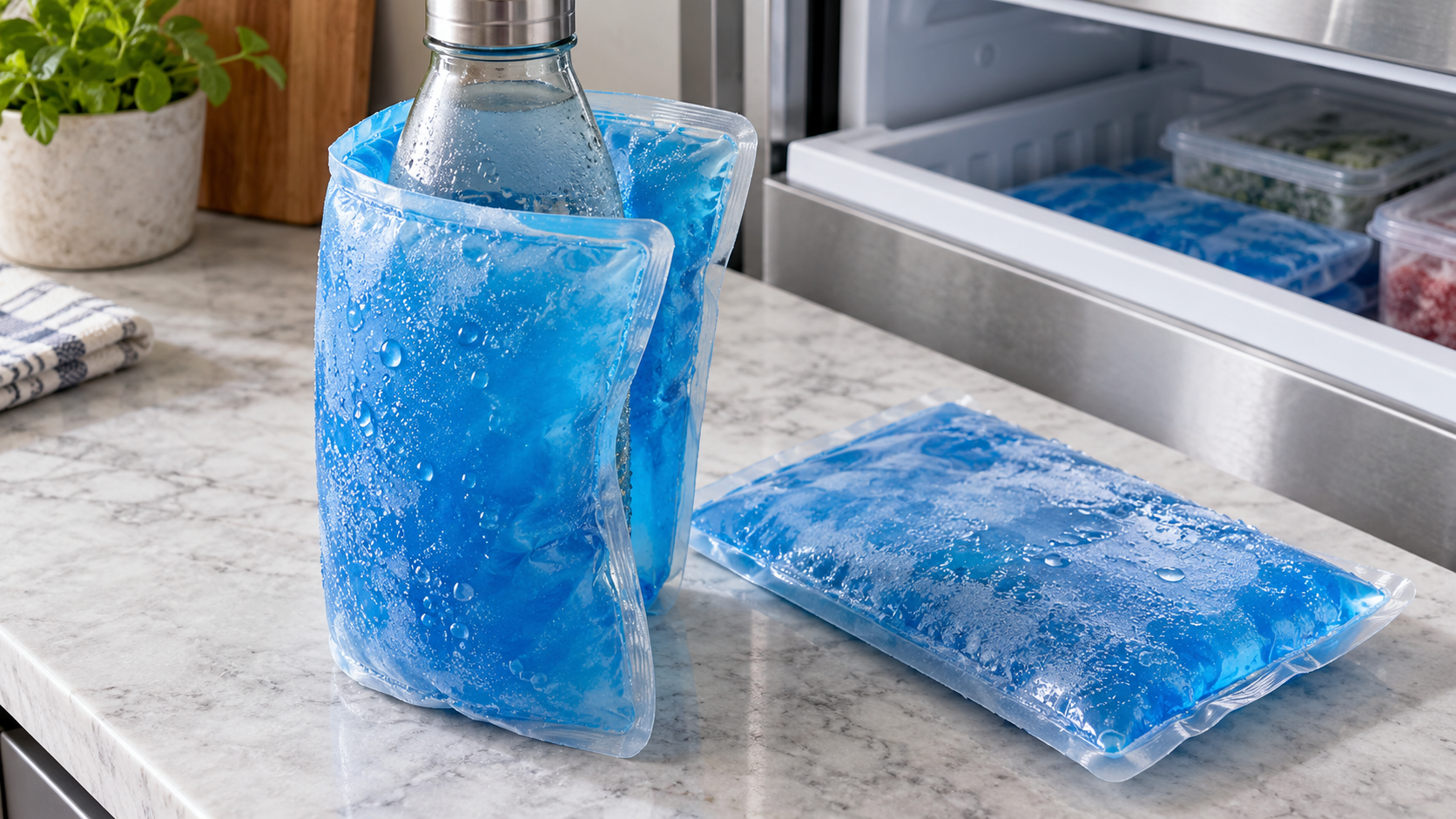
A reusable gel ice pack stores cooling capacity in a sealed mixture whose largest component is usually water. Instead of containing only pure water, the pack includes dissolved ingredients that change freezing behavior and a thickener that turns the liquid into a viscous gel. After time in a freezer, some water may form ice while the remaining concentrated liquid and polymer network stay softer, allowing the pouch to bend around an object.
Freezing releases latent heat, and melting requires that energy to be absorbed again. When a frozen pack is placed beside something warmer, heat flows into the pack. Ice within the mixture melts while holding the material near its phase-change range, so the pack can absorb substantial energy without immediately becoming warm. Once the ice fraction is gone, the entire gel continues warming according to its heat capacity, and cooling effectiveness gradually decreases.
Dissolved salts, glycols, or other formulation ingredients can depress the freezing point because they disrupt the orderly formation of ice crystals. The exact composition depends on the product and its intended temperature. Thickening agents such as cellulose derivatives or superabsorbent polymers hold water within a network, limit free sloshing, and help the mixture remain distributed across the pouch. Flexibility comes from partial freezing and gel structure, not from a permanent cold chemical reaction.
The outer film must remain flexible at low temperature while resisting puncture, seam failure, and water loss. Heat-sealed edges contain the gel, and a fabric sleeve may reduce direct cold contact and protect the pouch. The pack is pre-cooled again after use, so it is different from a single-use instant cold pack that starts an endothermic reaction when internal compartments are broken and mixed.
A gel pack is used according to its label and is not assumed safe to eat, drink, or apply directly to skin for unlimited time. A leaking, swollen, discolored, or damaged pouch is removed from service. For food transport, sealed packs help keep contents cold but do not replace temperature monitoring. For first aid, a cloth barrier and medically appropriate duration reduce the risk of cold injury, particularly where sensation or circulation is impaired.
The pack’s performance combines thermodynamics and texture control. Water and ice provide most of the thermal storage, dissolved material broadens or lowers the freezing range, and polymer thickener keeps the mixture cohesive. The flexible envelope lets the cold mass conform to a surface without releasing its contents. Reuse is possible because freezing and melting are physical changes: returning the intact pack to the freezer restores the ice fraction and prepares another cooling cycle.
Water supplies thermal mass, dissolved ingredients lower or broaden freezing, and polymer thickeners keep the partly frozen mixture flexible. Key terms include gel, freezing-point depression, thickener, phase change, latent heat, thermal mass, pouch, and seam.
Its dissolved ingredients and gel network keep part of the mixture from forming one continuous rigid ice block at normal freezer temperature.
No. A reusable pack is chilled in a freezer and cycles through freezing and melting; an instant pack uses a one-time chemical mixing process.
Explore more "Explainers"
Discover additional explainers across politics, science, business, technology, and other fields. Each explainer breaks down a complex idea into clear, everyday language—helping you better understand how major concepts, systems, and debates shape the world around us.