

Vacuum Storage Bag Explainer
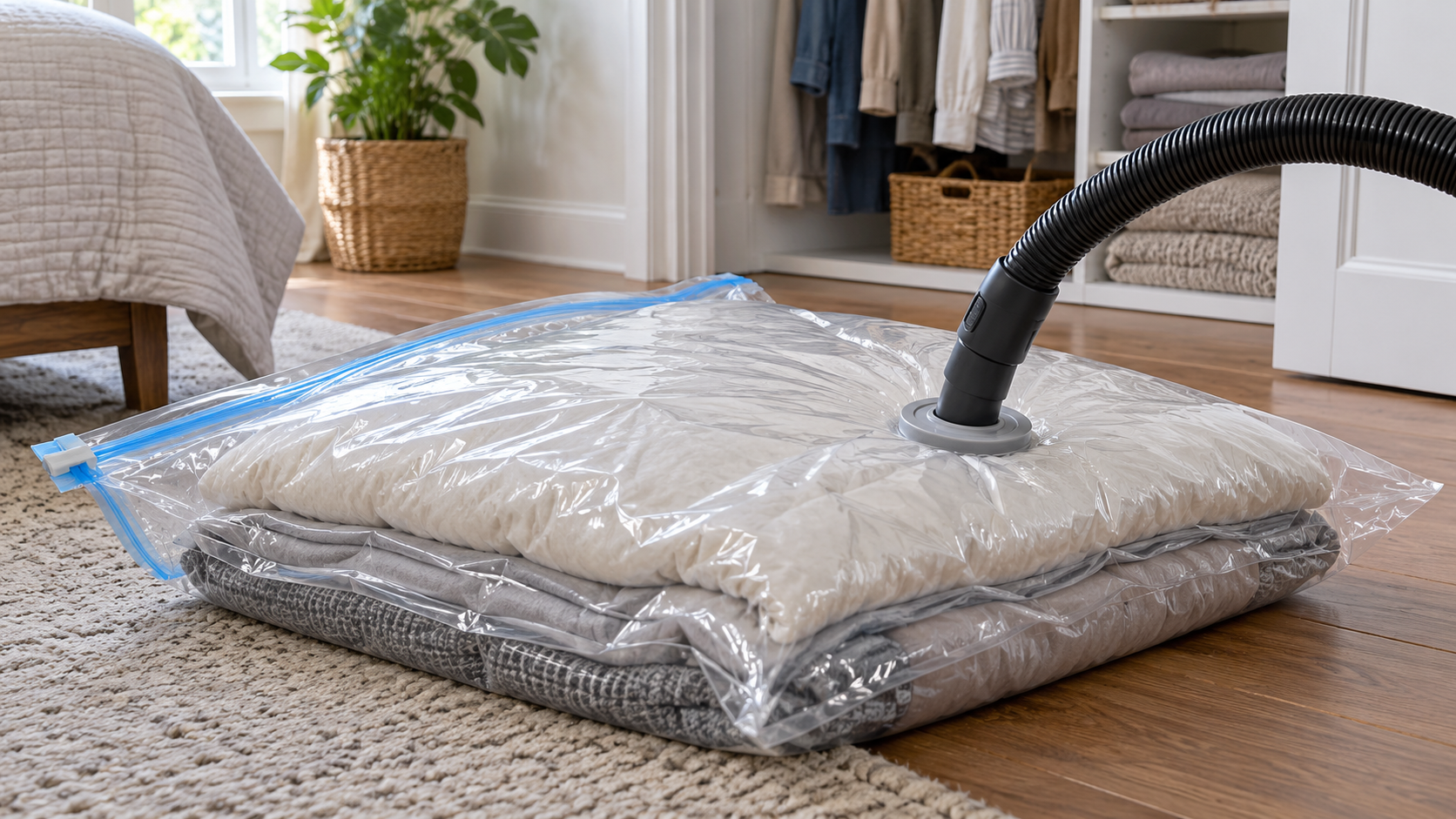
A vacuum storage bag becomes smaller because air is removed from the spaces among soft items and from the bag itself. Bedding is placed inside, and the wide opening is closed with an interlocking zipper seal. A vacuum cleaner or hand pump then draws air through a separate valve. As pressure inside falls below the surrounding atmospheric pressure, the outside air presses the flexible film inward and compresses the lofted contents.
The valve is one-way. During evacuation, the lower pressure at the vacuum nozzle lifts a flexible diaphragm or flapper from its seat, allowing internal air to leave. When suction stops, the higher outside pressure and the diaphragm’s own flexibility press it back against the seat. A cap may protect the assembly and provide a secondary seal. Internal ribs keep fabric from being sucked directly into the opening and blocking airflow.
The zipper must also be airtight across its full length. Its mating profiles snap together like those on a storage bag, but small wrinkles, fibers, or missed sections can admit air. The film seams around the bag perimeter and the joint around the valve are additional potential leak paths. Running the supplied closure tool or fingers along the track more than once helps seat it before the pump is attached.
Atmospheric pressure performs the visible compression; the vacuum source only removes enough internal air to create the pressure difference. The bag is not an empty perfect vacuum, and air remains inside porous fibers. Pillows and quilts shrink because their insulation contains large connected air spaces. Solid objects change little and may puncture the film. Sharp corners, zippers on clothing, and overfilling create stress points as the walls are drawn tightly inward.
A bag that slowly expands may have a contaminated zipper, loose cap, folded valve diaphragm, seam leak, or tiny puncture. The closure and valve seat are inspected and cleaned according to the maker. Vacuum bags are intended for dry, suitable textiles; damp items can develop odor or mildew, and long compression may affect loft. The bag is kept away from heat, children, pets, and rough surfaces that can damage the film.
The storage system coordinates three seals and one pressure difference. The zipper closes the loading opening, welded seams close the edges, and the check valve permits outward flow while blocking easy return. Removing air lowers internal pressure, then the atmosphere supplies a nearly uniform squeezing force over the broad bag surface. The reduced volume lasts only while every seal remains sound, making clean tracks and an intact valve more important than extended pumping.
A pump removes air through a one-way valve, and higher outside atmospheric pressure squeezes the sealed bag around soft contents. Key terms include vacuum, atmospheric pressure, zipper seal, diaphragm, valve seat, welded seam, porous textile, and pressure difference.
No. It removes air. The surrounding atmosphere then presses inward because the pressure outside the sealed bag is higher than inside.
Air can enter through an incompletely closed zipper, dirty valve seat, loose cap, damaged seam, or a tiny puncture in the film.
Explore more "Explainers"
Discover additional explainers across politics, science, business, technology, and other fields. Each explainer breaks down a complex idea into clear, everyday language—helping you better understand how major concepts, systems, and debates shape the world around us.