

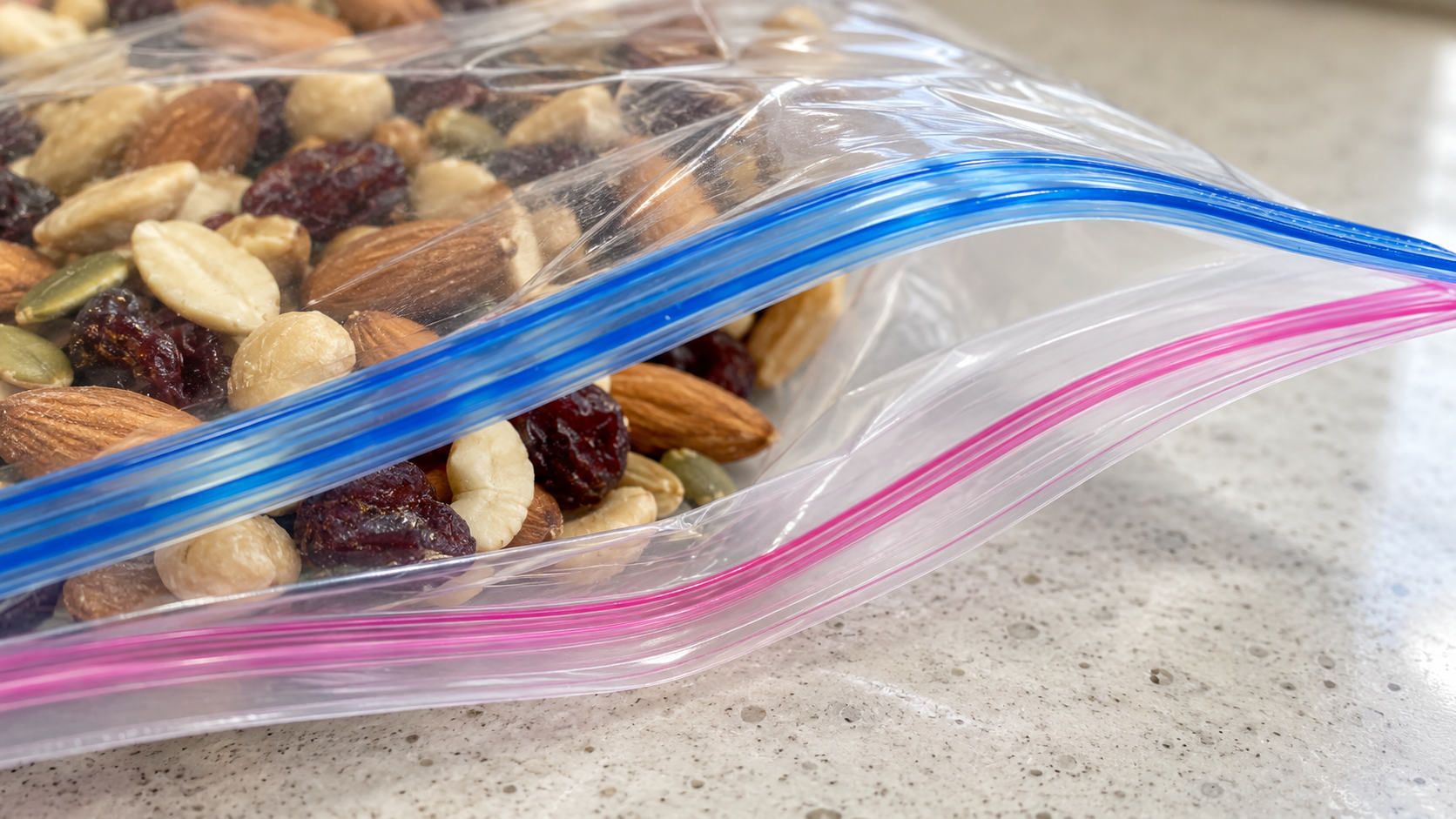
Zip-Top Bag Interlocking Seal Explainer
A zip-top storage bag uses two continuous plastic profiles formed along opposite sides of its opening. One profile contains a projecting rib or hook, and the other has a matching groove. Pressing them together forces the flexible shapes to deform slightly. When the projecting feature passes the narrow entrance of the groove, the plastic springs back and the profiles interlock. The closure can then resist modest internal pressure and pulling in ordinary use.
The profiles are extruded with or attached to the bag film, and broad flanges connect them to the side walls. Those flange seals must be continuous because a perfect interlock at the top cannot compensate for a gap where the closure joins the bag. Multiple ribs may provide tactile feedback and redundancy. The familiar change in feel or sound while pinching the seal helps the user detect whether the engagement has progressed across the full width.
A slider bag adds a small carriage that squeezes and guides the two profiles together as it travels. Its tapered internal channels bring the tracks into alignment and apply pressure at the correct angle. Moving the slider the other way may use a separating wedge to pull the profiles apart. Finger-closed bags do the same work directly, often by starting at one end and running thumb and forefinger along the entire closure.
The seal is mechanical, not a welded barrier. Crumbs, folded film, liquid, grease, or a stretched profile can keep the hooks from seating. Overfilling pulls the two sides apart and places peel force directly on the opening. Temperature also changes plastic stiffness, and freezing can make some films less flexible. Air may slowly move through the polymer or an imperfect closure, so a zip-top bag is not automatically vacuum-tight or suitable for every long-term storage need.
Before closing, the track is kept clean and the contents are moved below the seal. Pressing from one end toward the other can push excess air out before the last section engages. The user then checks the full width by sight and touch. Food safety still depends on correct temperature and storage time, and the bag’s material and label determine whether it is appropriate for freezer, microwave, hot liquid, or reusable applications.
The closure works because flexible geometry provides a repeatable snap fit. The rib must be narrow enough to enter under pressure, the groove must capture it after elastic recovery, and the flanges must transmit forces without tearing away from the film. Opening reverses the deformation by applying peel force at the lips. A useful seal therefore depends on profile shape, material resilience, alignment, cleanliness, and complete engagement along the entire mouth.
Matching plastic ribs and grooves flex under pressure, pass their narrowest point, and spring into an interlocked shape. Key terms include profile, rib, groove, elastic deformation, snap fit, flange, slider, and peel force.
A crumb, wrinkle, stretched track, or short unpressed section can leave a continuous path even when most of the profiles are engaged.
Its shaped channels align and squeeze the profiles together consistently as the carriage moves, reducing the need to pinch every point by hand.
Explore more "Explainers"
Discover additional explainers across politics, science, business, technology, and other fields. Each explainer breaks down a complex idea into clear, everyday language—helping you better understand how major concepts, systems, and debates shape the world around us.