

Porous Soaker Hose Explainer
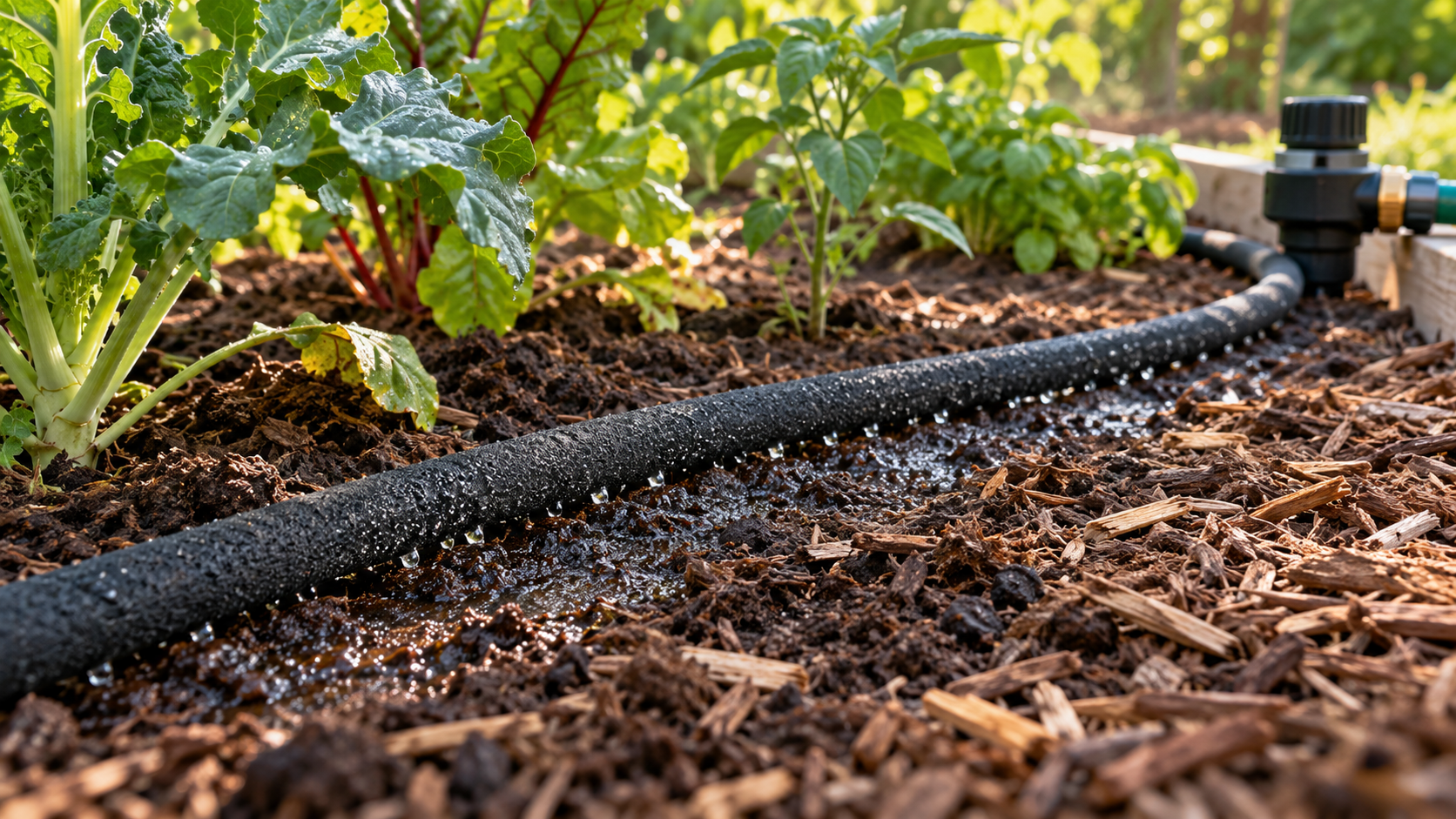
A soaker hose is made from porous rubber or plastic that contains many tiny connected passages. Water enters the hose at low pressure and fills its interior. The pressure difference across the wall pushes small amounts outward through the pores, so the surface appears to sweat or weep rather than spray. Laid beside plants, the hose wets a long narrow band of soil close to the root zone.
Flow is distributed through resistance. Every pore restricts water, and pressure gradually falls along the hose as some flow leaves through earlier sections. Very long runs, high elevation changes, kinks, or a weak supply can make the far end release less. A pressure regulator, flow restrictor, or partially opened valve may be specified to keep the hose within its designed range. Excess pressure can produce uneven jets or shorten service life.
Placement determines where the water goes. The hose is arranged across a level bed without sharp bends and kept near, but not tight against, plant stems. Mulch over the hose reduces evaporation and protects it from sunlight, while the connection and end cap remain accessible for inspection and flushing. On slopes, shorter level runs or separate zones prevent gravity and pressure differences from concentrating water at the lower end.
Soil must accept water as quickly as the hose supplies it. Sandy soil drains readily and may need closer spacing, while clay absorbs more slowly and spreads moisture sideways. If water puddles, the application rate or runtime exceeds local infiltration. Cycling the water on and off gives moisture time to soak downward. The goal is an appropriate root-zone depth, verified by checking the soil, not merely a dark surface strip.
Minerals and debris can block pores, so an inlet filter and periodic flushing help where recommended. Leaks near fittings, flattened sections, root intrusion, and rodent damage create uneven output. The hose is drained or stored for freezing weather as required. It is used for suitable irrigation water, and its material, pressure rating, and connection must match the system. A soaker hose is efficient only when leaks and excessive runtimes are avoided.
The hose turns one pressurized inlet into thousands of tiny outlets. Wall porosity meters local flow, internal pressure drives seepage, and soil distributes the released water around roots. Because pressure declines with length and terrain while soil intake varies by location, uniform watering depends on short sensible layouts, regulation, maintenance, and observation. Slow release reduces overspray and evaporation, but timing still has to match plant demand and actual soil moisture.
Low water pressure pushes moisture through many pores in the hose wall, wetting soil gradually along the run. Key terms include porous wall, pressure difference, flow resistance, regulator, infiltration, mulch, run length, and flushing.
Water leaving through earlier pores and friction along the tube reduce pressure, especially on a long, uphill, kinked, or undersupplied run.
Clay, compacted soil, or an excessive runtime may accept water more slowly than the hose releases it, requiring lower flow or shorter repeated cycles.
Explore more "Explainers"
Discover additional explainers across politics, science, business, technology, and other fields. Each explainer breaks down a complex idea into clear, everyday language—helping you better understand how major concepts, systems, and debates shape the world around us.