

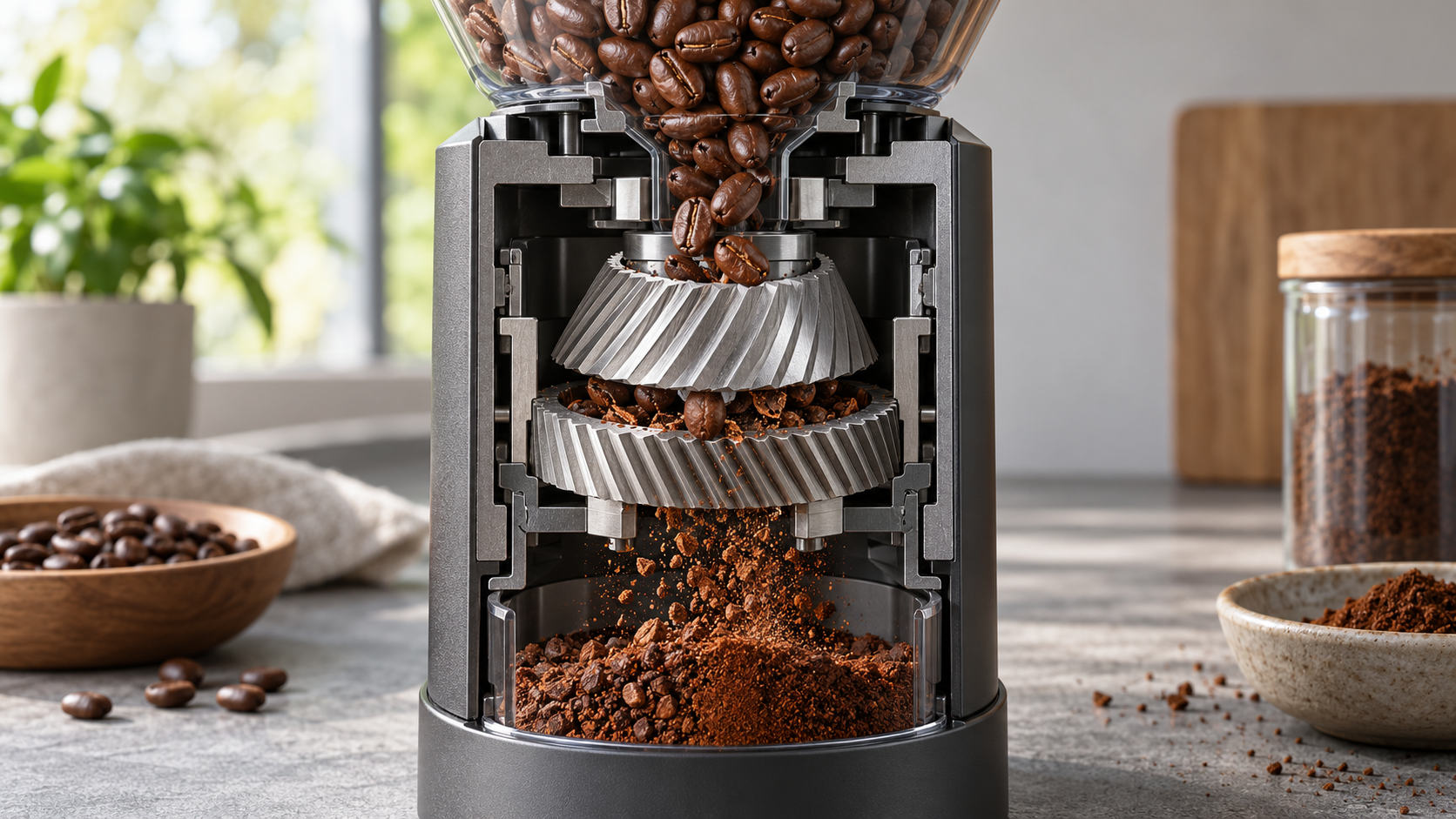
Burr Coffee Grinder Explainer
Two hard profiled grinding surfaces held at an adjustable gap is the core of this everyday mechanism. In normal use, beans fall between a rotating burr and a stationary or counter-rotating burr, where repeated compression and shear fracture them. The result comes from ordinary materials and geometry working together, not from a hidden consumable or a single isolated part. Understanding the starting condition makes the later motion or flow easier to see.
The operating sequence continues as particles leave the cutting zone after becoming small enough to pass through the selected gap, producing a narrower size range than random blade impacts. Each component has a distinct job: one admits, stores, guides, or resists energy, while another sets the useful output. If any link in that sequence cannot move, seal, align, or transfer force as intended, the device may still look normal while its performance drops.
Performance depends on burr geometry, alignment, rotational speed, feed rate, roast brittleness, heat, retention, static, and adjustment step size. These variables explain why two examples of the same product may behave differently, or why yesterday’s reliable result changes after wear, weather, loading, or installation. The mechanism works best inside a designed range, where forces remain balanced and the controlling surfaces can respond predictably.
Old grounds and oils can affect taste and movement, so the hopper and accessible parts are cleaned as directed with power disconnected. Water is kept away from mechanisms not designed for washing, and fingers never enter the burr path. Routine attention focuses on the actual flow path, contact faces, seals, pivots, or sensing area rather than cosmetic appearance alone. A symptom is useful evidence, but it does not automatically identify one failed part; careful inspection follows the product instructions and isolates energy or pressure first.
No grinder creates identical particles; fines and larger fragments still occur. The benefit is controlled geometry and repeatable gap, which makes brewing resistance and extraction more predictable from one dose to the next. Ratings and warnings matter because a mechanism that works under ordinary conditions can fail abruptly when overloaded, misapplied, damaged, or exposed to an incompatible material. Substituting extra force for diagnosis usually transfers the problem to a weaker component instead of fixing the cause.
In short, a burr coffee grinder make more even particles works as a coordinated chain of input, control, and output. Beans fall between a rotating burr and a stationary or counter-rotating burr, where repeated compression and shear fracture them, and particles leave the cutting zone after becoming small enough to pass through the selected gap, producing a narrower size range than random blade impacts. The practical lesson is to preserve the surfaces and moving parts that create that sequence, use the device within its specified range, and treat changes in feel, sound, leakage, alignment, or resistance as reasons to inspect it.
Beans fall between a rotating burr and a stationary or counter-rotating burr, where repeated compression and shear fracture them, then particles leave the cutting zone after becoming small enough to pass through the selected gap, producing a narrower size range than random blade impacts. Key factors include burr geometry, alignment, rotational speed, feed rate, roast brittleness, heat, retention, static, and adjustment step size.
A smaller exit gap keeps fragments in the cutting path longer, while a larger gap lets coarser pieces leave sooner.
Tilted or off-center burrs create an uneven gap, producing different particle sizes at different points around the circle.
Explore more "Explainers"
Discover additional explainers across politics, science, business, technology, and other fields. Each explainer breaks down a complex idea into clear, everyday language—helping you better understand how major concepts, systems, and debates shape the world around us.