

Milk Frother Air-Incorporation Explainer
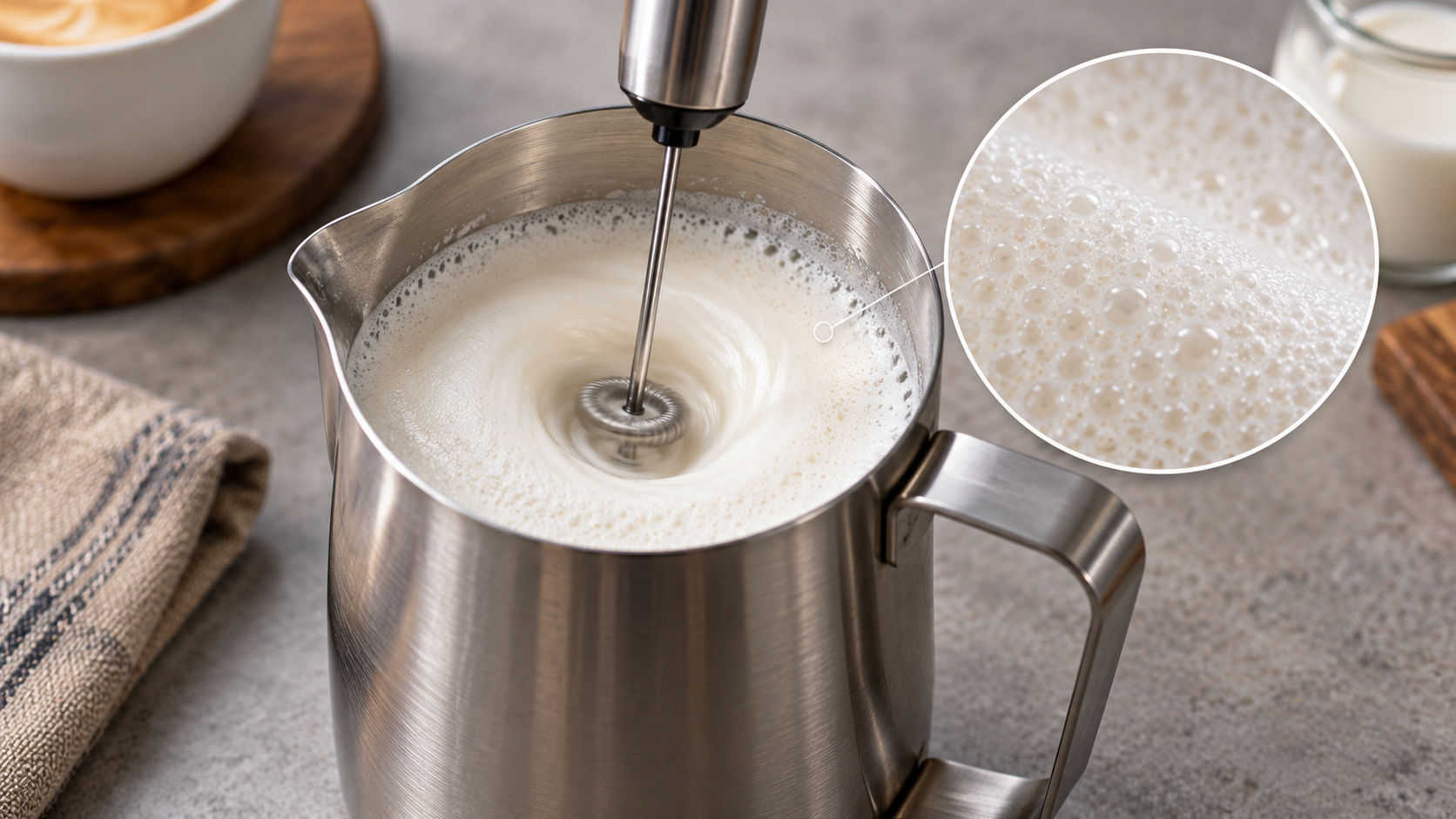
A rapidly moving whisk, impeller, steam jet, or screen that introduces air while circulating milk is the core of this everyday mechanism. In normal use, shear breaks incoming air into smaller bubbles and distributes them through the liquid instead of leaving one large pocket. The result comes from ordinary materials and geometry working together, not from a hidden consumable or a single isolated part. Understanding the starting condition makes the later motion or flow easier to see.
The operating sequence continues as milk proteins unfold at bubble surfaces and help stabilize the thin liquid films, while fat, temperature, and time influence texture and drainage. Each component has a distinct job: one admits, stores, guides, or resists energy, while another sets the useful output. If any link in that sequence cannot move, seal, align, or transfer force as intended, the device may still look normal while its performance drops.
Performance depends on protein content, fat, temperature, bubble size, whisk depth, vortex strength, heating rate, vessel volume, and resting time. These variables explain why two examples of the same product may behave differently, or why yesterday’s reliable result changes after wear, weather, loading, or installation. The mechanism works best inside a designed range, where forces remain balanced and the controlling surfaces can respond predictably.
Overheating can damage flavor and foam stability, while dried milk blocks small passages. Food-contact parts are cleaned promptly, steam wands are purged as directed, and electric bases or motors stay out of water. Routine attention focuses on the actual flow path, contact faces, seals, pivots, or sensing area rather than cosmetic appearance alone. A symptom is useful evidence, but it does not automatically identify one failed part; careful inspection follows the product instructions and isolates energy or pressure first.
Foam is a temporary structure of gas cells separated by liquid films. Good microfoam comes from adding the right amount of air early, then circulating it to refine bubbles rather than simply beating as much air as possible. Ratings and warnings matter because a mechanism that works under ordinary conditions can fail abruptly when overloaded, misapplied, damaged, or exposed to an incompatible material. Substituting extra force for diagnosis usually transfers the problem to a weaker component instead of fixing the cause.
In short, a milk frother turn liquid into foam works as a coordinated chain of input, control, and output. Shear breaks incoming air into smaller bubbles and distributes them through the liquid instead of leaving one large pocket, and milk proteins unfold at bubble surfaces and help stabilize the thin liquid films, while fat, temperature, and time influence texture and drainage. The practical lesson is to preserve the surfaces and moving parts that create that sequence, use the device within its specified range, and treat changes in feel, sound, leakage, alignment, or resistance as reasons to inspect it.
Shear breaks incoming air into smaller bubbles and distributes them through the liquid instead of leaving one large pocket, then milk proteins unfold at bubble surfaces and help stabilize the thin liquid films, while fat, temperature, and time influence texture and drainage. Key factors include protein content, fat, temperature, bubble size, whisk depth, vortex strength, heating rate, vessel volume, and resting time.
That position lets it draw controlled air into the moving milk; deeper circulation then breaks and distributes the bubbles.
Liquid drains from bubble films and gas diffuses or bubbles merge, eventually making the network too weak to support itself.
Explore more "Explainers"
Discover additional explainers across politics, science, business, technology, and other fields. Each explainer breaks down a complex idea into clear, everyday language—helping you better understand how major concepts, systems, and debates shape the world around us.