

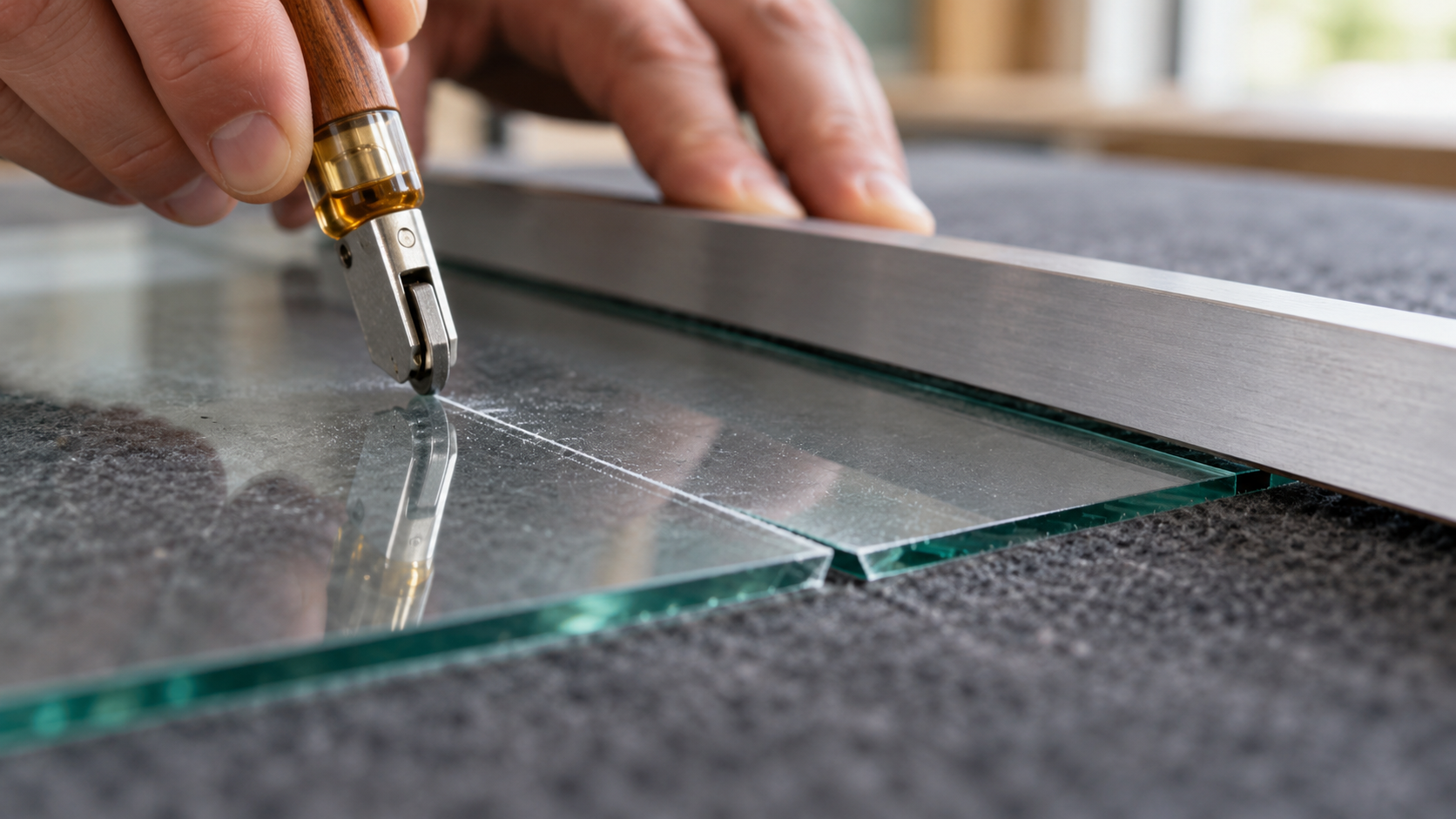
Carbide Wheel, Surface Fissure, and Controlled Snap
A handheld glass cutter does not slice through a pane; its hard wheel creates a narrow surface flaw that guides a later fracture. The wheel rolls once across clean glass under steady pressure, creating a continuous score and local stress; bending the pane with the score in tension concentrates stress at that flaw until a crack runs through the thickness. The result depends on the relationship among the working edge or gripping surfaces, the tool’s moving linkage, and the way the work is supported.
The wheel rolls once across clean glass under steady pressure, creating a continuous score and local stress; bending the pane with the score in tension concentrates stress at that flaw until a crack runs through the thickness. Parts that seem secondary still control the outcome. Guides keep motion on axis, springs or threads store and redirect force, and relief or open space lets chips, displaced material, or moving parts clear instead of jamming.
Real-world performance depends on wheel material and angle, glass type and thickness, score pressure, lubrication, surface cleanliness, one-pass continuity, edge distance, support, breaking method, temperature, existing damage, and protective equipment. These variables change leverage, contact pressure, accuracy, surface damage, tool life, and the amount of control the user feels during the operation.
Clean compatible glass is fully supported, a straight guide is positioned, one continuous score is made from edge to edge, and the break is opened promptly with controlled even force. A change in resistance, sound, alignment, or finish is a reason to stop and inspect the setup rather than adding force automatically.
Repeatedly retracing a score crushes the surface and makes the fracture less predictable; tempered glass and some coated or laminated products are not cut by this method. Eye protection, stable work support, and keeping hands outside the tool’s closing or cutting path remain basic safeguards. The product maker’s instructions should control compatible sizes, materials, adjustments, and permitted use.
In short, the tool works by converting a manageable hand motion into a concentrated and constrained action at the work. The wheel rolls once across clean glass under steady pressure, creating a continuous score and local stress; bending the pane with the score in tension concentrates stress at that flaw until a crack runs through the thickness. Consistent results come from correct sizing, full engagement, square alignment, gradual force, and stopping before a small mismatch becomes damage.
A handheld glass cutter does not slice through a pane; its hard wheel creates a narrow surface flaw that guides a later fracture. The wheel rolls once across clean glass under steady pressure, creating a continuous score and local stress; bending the pane with the score in tension concentrates stress at that flaw until a crack runs through the thickness.
A single clean fissure gives the crack one path, while a second pass can create competing chips and branching damage.
It lubricates the axle and wheel-to-glass contact, helps the wheel roll smoothly, and can improve the consistency of the score.
Explore more "Explainers"
Discover additional explainers across politics, science, business, technology, and other fields. Each explainer breaks down a complex idea into clear, everyday language—helping you better understand how major concepts, systems, and debates shape the world around us.