

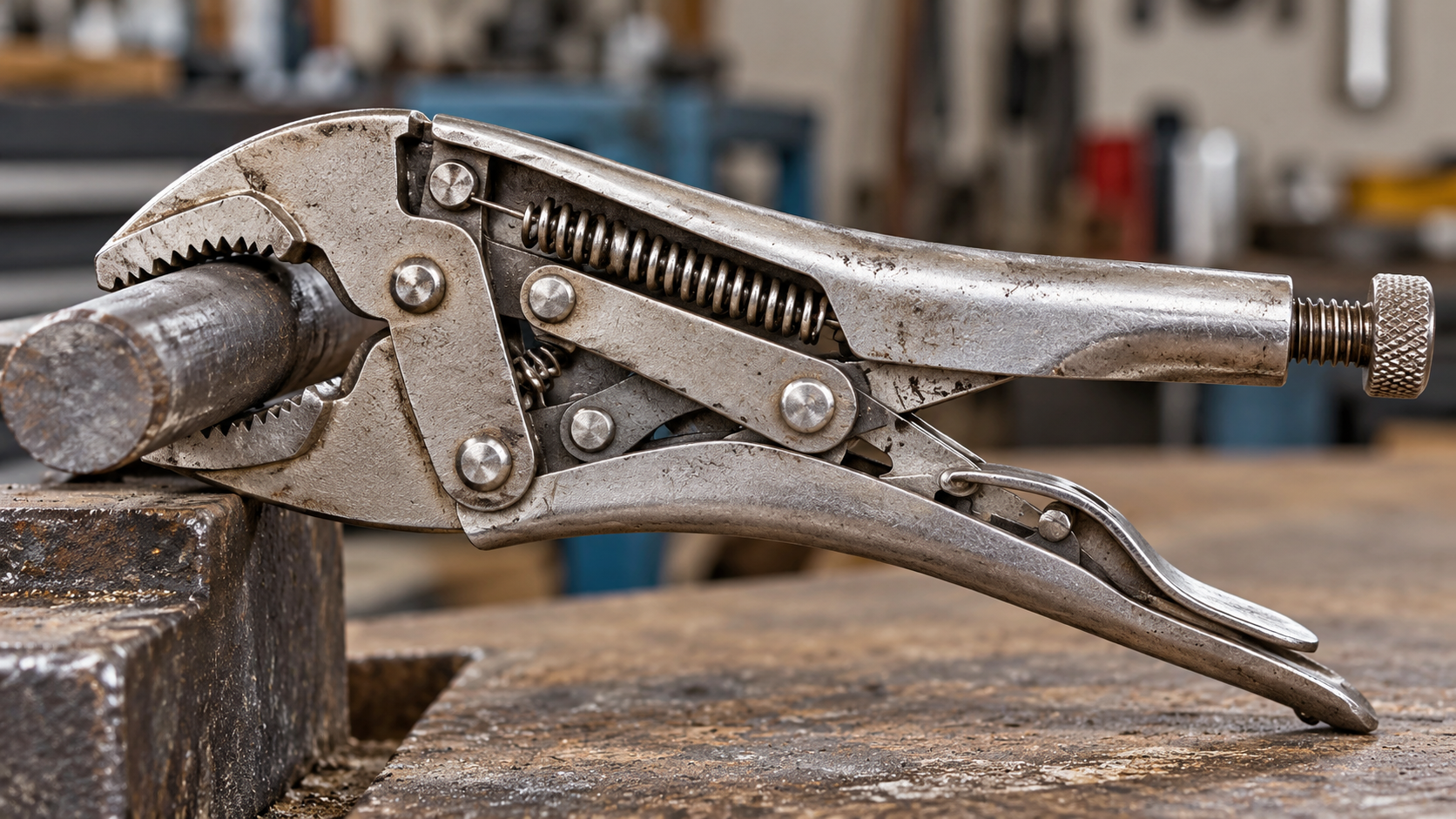
Toggle Linkage, Adjusting Screw, and Release Lever
Locking pliers combine adjustable jaws with an over-center toggle linkage that multiplies hand force and remains stable after the handles pass their locking point. The rear screw sets the jaw spacing and linkage geometry; squeezing the handles straightens the toggle, drives the movable jaw inward, and carries the pivot just beyond center so clamp reaction holds the mechanism closed. The result depends on the relationship among the working edge or gripping surfaces, the tool’s moving linkage, and the way the work is supported.
The rear screw sets the jaw spacing and linkage geometry; squeezing the handles straightens the toggle, drives the movable jaw inward, and carries the pivot just beyond center so clamp reaction holds the mechanism closed. Parts that seem secondary still control the outcome. Guides keep motion on axis, springs or threads store and redirect force, and relief or open space lets chips, displaced material, or moving parts clear instead of jamming.
Real-world performance depends on jaw shape, screw setting, object thickness, linkage wear, pivot position, handle force, release-lever design, surface hardness, round or flat geometry, required grip, heat exposure, and tool size. These variables change leverage, contact pressure, accuracy, surface damage, tool life, and the amount of control the user feels during the operation.
The screw is adjusted until firm closure requires controlled hand pressure, the jaws are seated fully on the work, and the release lever is used to disengage the toggle. A change in resistance, sound, alignment, or finish is a reason to stop and inspect the setup rather than adding force automatically.
Excessive screw tension can crush work, damage teeth or pivots, and create a violent release; locking pliers are not a substitute for every wrench or permanent clamp. Eye protection, stable work support, and keeping hands outside the tool’s closing or cutting path remain basic safeguards. The product maker’s instructions should control compatible sizes, materials, adjustments, and permitted use.
In short, the tool works by converting a manageable hand motion into a concentrated and constrained action at the work. The rear screw sets the jaw spacing and linkage geometry; squeezing the handles straightens the toggle, drives the movable jaw inward, and carries the pivot just beyond center so clamp reaction holds the mechanism closed. Consistent results come from correct sizing, full engagement, square alignment, gradual force, and stopping before a small mismatch becomes damage.
Locking pliers combine adjustable jaws with an over-center toggle linkage that multiplies hand force and remains stable after the handles pass their locking point. The rear screw sets the jaw spacing and linkage geometry; squeezing the handles straightens the toggle, drives the movable jaw inward, and carries the pivot just beyond center so clamp reaction holds the mechanism closed.
The main pivot moves slightly past a straight-line position, so the clamping force tends to keep the linkage locked instead of opening it.
It shifts the linkage’s starting point, setting both the jaw gap and the force reached at lockup.
Explore more "Explainers"
Discover additional explainers across politics, science, business, technology, and other fields. Each explainer breaks down a complex idea into clear, everyday language—helping you better understand how major concepts, systems, and debates shape the world around us.