

News Deserts Explainer
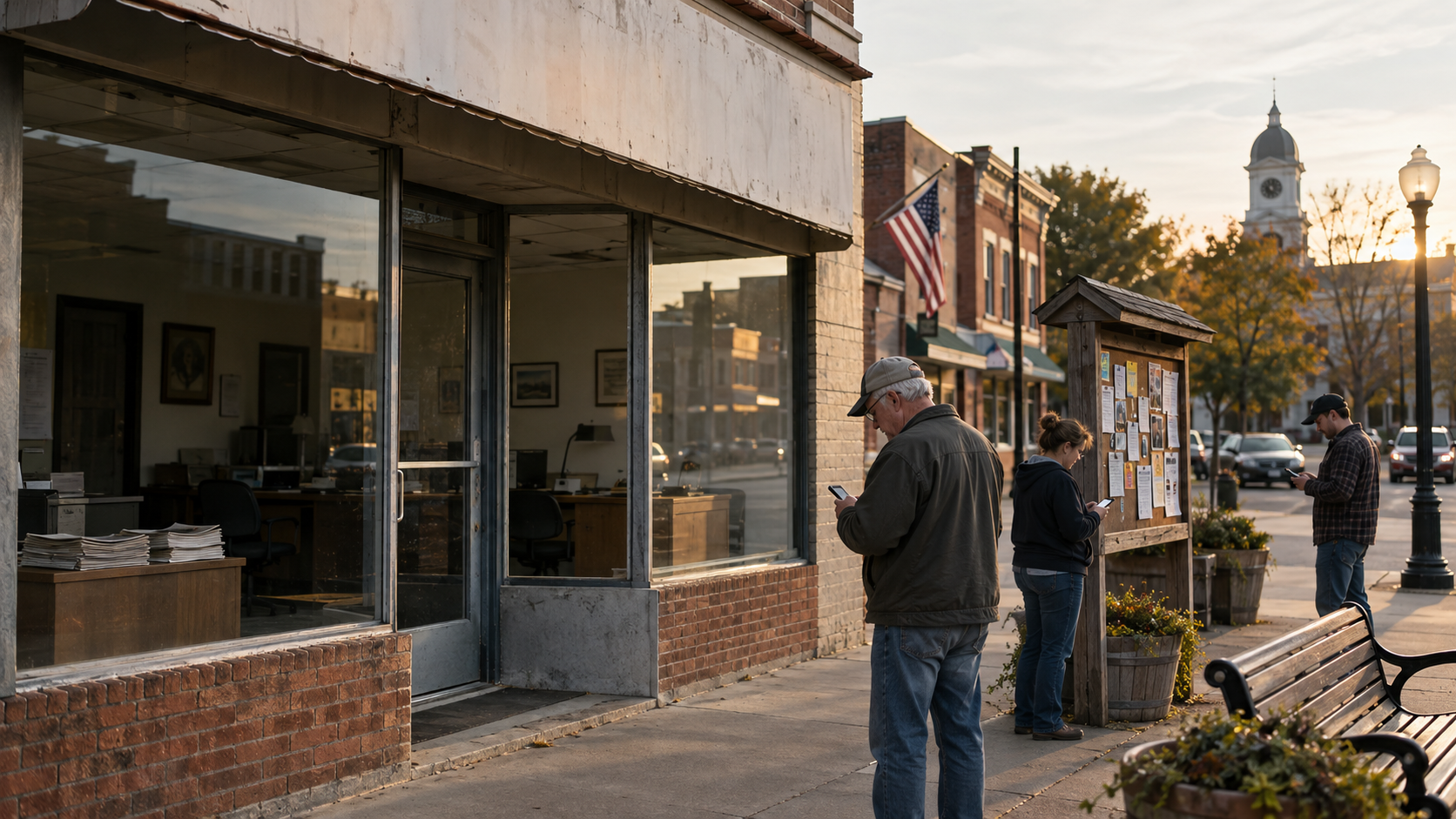
A news desert is a community with extremely limited or no consistent local reporting. The term usually describes places where residents cannot easily find original coverage of city government, schools, courts, public safety, businesses, health, and community life. A county may have no local news outlet at all, or it may have one publication with too few reporters to cover a large area. National news and social media do not fill the same role because they rarely attend local meetings, examine neighborhood records, or maintain relationships with the people responsible for public decisions.
News deserts often emerge gradually. Advertising that once supported newspapers moved to digital platforms, circulation declined, ownership consolidated, and newsroom jobs disappeared. Some papers closed; others reduced publication schedules or became “ghost newspapers” that retained a familiar name but produced little original local work. Radio and television stations can provide important coverage, but their service areas may be broad and their reporting resources limited. Rural areas face long travel distances, while lower-income urban neighborhoods may be overlooked even when outlets operate nearby.
The loss changes more than the media market. Without regular scrutiny, residents may learn about taxes, zoning, school policies, environmental hazards, or public contracts only after decisions are made. Researchers have examined links between declining local news and weaker civic participation, more misinformation, lower electoral competition, and higher costs for some local governments. Those effects are difficult to isolate perfectly, but the basic accountability gap is clear: public officials and powerful institutions receive less independent observation when fewer reporters are present.
Communities respond with nonprofit newsrooms, public media partnerships, university projects, newsletters, ethnic and community media, philanthropic support, and collaborations that share reporting. No single model works everywhere. Sustainable local news needs trusted relationships, useful distribution, editorial independence, and enough revenue to keep reporters in the field. A new outlet can reduce an information gap, but rebuilding coverage takes time; the measure is not simply whether a publication exists, but whether residents receive reliable, relevant, and continuous reporting.
Readers can evaluate local-news recovery by looking beyond the number of outlets. Useful measures include how often reporters attend public meetings, whether coverage reaches underserved neighborhoods, how corrections are handled, and whether residents can access stories without technical or financial barriers. Collaboration may stretch scarce resources, but communities still need journalists with time to develop sources and follow decisions over months. A place leaves the news-desert condition only when dependable reporting becomes part of civic life again, not merely when a website or newsletter appears.
Researchers count outlets, but they also examine staffing, publication frequency, geographic reach, and whether an organization produces original reporting. A county with one paper may still have a serious shortage if that newsroom cannot cover its population and institutions.
Boundaries are imperfect. Residents cross county and city lines, broadcast signals overlap, and digital outlets may serve communities without a printed product. Good assessments explain their definitions and update them as outlets open, close, or change capacity.
Community groups can distribute alerts and eyewitness accounts quickly, but most do not routinely verify records, attend meetings, request documents, or correct a continuing public record. Platform algorithms also decide which posts people see.
Social media can support local journalism by surfacing tips and reaching audiences. It becomes more useful when reporters add verification, context, attribution, and follow-up instead of treating popularity as evidence.
Possible models include subscriptions, memberships, sponsorships with clear safeguards, nonprofit grants, public media, events, and partnerships among outlets. Diversified revenue can reduce dependence on any one funder.
Trust grows when coverage answers local needs, reflects the community, and shows how reporting was done. Long-term success also requires business and technology capacity, not only strong stories, so that the newsroom can keep serving readers.
Explore more "Explainers"
Discover additional explainers across politics, science, business, technology, and other fields. Each explainer breaks down a complex idea into clear, everyday language—helping you better understand how major concepts, systems, and debates shape the world around us.