

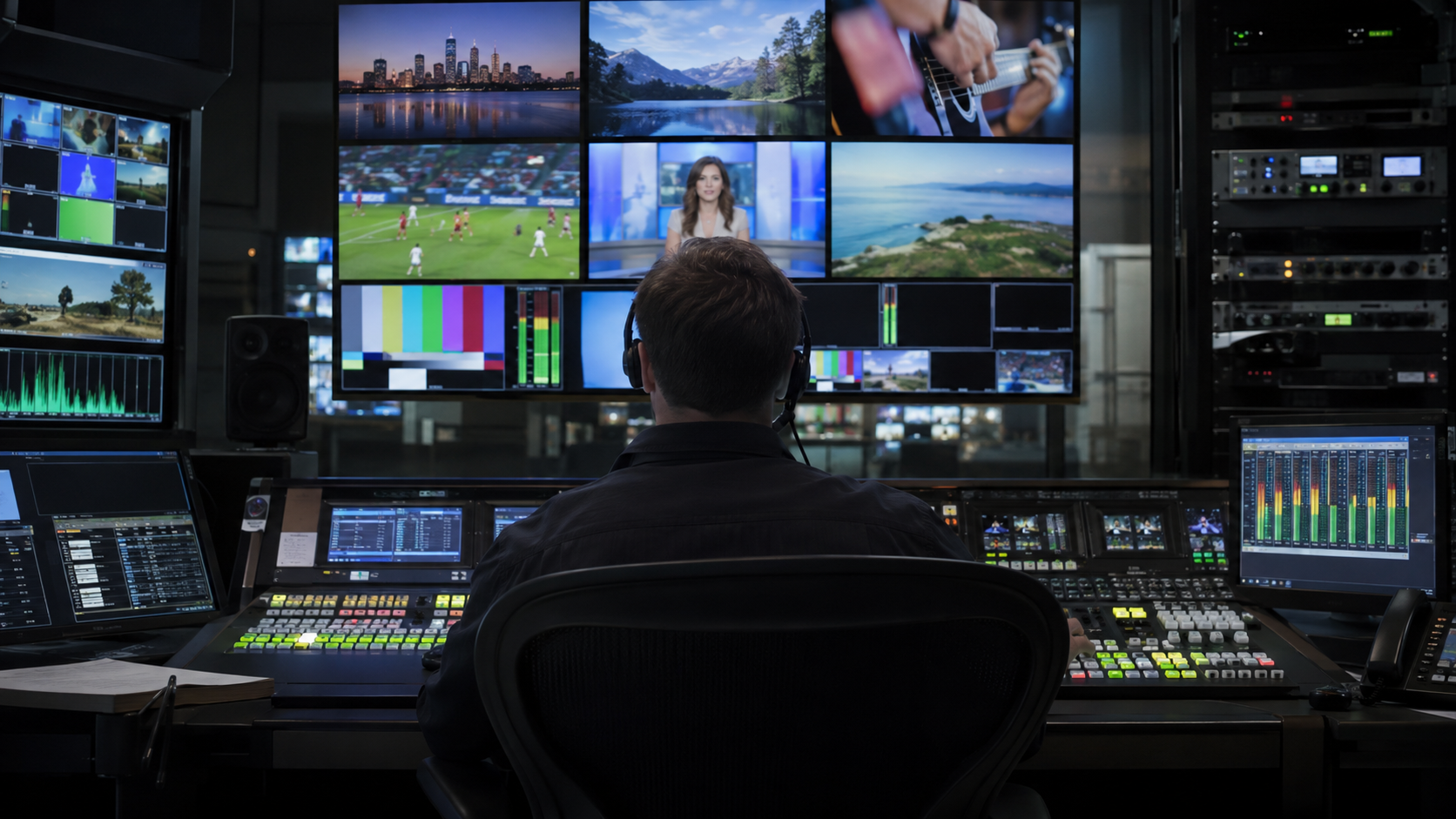
Television Master Control Explainer
Master control is the part of a television facility that manages the final program signal before it reaches viewers. It receives programs, live feeds, promotions, commercials, captions, and emergency information, then routes them into the scheduled channel output. A production control room builds an individual show; master control oversees the continuous stream of programming that leaves the station.
Many routine transitions are automated from a playlist, but operators monitor the system and verify that the correct material starts at the correct time. They watch video, listen to audio, check captions, review signal meters, and confirm that local content joins networks cleanly. They also prepare files in advance, inspect durations, and correct missing or mislabeled media before it can create an on-air gap.
The room connects to servers, routers, receivers, encoders, transmitters, and monitoring systems. Depending on the station, one facility may supervise several channels or locations. Redundant equipment and alternate paths are important because power loss, network failure, damaged files, or a missing feed can interrupt service. Operators rehearse how to switch to backups and document every unusual event.
Master control also has public-safety responsibilities. Emergency alerts must be received, tested, and inserted according to applicable rules and station procedures. Operators protect the integrity of the signal, but they do not invent editorial information when a feed fails. They contact the newsroom or engineering staff, use approved backup material, and keep accurate logs so technical and programming decisions can be reviewed.
Viewers rarely notice master control when it works well. Programs begin and end cleanly, sound levels remain usable, captions follow the correct content, and urgent warnings interrupt when required. Behind that continuity is constant monitoring and preparation. Master control is therefore both a technical gateway and a final quality checkpoint between everything a broadcaster assembles and the signal the public actually receives.
Production control builds a specific show; master control manages the station’s continuing channel output and transmission path.
Automation handles many scheduled events, but operators still monitor quality, failures, alerts, and unexpected changes.
Operators switch to an approved backup, notify engineering or the newsroom, and document the interruption.
Explore more "Explainers"
Discover additional explainers across politics, science, business, technology, and other fields. Each explainer breaks down a complex idea into clear, everyday language—helping you better understand how major concepts, systems, and debates shape the world around us.