

Cosplay Explainer
Cosplay is costume play: a fan dresses as a character and may recreate the character's pose, manner, or setting. The term was coined in Japan in the 1980s, while costuming at science-fiction gatherings has a longer history. Cosplay now includes characters from comics, games, animation, film, television, literature, and original designs. Participants may sew and fabricate everything, modify purchased pieces, commission specialists, or buy a complete costume. Making the outfit personally is not a universal requirement for participating.
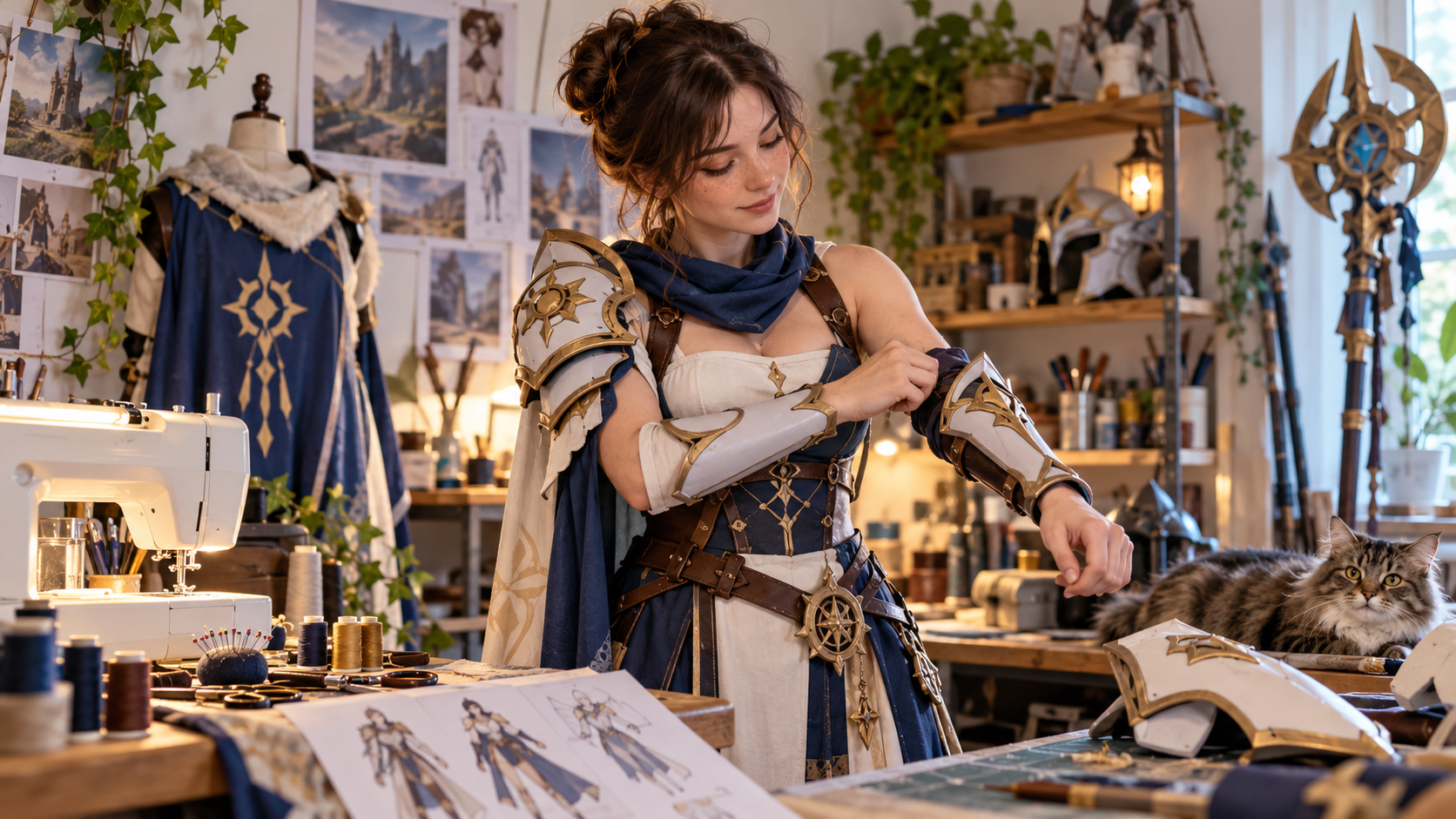
The craft combines research, patterning, sewing, armor fabrication, wig styling, makeup, prop building, electronics, and performance. A cosplayer decides which features make a character recognizable, then adapts a two-dimensional or fantastical design to a moving human body. Materials must balance appearance with weight, heat, visibility, mobility, transport, and venue rules. Iteration is normal: fittings reveal where armor collides, paint rubs, closures fail, or proportions that looked right in a sketch feel different in person.
Performance ranges from a pose for a photograph to an elaborate stage skit. Contests may judge craftsmanship, presentation, or both, often asking entrants to document their process. Photographers, assistants, makeup artists, and location organizers can become creative collaborators. Online platforms let cosplayers share tutorials and character interpretations, maintain community between events, and sometimes build professional work through commissions, appearances, sponsorships, or instructional content.
Cosplay also offers a structured way to explore identity and embodiment. The Smithsonian Center for Folklife and Cultural Heritage has described how participants use the community for expression, confidence, gender exploration, and belonging. That freedom does not remove social problems. Harassment, exclusion, body policing, racism, and transphobia can follow participants into fan spaces. The principle commonly expressed as cosplay is not consent emphasizes that a costume never grants permission for touching, sexual comments, or photography without agreement. Intellectual-property questions vary by country, item, and use. A private handmade costume, a commercial replica business, a paid character appearance, and sponsored online content raise different considerations. Conventions also impose safety rules for props, coverage, and conduct. Responsible participation begins with practical respect: ask before photographing, credit collaborators, follow venue policies, avoid blocking access, and accept that no one owes exact resemblance to a fictional design. Cosplay succeeds as a living fan practice because interpretation, not perfect duplication, is at its center. A practical way to read or discuss Cosplay is to separate the basic definition from the choices made in a particular example. Cosplay includes handmade, purchased, commissioned, altered, and mixed costumes; participation is not limited to professional-level fabrication. Then identify who sets the relevant rules, which parts are creative decisions, and which parts follow from law, contracts, technology, or production limits. Examples that look similar on the surface can operate differently because their purpose, audience, timing, and surrounding agreements are different. Online tutorials and event communities transmit specialized skills, and some participants turn those skills into commissions or other professional work. It is also useful to check whether a source is describing a formal industry category, an informal critical label, or one organization's current practice. Those distinctions prevent a memorable anecdote from becoming a false universal rule. The date and market matter too: tools, distribution systems, and standard agreements change, while older examples can preserve assumptions that no longer apply everywhere. When a claim sounds absolute, compare it with a second type of source and look for the conditions under which it is actually true. Finally, compare the visible result with the less visible work that produced it. Cross-gender, adapted, accessible, and body-diverse interpretations are part of cosplay's creative practice, not failures to reproduce an image exactly. That approach keeps the explanation grounded while leaving room for reasonable disagreement about borderline cases.
Cosplay includes handmade, purchased, commissioned, altered, and mixed costumes; participation is not limited to professional-level fabrication.
Translating a design into wearable form requires decisions about scale, support, heat, movement, visibility, durability, travel, and venue safety.
Posing and characterization can be as important as construction, while contests may separate craftsmanship judging from stage presentation.
Online tutorials and event communities transmit specialized skills, and some participants turn those skills into commissions or other professional work.
Consent remains specific: always ask before photographing or touching a cosplayer, regardless of the character, costume, or pose.
Cross-gender, adapted, accessible, and body-diverse interpretations are part of cosplay's creative practice, not failures to reproduce an image exactly.
Explore more "Explainers"
Discover additional explainers across politics, science, business, technology, and other fields. Each explainer breaks down a complex idea into clear, everyday language—helping you better understand how major concepts, systems, and debates shape the world around us.