

Session Musicians Explainer
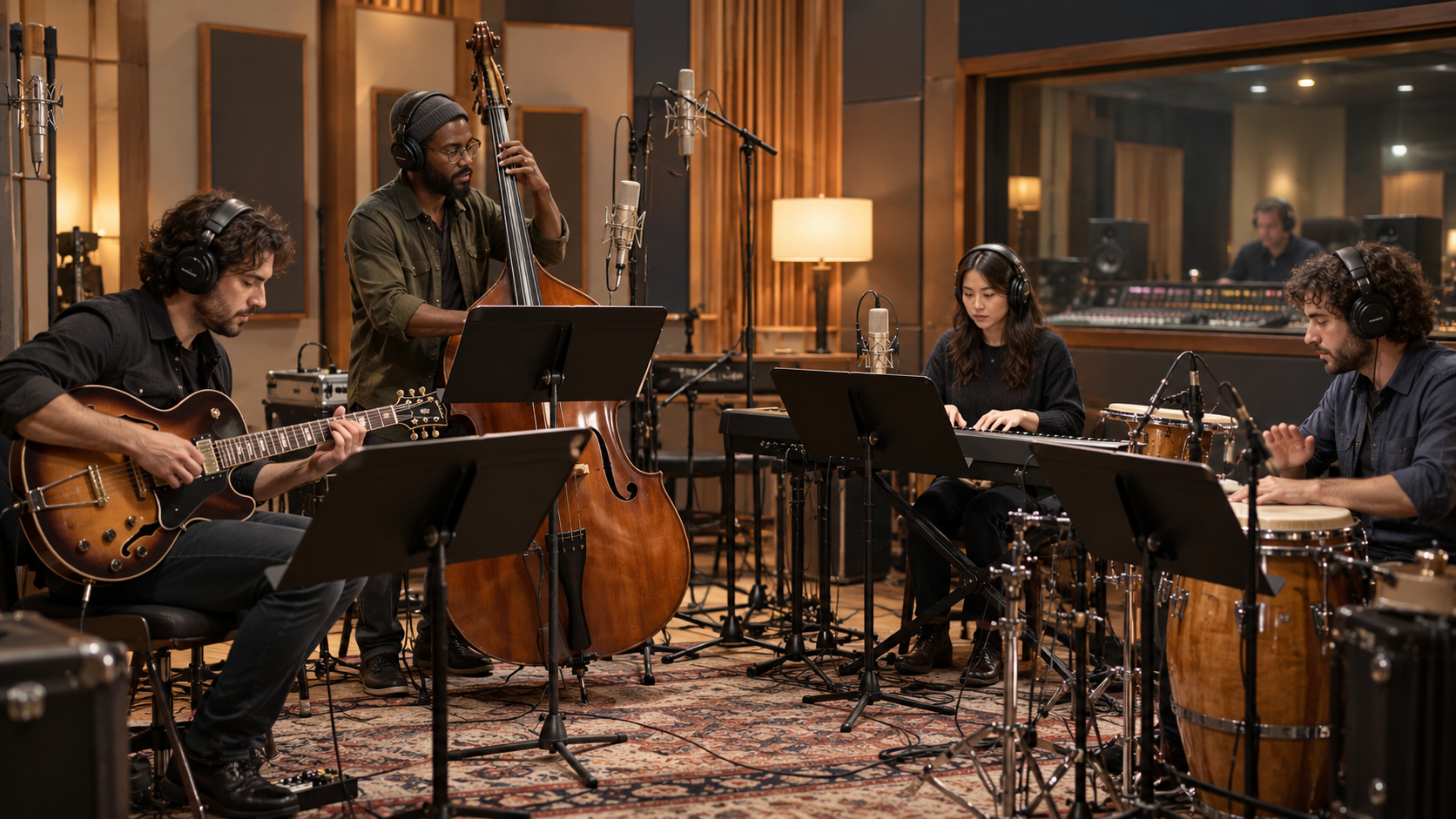
A session musician is a performer hired to record or perform music for a specific production, such as a song, album, film score, television program, advertisement, or game. The musician may support a featured artist without becoming a permanent member of that act. Some sessions use detailed notation; others rely on chord charts, demonstrations, improvisation, or rapid arrangement decisions. The common requirement is dependable performance under limited studio time.
Preparation depends on the project. A player may receive a score in advance, encounter music at the session, or be expected to create an idiomatic part from a rough demo. Sight-reading, stylistic vocabulary, tuning, rhythm, tone control, and communication all matter. Musicians also bring maintained instruments, appropriate accessories, and backup solutions. The goal is not always to display virtuosity. A simple, repeatable part that supports the song can be more valuable than a complex one.
During recording, the producer, artist, conductor, arranger, or musical director may request alternate takes, sounds, articulations, or shorter versions. Isolation booths and headphones help control bleed, while ensemble recording can preserve interaction. Punch-ins repair passages; comping can assemble a performance from several takes. Session players need consistency because changes in tuning, dynamics, or microphone position can make edits obvious. They also listen for how their part occupies space with every other part.
Professional agreements define session length, minimum rates, breaks, doubling, overtime, benefits, reuse, and reporting. The American Federation of Musicians, for example, distinguishes types of recording sessions and uses forms that document players and work. Exact terms depend on union coverage, territory, medium, budget, and contract. A recording later used in a new context may trigger additional obligations, so accurate records matter long after the microphones are packed away. Session work is often invisible to listeners because marketing centers the featured artist. Credits can be limited by format or contract even when a player made an important contribution. That does not make every improvised part a separate composition; performance, arrangement, authorship, and ownership are distinct questions. A useful appreciation focuses on precision, responsiveness, stylistic fluency, and the ability to improve a recording without drawing attention away from its purpose. A practical way to read or discuss Session Musicians is to begin with the basic definition and then identify the choices made in a particular example. Session musicians are hired for defined recording or performance projects and need not become members of the featured act. Next, ask who sets the relevant rules, who performs the work, and which results follow from creative judgment, law, contracts, technology, budget, or production limits. Similar-looking examples can operate differently because their audience, market, format, timing, and agreements are different. Studio workflows can include ensemble takes, isolation, punch-ins, comping, and requests for alternate articulations or shortened versions. It also helps to distinguish a formal industry category from an informal critical label or one organization's current practice. That separation keeps a memorable anecdote from becoming a false universal rule. Dates and territories matter: tools, distribution systems, audience behavior, and standard agreements change, while older examples can preserve assumptions that no longer apply everywhere. When a claim sounds absolute, compare it with a second kind of source and look for the conditions under which the claim is true. Then trace the process from the visible result back through the less visible decisions, handoffs, and quality checks that produced it. Performance, arrangement, songwriting, credit, and ownership overlap in practice but are not automatically the same legal or creative contribution. Finally, compare the example with a contrasting case and note which part of the definition still holds. This method keeps the explanation grounded, highlights the people and systems behind the outcome, and leaves room for reasonable disagreement about hybrid or borderline cases.
Session musicians are hired for defined recording or performance projects and need not become members of the featured act.
They may sight-read notation, interpret chord charts, reproduce a demo, improvise, or help refine parts under a producer's direction.
Reliable timing, tuning, sound, repeatability, equipment preparation, and communication are often more important than conspicuous virtuosity.
Studio workflows can include ensemble takes, isolation, punch-ins, comping, and requests for alternate articulations or shortened versions.
Rates, session length, doubling, overtime, benefits, reuse, and documentation depend on the applicable agreement and production context.
Performance, arrangement, songwriting, credit, and ownership overlap in practice but are not automatically the same legal or creative contribution.
Explore more "Explainers"
Discover additional explainers across politics, science, business, technology, and other fields. Each explainer breaks down a complex idea into clear, everyday language—helping you better understand how major concepts, systems, and debates shape the world around us.