

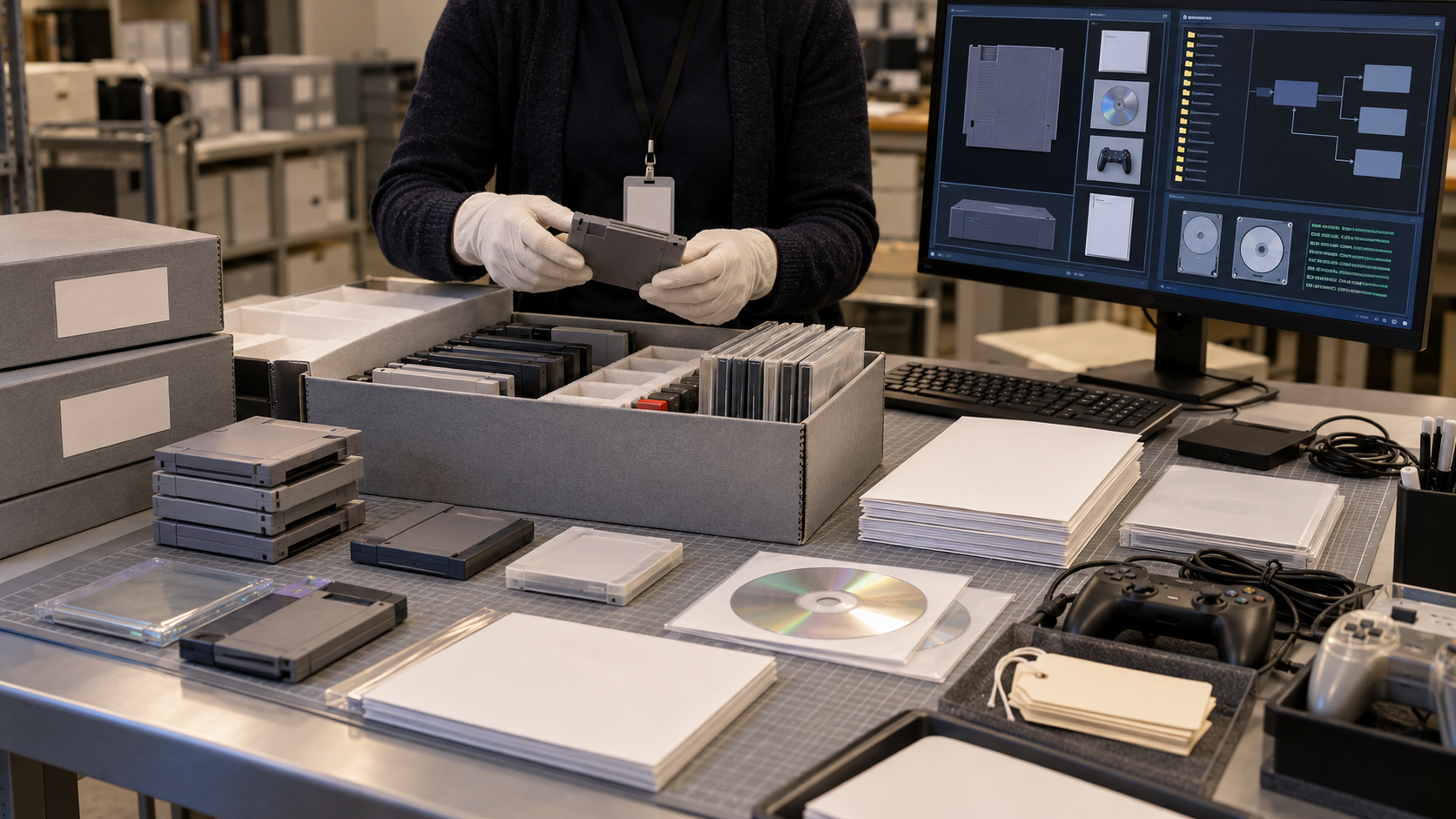
Video Game Preservation Explainer
Video game preservation is the work of keeping games available for future study and experience despite changing hardware, software, services, and media. A playable game can depend on executable code, data, operating systems, controllers, displays, manuals, packaging, patches, servers, and accounts. Copying one disc or download is important, but it may not capture the conditions needed to run or understand the work decades later.
Preservation begins with acquisition and documentation. Archivists identify versions, platforms, regions, dates, carriers, file structures, checksums, and related materials. Original source code and development records can illuminate production but are rarely available to every collecting institution. A stable preservation copy should retain the bitstream without silently altering it, while descriptive metadata explains provenance and the relationships among updates, downloadable content, and releases.
Hardware can fail, and storage media can decay or rely on obsolete drives. Emulation recreates the behavior of older systems in new software, while migration adapts content to a newer environment. Both can change timing, graphics, audio, input, or bugs if not carefully validated. Maintaining original equipment provides a reference but is costly and cannot scale forever. Documentation, captured gameplay, photographs, and interviews can preserve context when perfect execution is impossible.
Online games create a special problem because essential logic or communities may exist on remote servers. Authentication, matchmaking, economies, user-generated content, and continuous updates can disappear when service ends. A client alone may reach only a login screen. Server cooperation, source deposits, network captures, reconstructed services, video, and design records can each preserve different aspects, but none automatically recreates the live social world at its original scale. Copyright and license restrictions shape what libraries, museums, researchers, and the public can lawfully copy, circumvent, and access. Preservation exemptions can be limited by institution, purpose, market availability, and network conditions. The goal is not necessarily to provide unrestricted copies of every game. It is to retain evidence and enable responsible access so future people can study a major cultural form rather than inherit only screenshots, fragments, and memories. A practical way to read or discuss Video Game Preservation is to begin with the basic definition and then identify the choices made in a particular example. Preserving a game can require executable files, assets, patches, hardware behavior, controllers, manuals, packaging, and production context. Next, ask who sets the relevant rules, who performs the work, and which results follow from creative judgment, law, contracts, technology, budget, or production limits. Similar-looking examples can operate differently because their audience, market, format, timing, and agreements are different. Original hardware is valuable as a reference but fragile, scarce, and difficult to maintain as storage media and components age. It also helps to distinguish a formal industry category from an informal critical label or one organization's current practice. That separation keeps a memorable anecdote from becoming a false universal rule. Dates and territories matter: tools, distribution systems, audience behavior, and standard agreements change, while older examples can preserve assumptions that no longer apply everywhere. When a claim sounds absolute, compare it with a second kind of source and look for the conditions under which the claim is true. Then trace the process from the visible result back through the less visible decisions, handoffs, and quality checks that produced it. Copyright exemptions and licenses affect who may copy, circumvent, research, and provide access, so preservation and public distribution are separate questions. Finally, compare the example with a contrasting case and note which part of the definition still holds. This method keeps the explanation grounded, highlights the people and systems behind the outcome, and leaves room for reasonable disagreement about hybrid or borderline cases.
Preserving a game can require executable files, assets, patches, hardware behavior, controllers, manuals, packaging, and production context.
Archivists document versions, regions, platforms, provenance, checksums, and relationships among updates and downloadable components.
Emulation recreates an older system, while migration adapts content; both need validation because timing, input, graphics, and bugs can change.
Original hardware is valuable as a reference but fragile, scarce, and difficult to maintain as storage media and components age.
Online dependencies can make a client unplayable after shutdown, and recordings preserve experience without recreating the complete live system.
Copyright exemptions and licenses affect who may copy, circumvent, research, and provide access, so preservation and public distribution are separate questions.
Explore more "Explainers"
Discover additional explainers across politics, science, business, technology, and other fields. Each explainer breaks down a complex idea into clear, everyday language—helping you better understand how major concepts, systems, and debates shape the world around us.