

Documentary Filmmaking Explainer
Documentary filmmaking uses images, sounds, records, and testimony from the real world to create a nonfiction work. That description does not mean a documentary is an unmediated window onto truth. The filmmaker chooses a subject, gains access, frames questions, places a camera, selects evidence, and orders material for an audience. Observational scenes, interviews, archives, narration, graphics, animation, and reenactments can all appear, provided the finished work is principally concerned with factual people, events, or conditions rather than presenting fiction as fact.
Research establishes what can responsibly be claimed. Filmmakers locate primary documents, compare accounts, build timelines, verify identities, and learn the legal or technical context behind a story. Access agreements and releases may permit recording, but permission alone does not settle every ethical issue. The presence of a camera can influence behavior, and participants may not foresee how years of footage will be condensed. Clear communication about intent, risk, and the limits of control is therefore part of production, not an afterthought.
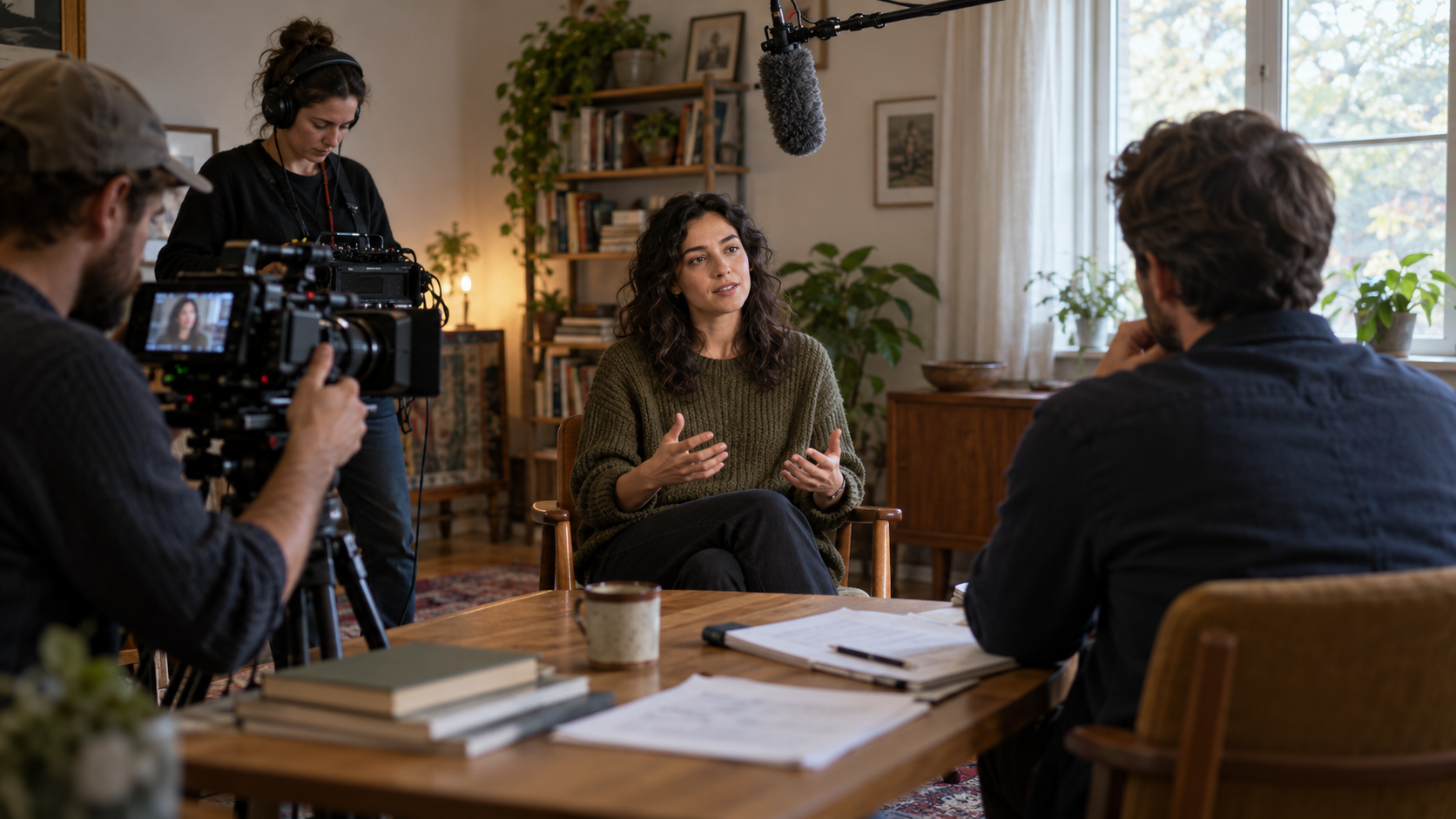
Shooting strategy depends on the kind of evidence available. A crew may observe unfolding events, conduct interviews, record places after an event, or reproduce a process for clarity. Interview questions can invite memory and interpretation, but memory is fallible. Archival photographs and clips bring their own dates, owners, captions, and original purposes. Reenactments and illustrative images can help an audience understand an unseen event, yet their presentation should not quietly imply that a reconstruction is contemporaneous footage.
Editing creates structure from material that rarely arrives in story order. Juxtaposition can reveal relationships, compress time, or suggest causation, so factual accuracy involves more than keeping individual statements intact. Music, reaction shots, narration, and omitted context can change how testimony feels. Fact-checking, legal review, source logs, and opportunities to verify sensitive details reduce error, although editorial independence may prevent participants from approving the final cut. A documentary can be rigorous and still have a point of view. Transparency about methods, uncertainty, and conflicts is more useful than pretending the filmmaker made no choices. Viewers should ask who speaks, who is absent, what evidence supports the central claims, and whether images are used in their original context. These questions do not dismiss nonfiction storytelling; they reveal its craft. The form earns trust by showing how a compelling narrative remains accountable to people and facts beyond the screen. A practical way to read or discuss Documentary Filmmaking is to begin with the basic definition and then identify the choices made in a particular example. A documentary is a designed nonfiction work, not raw reality; selection, framing, sound, and editing shape every account. Next, ask who sets the relevant rules, who performs the work, and which results follow from creative judgment, law, contracts, technology, budget, or production limits. Similar-looking examples can operate differently because their audience, market, format, timing, and agreements are different. Reenactments, animation, and illustrative footage can clarify missing events when the presentation does not misrepresent them as original evidence. It also helps to distinguish a formal industry category from an informal critical label or one organization's current practice. That separation keeps a memorable anecdote from becoming a false universal rule. Dates and territories matter: tools, distribution systems, audience behavior, and standard agreements change, while older examples can preserve assumptions that no longer apply everywhere. When a claim sounds absolute, compare it with a second kind of source and look for the conditions under which the claim is true. Then trace the process from the visible result back through the less visible decisions, handoffs, and quality checks that produced it. A useful viewing test asks who is making the claim, what supports it, which perspective is missing, and how uncertainty is communicated. Finally, compare the example with a contrasting case and note which part of the definition still holds. This method keeps the explanation grounded, highlights the people and systems behind the outcome, and leaves room for reasonable disagreement about hybrid or borderline cases.
A documentary is a designed nonfiction work, not raw reality; selection, framing, sound, and editing shape every account.
Research may combine interviews, direct observation, public records, private archives, expert analysis, and contemporaneous media.
Participant consent and a signed release address access, but filmmakers must still consider safety, power differences, and foreseeable harm.
Reenactments, animation, and illustrative footage can clarify missing events when the presentation does not misrepresent them as original evidence.
Editing can create implications through sequence and omission, so verification must examine context and relationships as well as isolated facts.
A useful viewing test asks who is making the claim, what supports it, which perspective is missing, and how uncertainty is communicated.
Explore more "Explainers"
Discover additional explainers across politics, science, business, technology, and other fields. Each explainer breaks down a complex idea into clear, everyday language—helping you better understand how major concepts, systems, and debates shape the world around us.