

Cloud Gaming Explainer
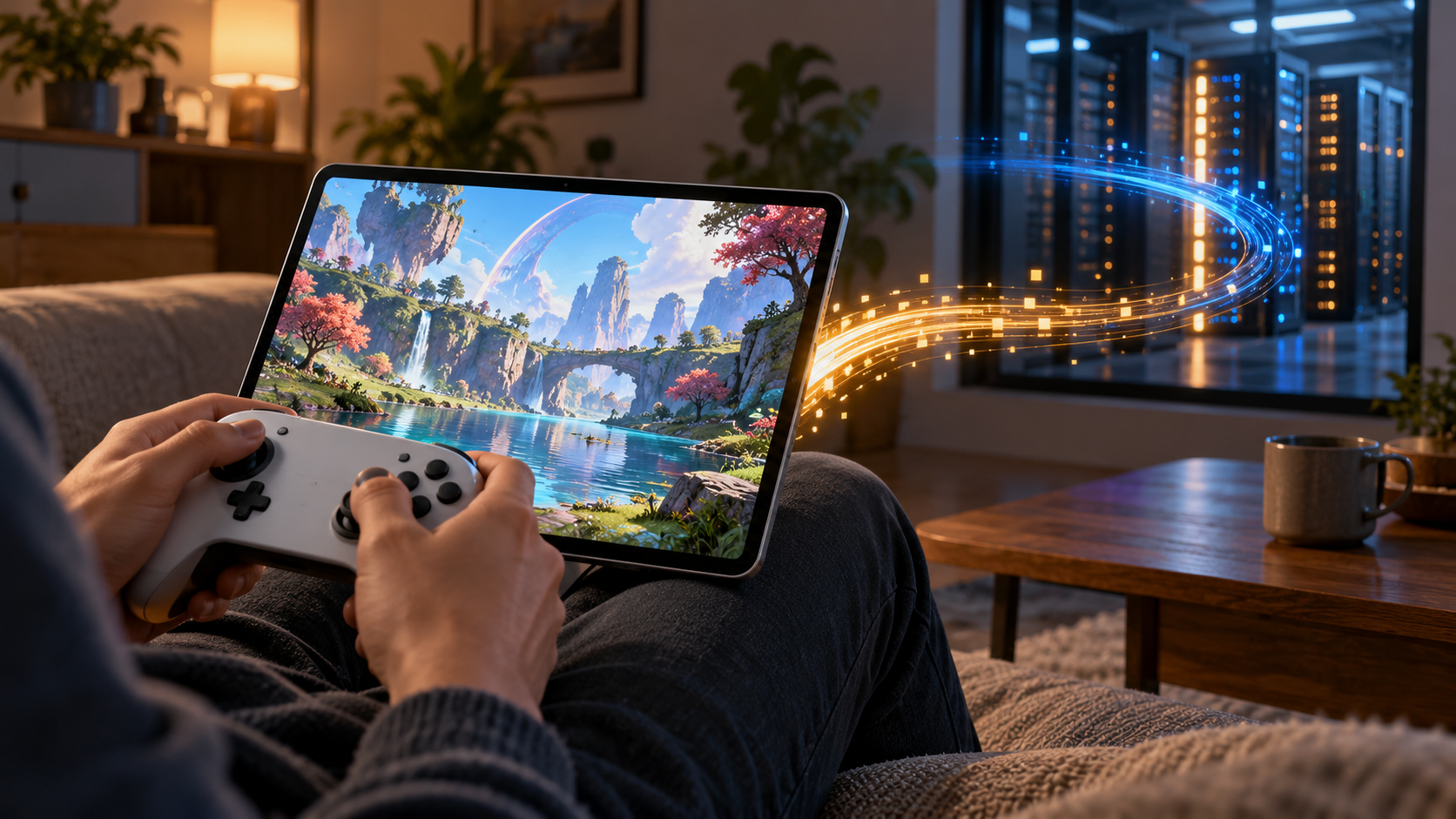
Cloud gaming runs a video game on remote computing hardware and streams the resulting picture and sound to a player's device. Controller, keyboard, mouse, or touch input travels to the data center; the game updates there; a video encoder compresses the new frames; and the stream returns over the network. The local device behaves partly like an interactive video receiver, so supported phones, tablets, televisions, browsers, and less powerful computers can play games that would otherwise require a console or gaming PC.
The service must authenticate the player, confirm access to the game, create or resume a remote session, synchronize saves, and assign nearby capacity. Libraries can come from a subscription, selected owned games, free-to-play titles, or publisher agreements. Availability varies by region, device, account, and contract. A game being sold digitally does not automatically make it cloud playable, because the platform needs technical support and the rights to stream it through that service.
Latency is the delay from a player's action to the visible and audible response. It includes input capture, network travel, server processing, rendering, encoding, return travel, decoding, and display. Bandwidth supports image quality, but a high speed test alone cannot guarantee low delay or stability. Distance, congestion, Wi-Fi interference, packet loss, routing, device decoding, display processing, and game frame rate all contribute. Fast competitive games expose delay more readily than slower turn-based experiences.
Video compression creates another tradeoff. The service adapts resolution, frame rate, and bitrate to changing network conditions, which can produce softness, blocking, banding, or brief pauses. Text-heavy interfaces and dark fast motion are especially challenging. Controllers may connect by Bluetooth or USB, and some games provide touch layouts. Accessibility features must survive both the game and the streaming interface, including readable text, input remapping, captions, and consistent session control. Cloud gaming reduces downloads and local hardware requirements but increases dependence on networks, server availability, subscription terms, data use, and service continuity. It can complement local play rather than replace it: a player might stream to test a game or continue on another screen, then install locally for the best fidelity. To evaluate a service, consider library rights, geographic coverage, queue time, input delay, stream quality, save portability, device support, and what remains usable when the connection fails. A practical way to read or discuss Cloud Gaming is to begin with the basic definition and then identify the choices made in a particular example. Cloud gaming executes the game remotely, sends player input to the server, and returns compressed interactive video and audio. Next, ask who sets the relevant rules, who performs the work, and which results follow from creative judgment, law, contracts, technology, budget, or production limits. Similar-looking examples can operate differently because their audience, market, format, timing, and agreements are different. Adaptive streaming changes bitrate, resolution, and frame rate as conditions vary, trading image stability against visible compression. It also helps to distinguish a formal industry category from an informal critical label or one organization's current practice. That separation keeps a memorable anecdote from becoming a false universal rule. Dates and territories matter: tools, distribution systems, audience behavior, and standard agreements change, while older examples can preserve assumptions that no longer apply everywhere. When a claim sounds absolute, compare it with a second kind of source and look for the conditions under which the claim is true. Then trace the process from the visible result back through the less visible decisions, handoffs, and quality checks that produced it. Cloud and local play can coexist, with saves and account systems allowing a player to continue across supported devices. Finally, compare the example with a contrasting case and note which part of the definition still holds. This method keeps the explanation grounded, highlights the people and systems behind the outcome, and leaves room for reasonable disagreement about hybrid or borderline cases.
Cloud gaming executes the game remotely, sends player input to the server, and returns compressed interactive video and audio.
A supported device can avoid local rendering demands, but it still needs compatible input, decoding, display, account, and network access.
Latency combines input, networking, simulation, rendering, encoding, decoding, and display delay rather than bandwidth alone.
Adaptive streaming changes bitrate, resolution, and frame rate as conditions vary, trading image stability against visible compression.
Game libraries depend on subscription, ownership, publisher rights, region, platform, and technical enablement.
Cloud and local play can coexist, with saves and account systems allowing a player to continue across supported devices.
Explore more "Explainers"
Discover additional explainers across politics, science, business, technology, and other fields. Each explainer breaks down a complex idea into clear, everyday language—helping you better understand how major concepts, systems, and debates shape the world around us.