

Narrative Design in Games Explainer
Narrative design in games connects story and meaning to the player's interactive experience. It includes dialogue and cinematic scenes, but it also shapes quests, objectives, environments, item descriptions, progression, rules, feedback, and the consequences of action. A narrative designer asks what the player knows, wants, can do, and feels at each stage, then works with other disciplines so the game's systems and presentation reinforce that context rather than telling a separate story beside it.
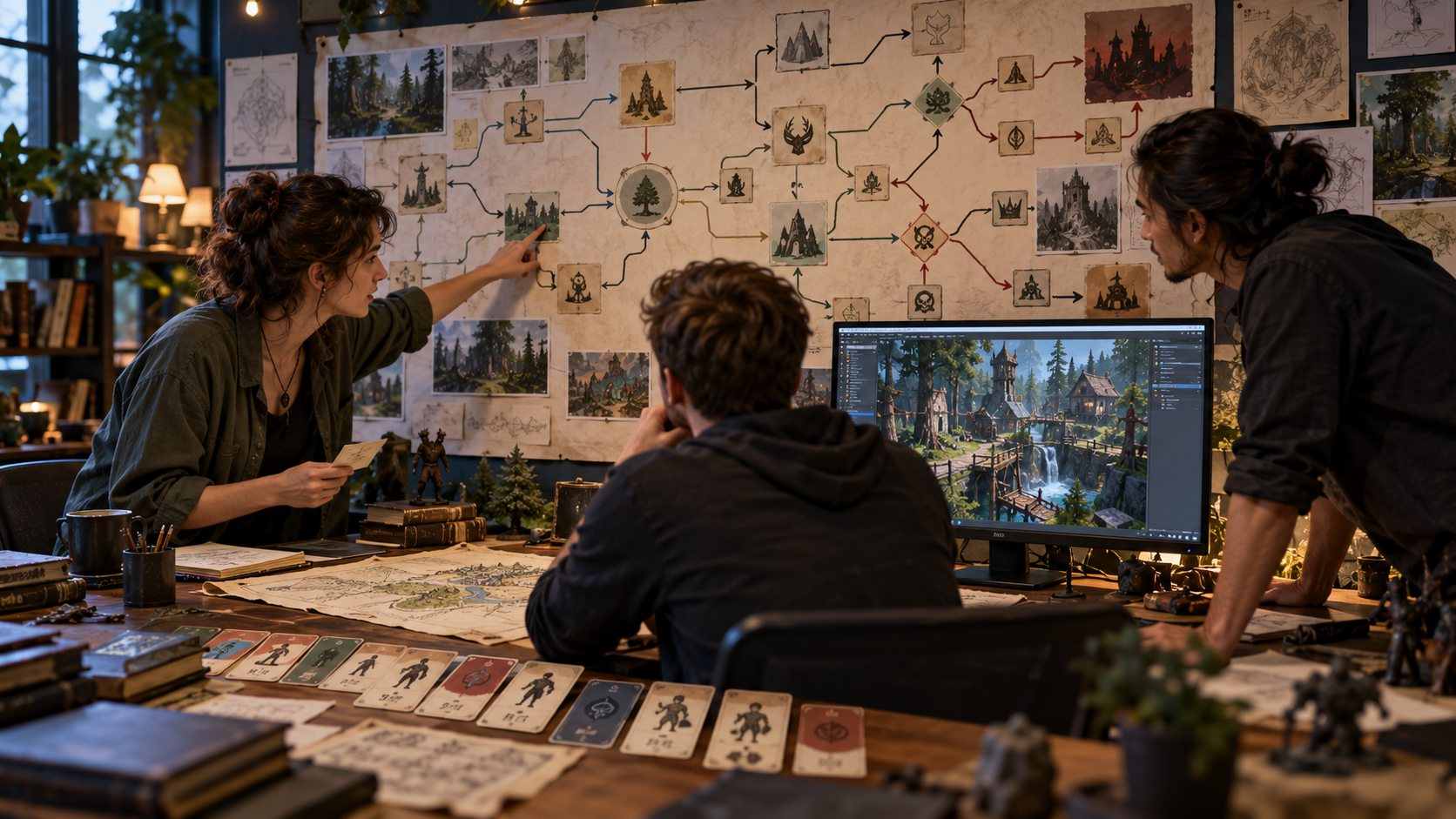
The work begins with the game's premise, themes, audience, mechanics, scope, and production constraints. Designers map characters, locations, factions, arcs, and information flow while identifying what must remain flexible for play. A linear game can still let players discover details in different orders. A branching game must define decision points, conditions, states, and outcomes that code and content tools can track. More branches increase writing, recording, animation, testing, localization, and continuity demands.
Quest design translates dramatic goals into playable tasks. Objectives need clear motivation, useful feedback, and pacing that survives experimentation or failure. A mechanically efficient instruction can feel arbitrary if the world gives no reason to perform it, while extensive exposition can interrupt agency. Narrative designers collaborate with level and systems designers to place information, encounters, rewards, and choices where players are likely to experience them through movement and decision.
Dialogue systems can use conversations, barks, banter, journals, radio, narration, and responsive lines triggered by game state. Writers and designers manage variables such as prior choices, companion presence, inventory, location, and timing. Implementation is part of authorship: a strong line can fail if it triggers too often, plays over combat, contradicts the current world state, or is impossible to hear. Tools, naming, spreadsheets, graphs, and version control help large teams keep conditions understandable. Interactive stories cannot guarantee that every player sees material in the intended sequence. Testing therefore includes narrative continuity, pacing, choice clarity, broken conditions, repetition, missing context, and the emotional result of real play. Viewers can analyze a game by asking what meaning arises from rules and consequences, not only from cutscenes. The distinctive craft lies in designing a story space where player action, authored material, and system response continually interpret one another. A practical way to read or discuss Narrative Design in Games is to begin with the basic definition and then identify the choices made in a particular example. Narrative design integrates story with mechanics, quests, environments, progression, interface, dialogue, and the consequences of player action. Next, ask who sets the relevant rules, who performs the work, and which results follow from creative judgment, law, contracts, technology, budget, or production limits. Similar-looking examples can operate differently because their audience, market, format, timing, and agreements are different. Quest design connects dramatic motivation to objectives, obstacles, feedback, rewards, failure, and the physical layout of play. It also helps to distinguish a formal industry category from an informal critical label or one organization's current practice. That separation keeps a memorable anecdote from becoming a false universal rule. Dates and territories matter: tools, distribution systems, audience behavior, and standard agreements change, while older examples can preserve assumptions that no longer apply everywhere. When a claim sounds absolute, compare it with a second kind of source and look for the conditions under which the claim is true. Then trace the process from the visible result back through the less visible decisions, handoffs, and quality checks that produced it. Narrative testing looks for contradictions, missing context, repetition, unclear choices, broken states, and unintended emotional effects. Finally, compare the example with a contrasting case and note which part of the definition still holds. This method keeps the explanation grounded, highlights the people and systems behind the outcome, and leaves room for reasonable disagreement about hybrid or borderline cases.
Narrative design integrates story with mechanics, quests, environments, progression, interface, dialogue, and the consequences of player action.
It manages what players know and can influence at each point, including content they may encounter in different orders.
Branching choices require tracked states and multiply writing, implementation, voice, animation, localization, and testing work.
Quest design connects dramatic motivation to objectives, obstacles, feedback, rewards, failure, and the physical layout of play.
Dialogue triggers must respect context, frequency, audibility, companions, prior choices, and the current game state.
Narrative testing looks for contradictions, missing context, repetition, unclear choices, broken states, and unintended emotional effects.
Explore more "Explainers"
Discover additional explainers across politics, science, business, technology, and other fields. Each explainer breaks down a complex idea into clear, everyday language—helping you better understand how major concepts, systems, and debates shape the world around us.