

Mise-en-Scène Explainer
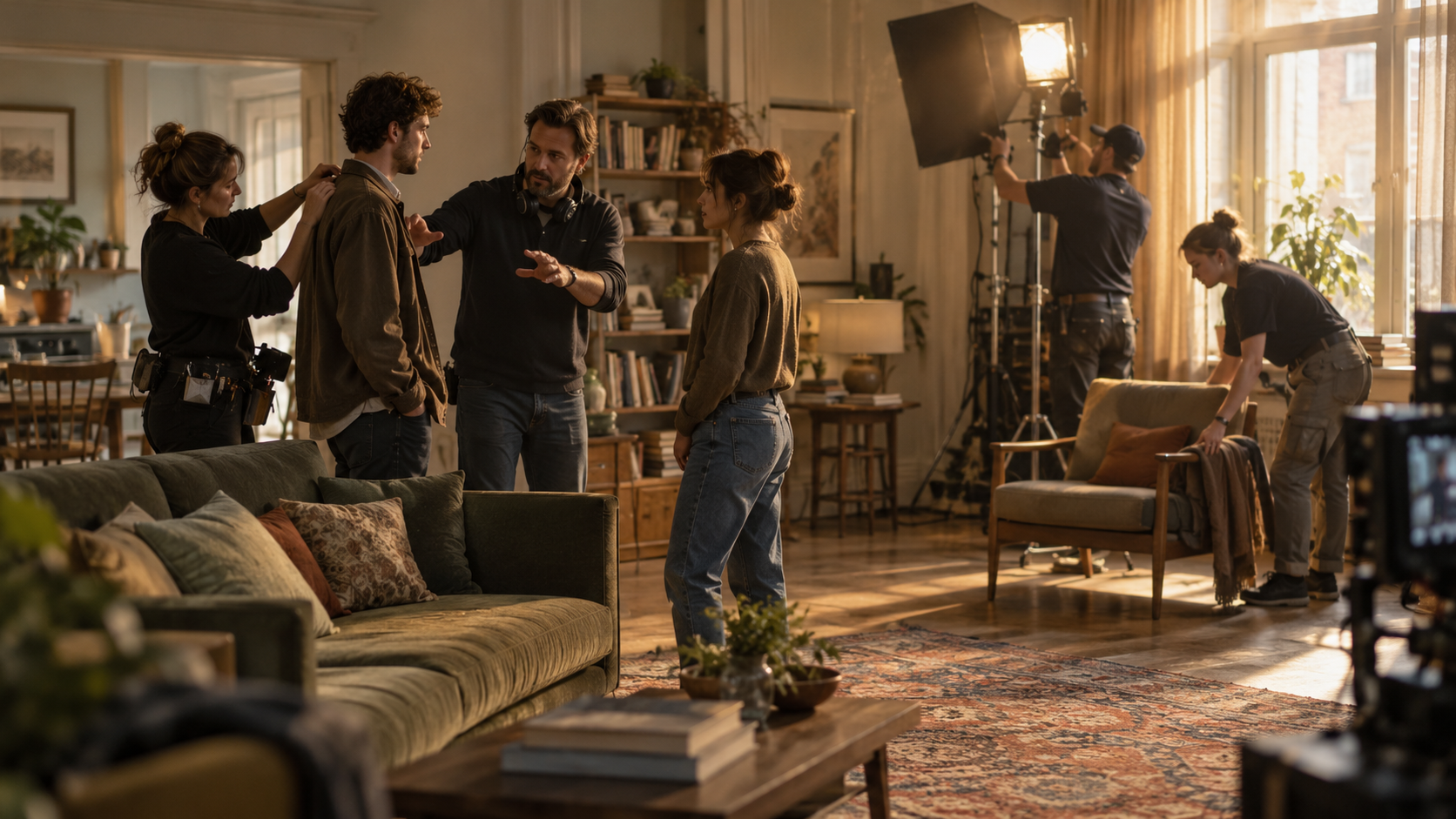
Mise-en-scène is the arrangement of what appears before the camera and how those elements behave within the shot. Sets, locations, props, costume, hair, makeup, lighting, color, performance, blocking, and spatial relationships all contribute. Critics use the term to explain how a scene communicates through its visible and physical organization, not only through dialogue or plot. A crowded room can signal pressure, a doorway can divide characters, and an ordinary object can gain meaning through placement and repetition.
The process begins long before filming. Designers translate a script into environments, palettes, textures, and objects; costume and makeup departments track character, period, continuity, and transformation; lighting plans determine what the audience can see and how the space feels. These choices are coordinated with budget, location limits, camera tests, safety, and schedule. A visually rich image is not automatically effective mise-en-scène. The arrangement matters because it directs attention and supports a scene's dramatic purpose.
Blocking gives the design motion. Where performers stand, when they cross, whether they face one another, and how they use furniture can reveal status, intimacy, conflict, or hesitation. Gesture and posture may carry an idea that the dialogue avoids. The camera participates by selecting a viewpoint, distance, lens, and movement, but mise-en-scène is not simply cinematography. It concerns the staged world and its relationships as they are presented for the lens.
Continuity can maintain a coherent world, while deliberate disruption can signal a shift in memory, mood, or point of view. Filmmakers may use symmetry, clutter, empty space, reflective surfaces, or contrasting colors as patterns. Interpretation should remain specific: a red costume has no fixed universal meaning. Its effect depends on the surrounding palette, story context, cultural associations, lighting, and whether the motif changes across the work. To analyze mise-en-scène, pause on a scene and map its foreground, middle ground, and background. Note where light falls, who controls space, which objects repeat, how bodies are arranged, and when that arrangement changes. Then connect those choices to performance and story rather than treating the frame as decoration. The most revealing question is often not what looks beautiful, but how the organized space makes a relationship, decision, or tension understandable before anyone explains it. A practical way to read or discuss Mise-en-Scène is to begin with the basic definition and then identify the choices made in a particular example. Mise-en-scène covers the performers, objects, environments, light, color, and movement organized within a filmed scene. Next, ask who sets the relevant rules, who performs the work, and which results follow from creative judgment, law, contracts, technology, budget, or production limits. Similar-looking examples can operate differently because their audience, market, format, timing, and agreements are different. The camera frames the mise-en-scène, but the term is broader than lens choice or lighting alone. It also helps to distinguish a formal industry category from an informal critical label or one organization's current practice. That separation keeps a memorable anecdote from becoming a false universal rule. Dates and territories matter: tools, distribution systems, audience behavior, and standard agreements change, while older examples can preserve assumptions that no longer apply everywhere. When a claim sounds absolute, compare it with a second kind of source and look for the conditions under which the claim is true. Then trace the process from the visible result back through the less visible decisions, handoffs, and quality checks that produced it. Close analysis connects spatial and visual choices to story, performance, emotion, and power inside a particular scene. Finally, compare the example with a contrasting case and note which part of the definition still holds. This method keeps the explanation grounded, highlights the people and systems behind the outcome, and leaves room for reasonable disagreement about hybrid or borderline cases.
Mise-en-scène covers the performers, objects, environments, light, color, and movement organized within a filmed scene.
Production design, costume, makeup, lighting, props, and direction coordinate before shooting to make the staged world coherent.
Blocking uses position, distance, gesture, entrances, and movement to express relationships and direct attention.
The camera frames the mise-en-scène, but the term is broader than lens choice or lighting alone.
Colors and objects gain meaning through context, repetition, contrast, and change rather than through a universal symbolic code.
Close analysis connects spatial and visual choices to story, performance, emotion, and power inside a particular scene.
Explore more "Explainers"
Discover additional explainers across politics, science, business, technology, and other fields. Each explainer breaks down a complex idea into clear, everyday language—helping you better understand how major concepts, systems, and debates shape the world around us.