

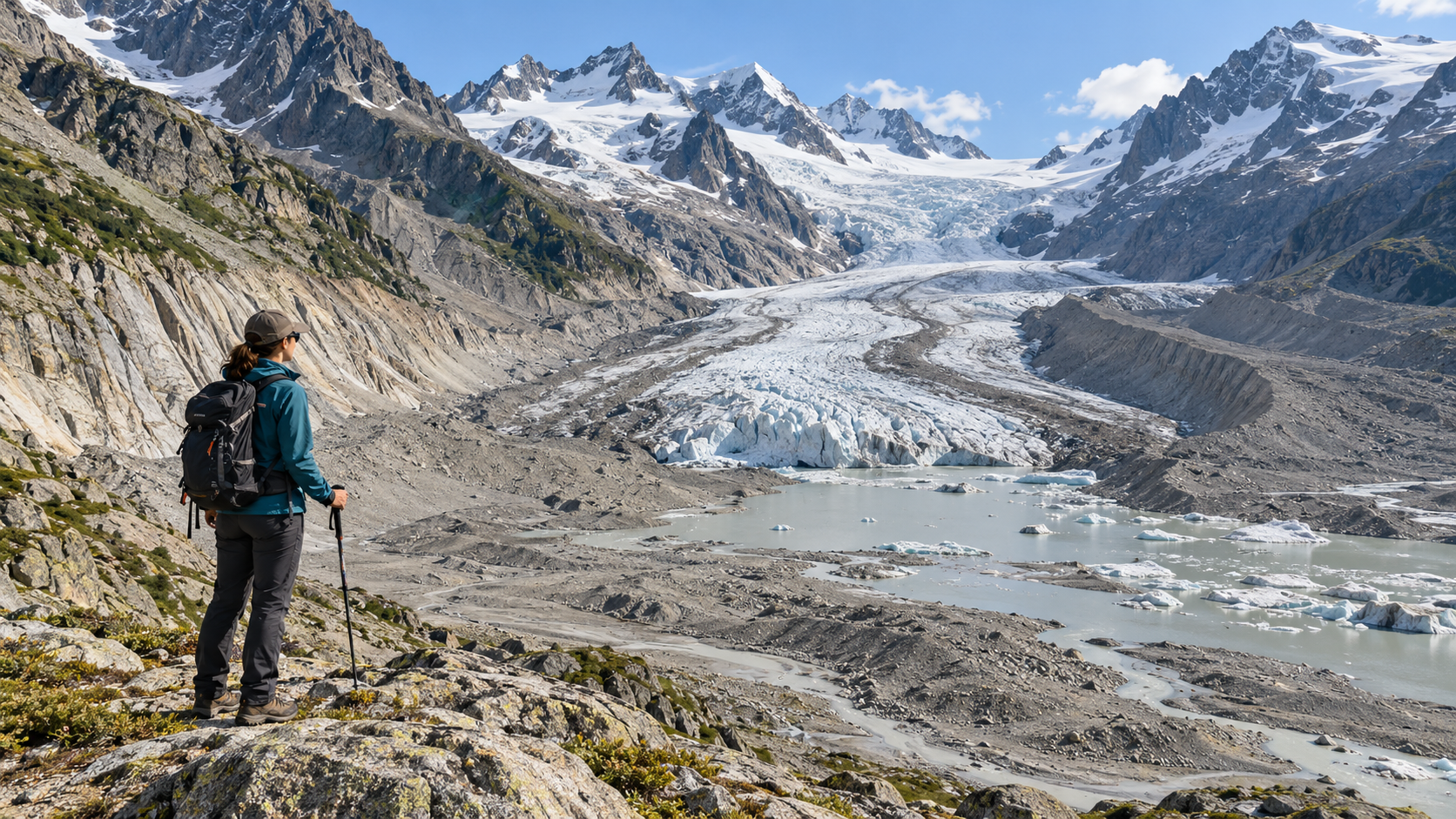
How Glaciers Carve Valleys Explainer
A glacier is not a stationary block of ice. Snow accumulated over years is compressed into dense ice, and gravity causes that ice to deform and move downslope or outward. The upper portion may behave rigidly enough to crack into crevasses, while deeper ice flows slowly under pressure. Meltwater at the base can also help the glacier slide over its bed.
Moving ice erodes rock mainly through abrasion and plucking. In abrasion, sand, gravel, and boulders frozen into the base scrape and polish bedrock like tools in slow motion. They can leave parallel grooves called striations. In plucking, water enters fractures, freezes or changes pressure, and helps loosen blocks that the moving glacier then carries away.
A river usually concentrates erosion near its channel and tends to cut a narrow V-shaped valley. A valley glacier fills much more of the cross-section, pressing against the floor and sides. Over repeated advances, it can deepen, widen, and straighten the valley into a broad U shape with steep walls and a relatively flat floor. Tributary glaciers may leave hanging valleys above the main trough.
Erosion varies with ice thickness, movement speed, bedrock fractures, debris at the base, temperature, and the availability of meltwater. Thick, fast-moving ice can erode powerfully, but ice frozen firmly to its bed may move little and cause limited abrasion. Glaciers can also sharpen divides into arêtes and excavate bowl-shaped cirques near their source areas.
The glacier transports the material it removes. When ice melts, unsorted debris called till may be left in ridges known as moraines or spread across the landscape. Meltwater sorts other sediment into layers of sand and gravel. Rock basins may fill with lakes, and coastal glacial valleys flooded by the sea become fjords.
A U-shaped valley is evidence of past glaciation, but its present form may also reflect rivers, landslides, weathering, and later human activity. Glaciers do not cut rock instantly or only by freezing it. Their landscapes emerge from sustained motion, pressure, entrained sediment, water, and repeated climate-driven advances and retreats over long periods.
Gravity makes glacier ice deform internally and, in many settings, slide at its base. That motion lets the ice erode and transport rock.
Glacial movement may be only centimeters to meters per day, but it operates across large areas and long times.
Debris in basal ice abrades bedrock, while plucking removes loosened blocks. Valley-wide erosion turns many V-shaped river valleys into U-shaped troughs.
Ice thickness, speed, temperature, meltwater, bedrock structure, and debris determine how rapidly erosion proceeds.
Melting ice leaves unsorted till and moraines, while meltwater sorts sediment. Glacial basins can become lakes and drowned troughs can become fjords.
Not every steep valley is glacial, and later processes modify old landforms. Geologists use several features together to reconstruct a valley's history.
Explore more "Explainers"
Discover additional explainers across politics, science, business, technology, and other fields. Each explainer breaks down a complex idea into clear, everyday language—helping you better understand how major concepts, systems, and debates shape the world around us.