

How Exoplanet Transits Reveal Distant Worlds Explainer
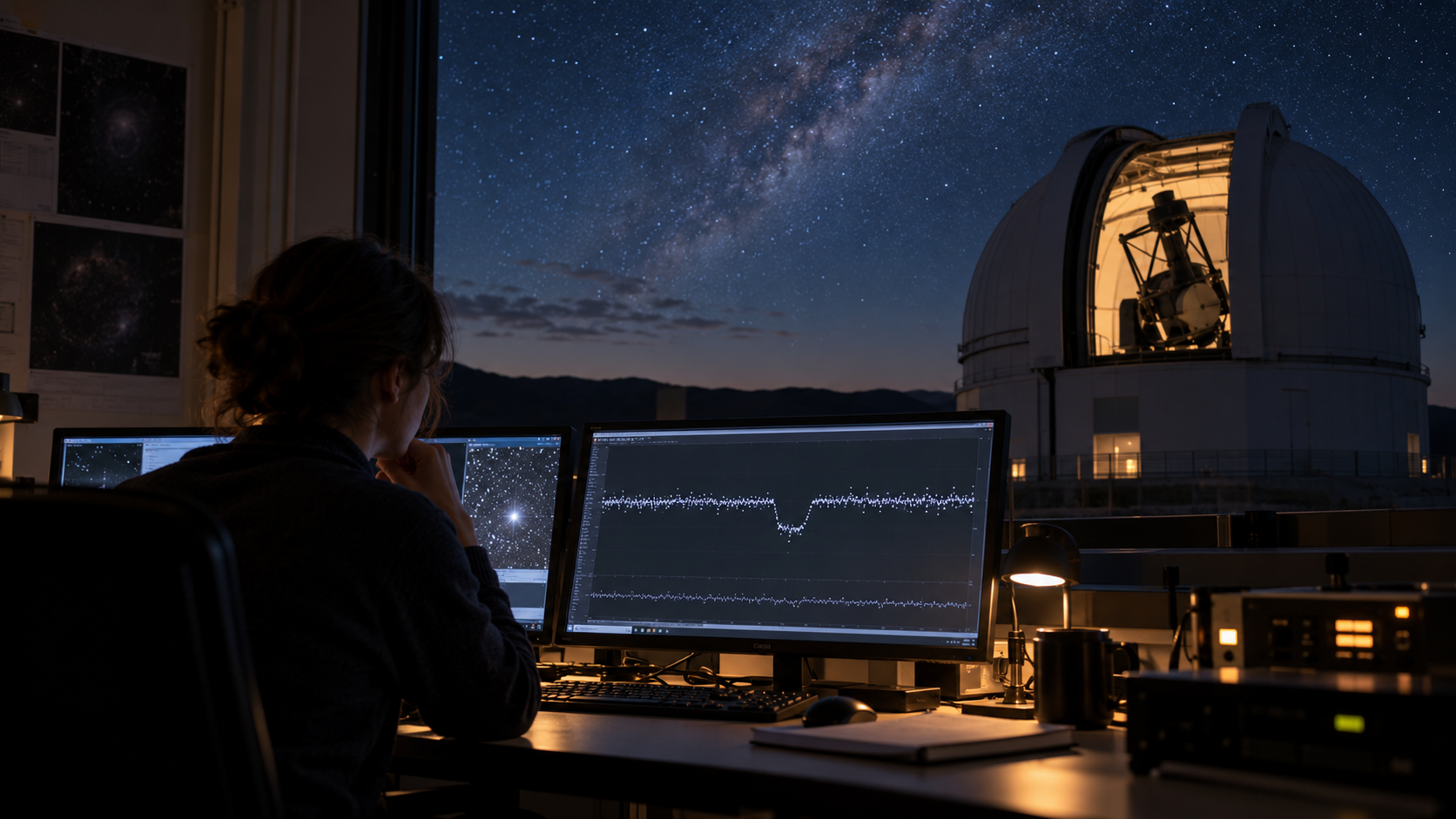
A transit occurs when a planet passes between its star and an observer. The planet blocks only a small fraction of the stellar disk, so the star appears slightly dimmer for a limited time. Sensitive telescopes record brightness repeatedly and arrange those measurements into a light curve. A regular sequence of shallow dips can be the first evidence that an unseen world is orbiting the star.
The depth of the dip carries information about size. A larger planet hides more of the star than a smaller one, so it produces a deeper transit when the star and orbit are otherwise comparable. Astronomers combine the measured depth with an estimate of the star’s radius to calculate the planet’s radius. The interval between matching dips gives the orbital period.
The shape and duration of a transit add more clues. A planet crossing near the star’s center usually remains in front of it longer than one grazing the edge. The gradual loss and return of light records the planet entering and leaving the stellar disk. Models also account for limb darkening, because a star’s visible edge is dimmer than its center.
During a transit, a small amount of starlight can filter through a planet’s atmosphere. Molecules and atoms absorb particular wavelengths, leaving subtle patterns in a spectrum. Repeated observations can reveal gases, haze, clouds, and temperature structure. This technique is demanding because the atmospheric signal is much smaller than the already tiny loss of light caused by the planet itself.
A dip alone is not proof of a planet. Eclipsing binary stars, starspots, instrumental drift, and background stars can imitate or distort a transit. Researchers compare different wavelengths, inspect images, model the host star, and use follow-up measurements such as radial velocity. Several consistent transits are usually needed to establish the period and reject chance noise.
Transit surveys favor planets whose orbits happen to be aligned edge-on from Earth, so they do not reveal every planet around a star. Large worlds on short orbits are easier to detect because they make deeper, more frequent dips. Even with that bias, the method has transformed planetary science by turning minute changes in starlight into measurements of distant worlds.
A transit is the temporary dimming that occurs when an orbiting planet crosses the face of its star from our point of view.
Transit depth mainly reflects the planet-to-star size ratio, while the spacing between dips reveals the orbital period.
Ingress, egress, and total duration help constrain the path across the star and the geometry of the orbit.
Some starlight passes through the atmosphere, allowing spectroscopy to search for wavelength-specific absorption.
Binary stars, starspots, and background objects can mimic a planet, so candidates require repeated measurements and follow-up.
The method detects only favorably aligned systems and is most sensitive to large planets with short periods.
Explore more "Explainers"
Discover additional explainers across politics, science, business, technology, and other fields. Each explainer breaks down a complex idea into clear, everyday language—helping you better understand how major concepts, systems, and debates shape the world around us.