

How pH and Buffers Control Acidity Explainer
Acidity depends on how readily a solution supplies hydrogen ions, more precisely their effective activity in water. The pH scale condenses that behavior into a manageable number. A lower pH describes a more acidic solution, while a higher pH describes a more basic one. Neutral water sits near pH 7 under common conditions, although temperature can shift the exact neutral point.
The scale is logarithmic rather than linear. A change of one pH unit corresponds to a tenfold change in hydrogen-ion activity. A solution at pH 4 is therefore about ten times more acidic by this measure than one at pH 5 and about one hundred times more acidic than one at pH 6. Small numerical changes can represent large chemical differences.
A buffer contains a weak acid together with its conjugate base, or a weak base with its conjugate acid. When a small amount of acid is added, the base component can accept some of the added protons. When base is added, the acid component can donate protons. Those reversible reactions keep the free hydrogen-ion level from shifting as dramatically as it would in plain water.
Buffering is strongest when the acid and conjugate base are present in comparable amounts and the working pH is close to the acid’s pKa. Every buffer has a finite capacity. Once one component is largely consumed, additional acid or base can drive a rapid pH change. Dilution also reduces the total amount of buffering material available.
Living systems depend on this chemical restraint. Bicarbonate, phosphate, proteins, and other compounds help stabilize pH in blood, cells, soils, and natural waters. Enzymes and membranes often work only across a limited pH range. Organisms therefore combine buffers with breathing, circulation, excretion, or ion transport to control both immediate and long-term changes.
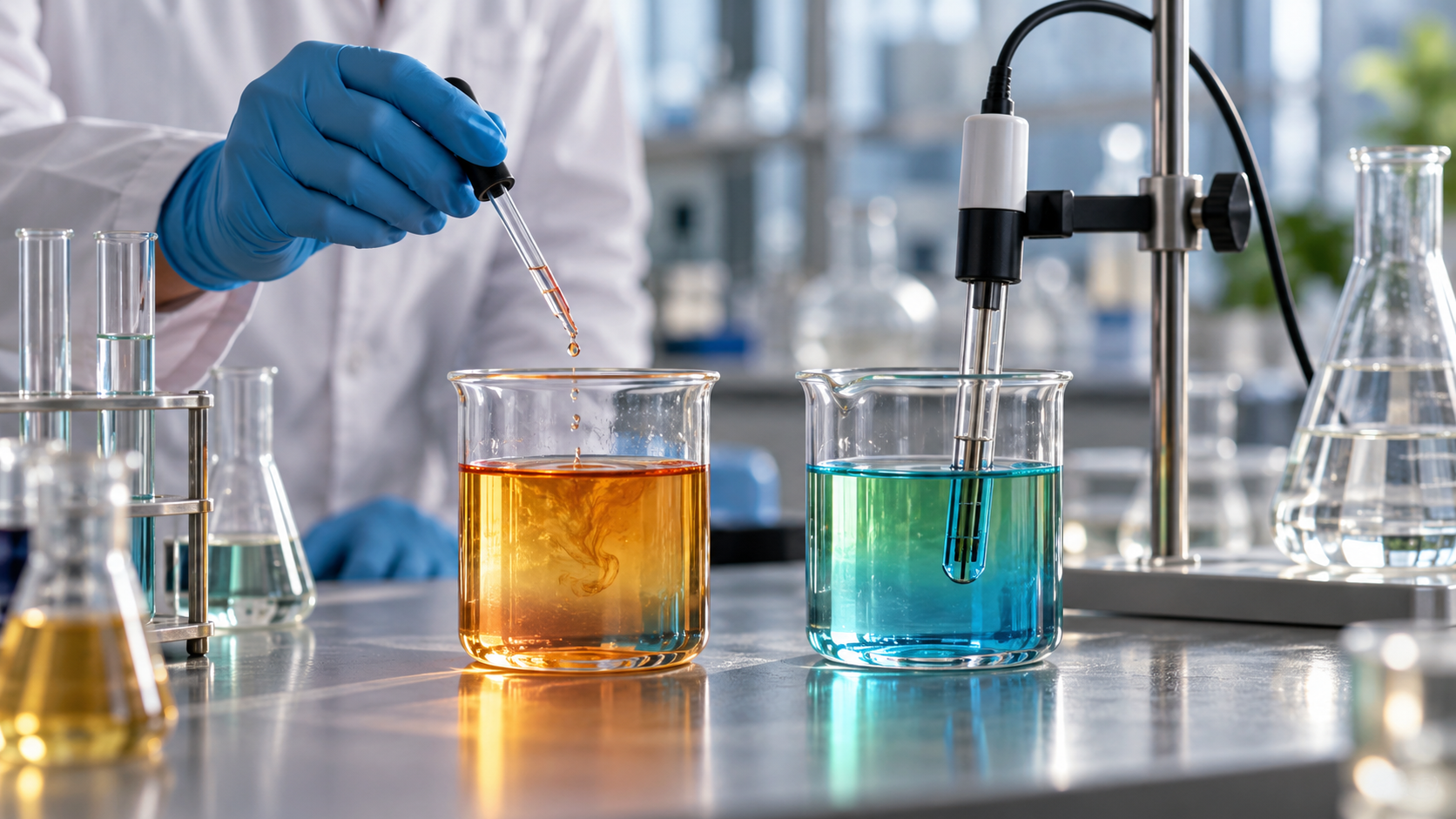
A pH meter measures an electrical response related to hydrogen-ion activity and must be calibrated with standards. Indicator dyes offer a simpler estimate by changing color across selected ranges. Neither method makes acidity disappear; it reports the chemical balance. Buffers likewise do not hold pH perfectly constant. They soften a disturbance until their capacity is exceeded.
pH is a logarithmic expression of hydrogen-ion activity, so one unit represents roughly a tenfold change.
Acids donate protons and bases accept them; water and dissolved compounds establish a dynamic equilibrium.
A buffer pairs a weak acid with its conjugate base so one component can absorb added acid and the other added base.
Buffer action is strongest near the acid's pKa and weakens when either component is depleted.
Blood, cells, soils, and natural waters use several buffers because many reactions tolerate only a narrow pH range.
Meters and indicators measure pH, but calibration, temperature, and limited buffer capacity affect interpretation.
Explore more "Explainers"
Discover additional explainers across politics, science, business, technology, and other fields. Each explainer breaks down a complex idea into clear, everyday language—helping you better understand how major concepts, systems, and debates shape the world around us.