

How Ribosomes Build Proteins Explainer
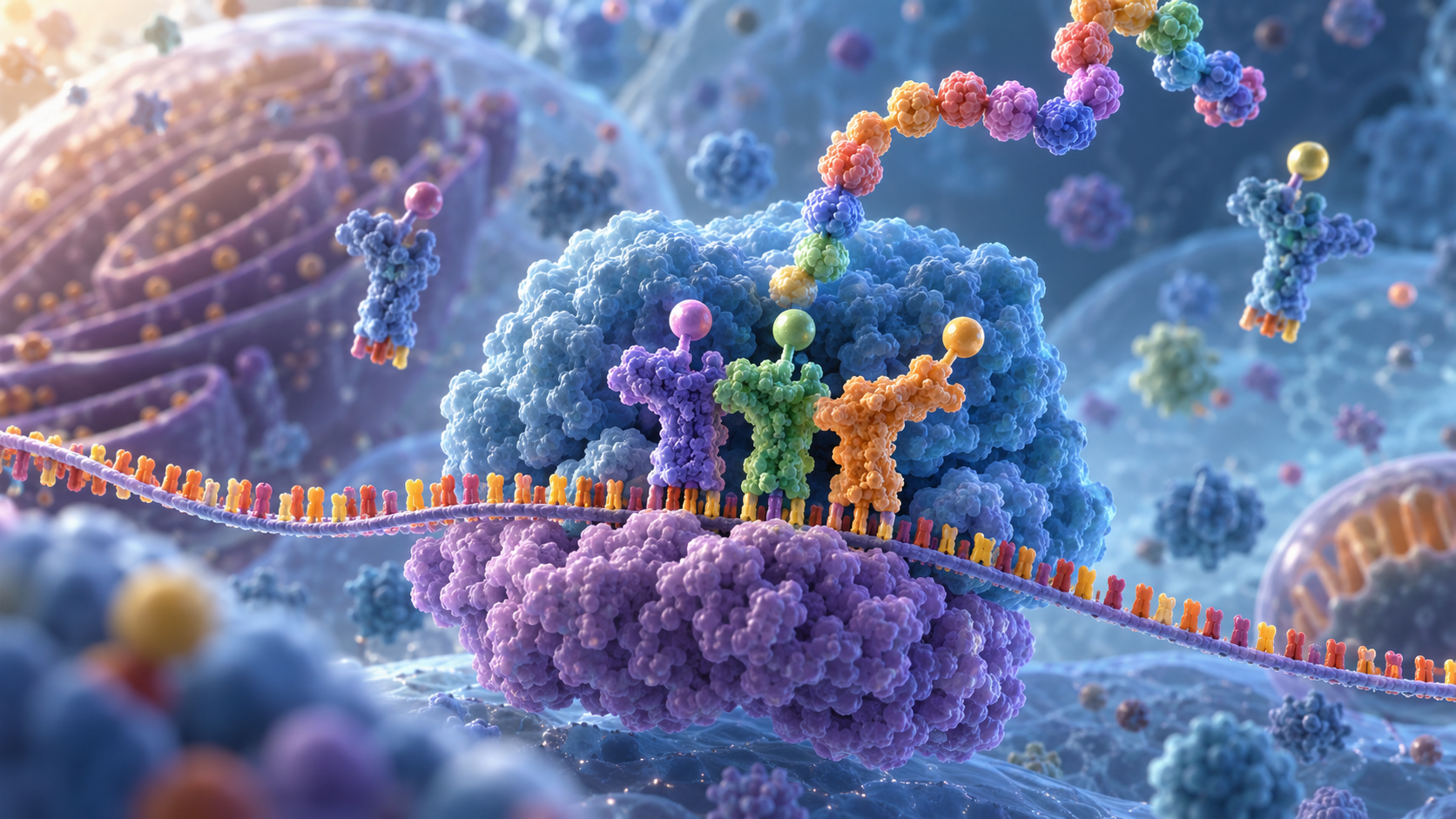
A ribosome is the cell’s protein-building machine. It does not read DNA directly. Instead, a gene is first copied into messenger RNA, or mRNA, which carries a sequence of three-letter codons. The ribosome moves along that message and converts the order of codons into the order of amino acids in a polypeptide chain.
Each transfer RNA, or tRNA, carries a particular amino acid and has an anticodon that can pair with a complementary codon in the mRNA. Enzymes called aminoacyl-tRNA synthetases attach the correct amino acid to each tRNA. This charging step is crucial: the ribosome checks the codon-anticodon match, but it relies on the tRNA to arrive with the proper cargo.
Translation begins when the small ribosomal subunit binds the mRNA and identifies a start codon. An initiator tRNA pairs with that codon, and the large subunit joins. Together the subunits create sites that hold the growing chain, admit the next charged tRNA, and release the empty tRNA after its amino acid has been transferred.
During elongation, the ribosome tests a new tRNA against the exposed codon. If the pairing is correct, the ribosome catalyzes a peptide bond between adjacent amino acids. It then advances by one codon, shifting the tRNAs through its sites. Repeating this cycle grows the chain from one end while preserving the order encoded by the mRNA.
A stop codon does not recruit a normal tRNA. Instead, a release factor enters the ribosome and triggers separation of the completed polypeptide. The subunits, mRNA, and other components can be reused. Many ribosomes may translate the same mRNA at once, forming a polysome that produces multiple copies efficiently.
The newly released chain is not necessarily a finished functional protein. It must fold into a precise shape, sometimes with help from chaperone proteins, and may be cut, chemically modified, or sent to a particular cell compartment. Translation errors and damaged mRNA can produce faulty proteins, so cells also monitor ribosomes and remove defective products.
Ribosomes translate the nucleotide message in mRNA into the amino-acid sequence of a protein.
Charged tRNAs pair their anticodons with mRNA codons and deliver the corresponding amino acids.
Initiation assembles the ribosomal subunits at a start codon with an initiator tRNA.
Elongation repeatedly checks codon pairing, forms a peptide bond, and moves the ribosome forward.
A stop codon recruits a release factor, freeing the completed polypeptide and recycling the translation machinery.
The chain must still fold and may be modified or transported before it becomes a working protein.
Explore more "Explainers"
Discover additional explainers across politics, science, business, technology, and other fields. Each explainer breaks down a complex idea into clear, everyday language—helping you better understand how major concepts, systems, and debates shape the world around us.