

How Landslides Begin Explainer
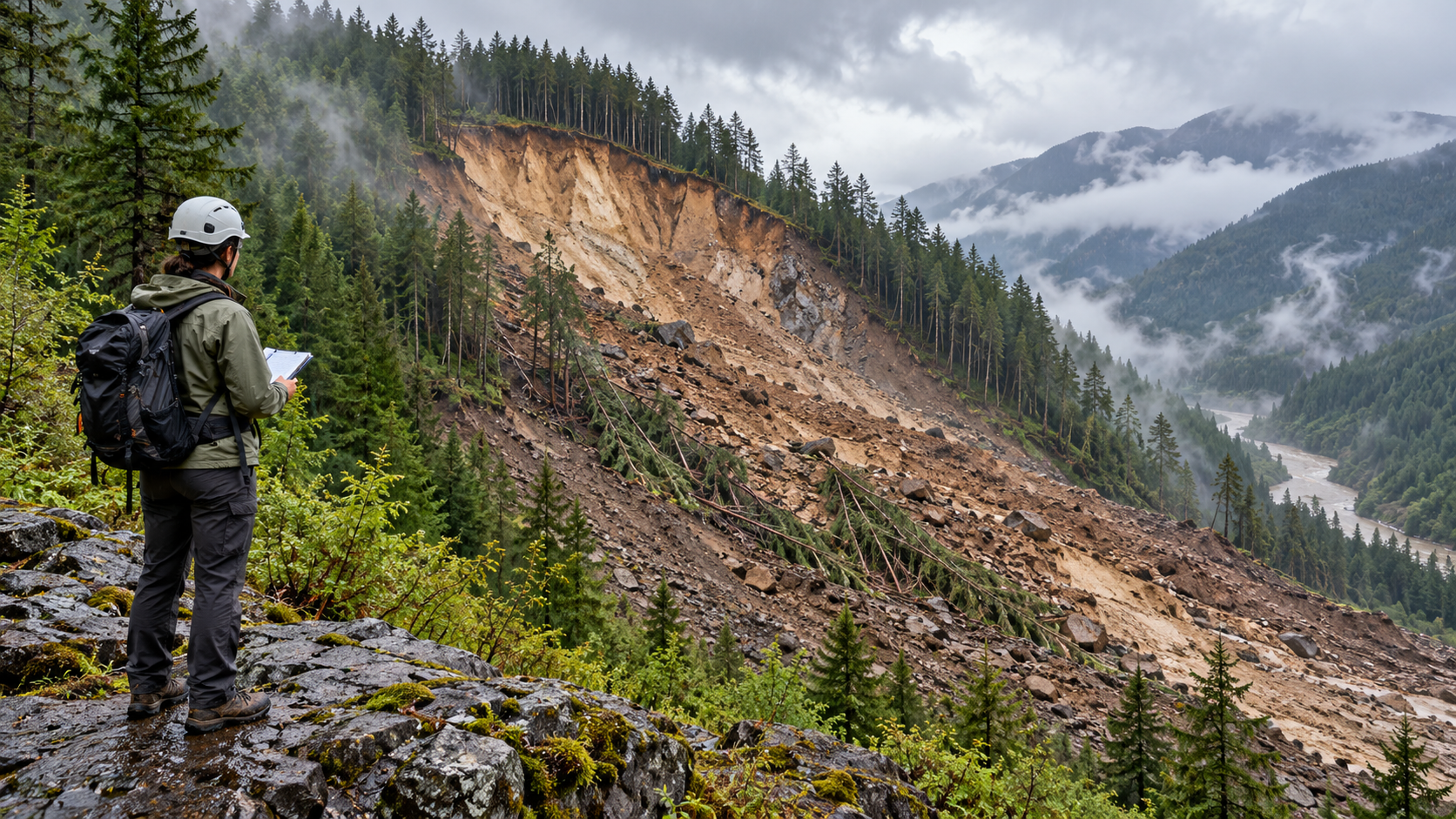
A slope remains stable while the material’s resisting strength exceeds the downslope pull of gravity. Soil grains press and lock together, rock bridges cracks, roots reinforce shallow ground, and friction resists movement. A landslide begins when that balance reverses along a surface or zone of weakness. The movement may be a sudden rockfall, a rotating slump, a sliding block, or a fast debris flow.
Slope angle matters because steeper ground directs a larger share of weight downslope. Geology matters just as much. Weathered rock, clay-rich layers, old slide surfaces, joints tilted toward a valley, and contrasts between permeable and impermeable material can localize failure. Erosion by rivers, waves, glaciers, or construction may remove support from the base of a slope.
Water is a common trigger. Rain or snowmelt adds weight and seeps into pores and fractures. Rising pore-water pressure pushes grains apart and reduces the effective stress that creates friction. Water can also soften some materials or concentrate flow above a less permeable layer. Intense short storms may trigger shallow failures, while long wet periods can destabilize deeper slopes.
Earthquake shaking applies rapid forces and can weaken contacts between grains or break fractured rock loose. Volcanic activity, freeze-thaw cycles, wildfire, and rapid reservoir changes can also alter stability. Human excavation, added fill, leaking pipes, poor drainage, and removal of vegetation may change the same forces, although no single factor explains every landslide.
Warning signs can include new cracks, bulging ground, tilting trees or fences, doors that suddenly stick, and small rockfalls. Some slopes creep for years, while others fail with little visible notice. Scientists combine mapping, rainfall measurements, ground instruments, satellite radar, and models to identify susceptible terrain and track motion, but forecasts are usually probabilistic.
Risk can be reduced by avoiding unstable ground, controlling drainage, preserving support at the slope toe, and using engineered retaining or reinforcement systems where appropriate. After fire, land managers may watch burn scars closely because lost vegetation and water-repellent soils can increase debris-flow hazards. The central principle remains a force balance: failure begins when driving stress overtakes resistance.
Slopes are stable when friction, cohesion, rock strength, and roots provide more resistance than gravity provides driving stress.
Steep terrain, weak layers, fractures, old slide surfaces, and toe erosion can prepare a slope for failure.
Water adds weight and raises pore pressure, reducing the grain-to-grain friction that helps hold soil in place.
Earthquakes, wildfire, freeze-thaw action, construction, and drainage changes can trigger or accelerate movement.
Cracks, bulges, tilted objects, and small falls may warn of motion, but some landslides begin abruptly.
Mapping, monitoring, drainage, careful land use, and engineering reduce risk without eliminating all uncertainty.
Explore more "Explainers"
Discover additional explainers across politics, science, business, technology, and other fields. Each explainer breaks down a complex idea into clear, everyday language—helping you better understand how major concepts, systems, and debates shape the world around us.