

How Stars Form from Molecular Clouds Explainer
Stars begin inside cold molecular clouds made mostly of hydrogen, with helium, dust, and trace molecules. These clouds can stretch across many light-years and contain far more mass than a single star. Turbulence, magnetic fields, and internal pressure resist gravity, so an entire cloud does not collapse uniformly. Denser knots form within filaments and become the likely sites of new stars.
If a knot gains enough mass or loses enough support, its self-gravity overwhelms thermal and turbulent pressure. The region contracts and fragments, often producing a cluster rather than an isolated star. Gravitational energy becomes heat, but dust initially radiates much of that energy away. The center grows denser and becomes a protostar hidden within an infalling envelope.
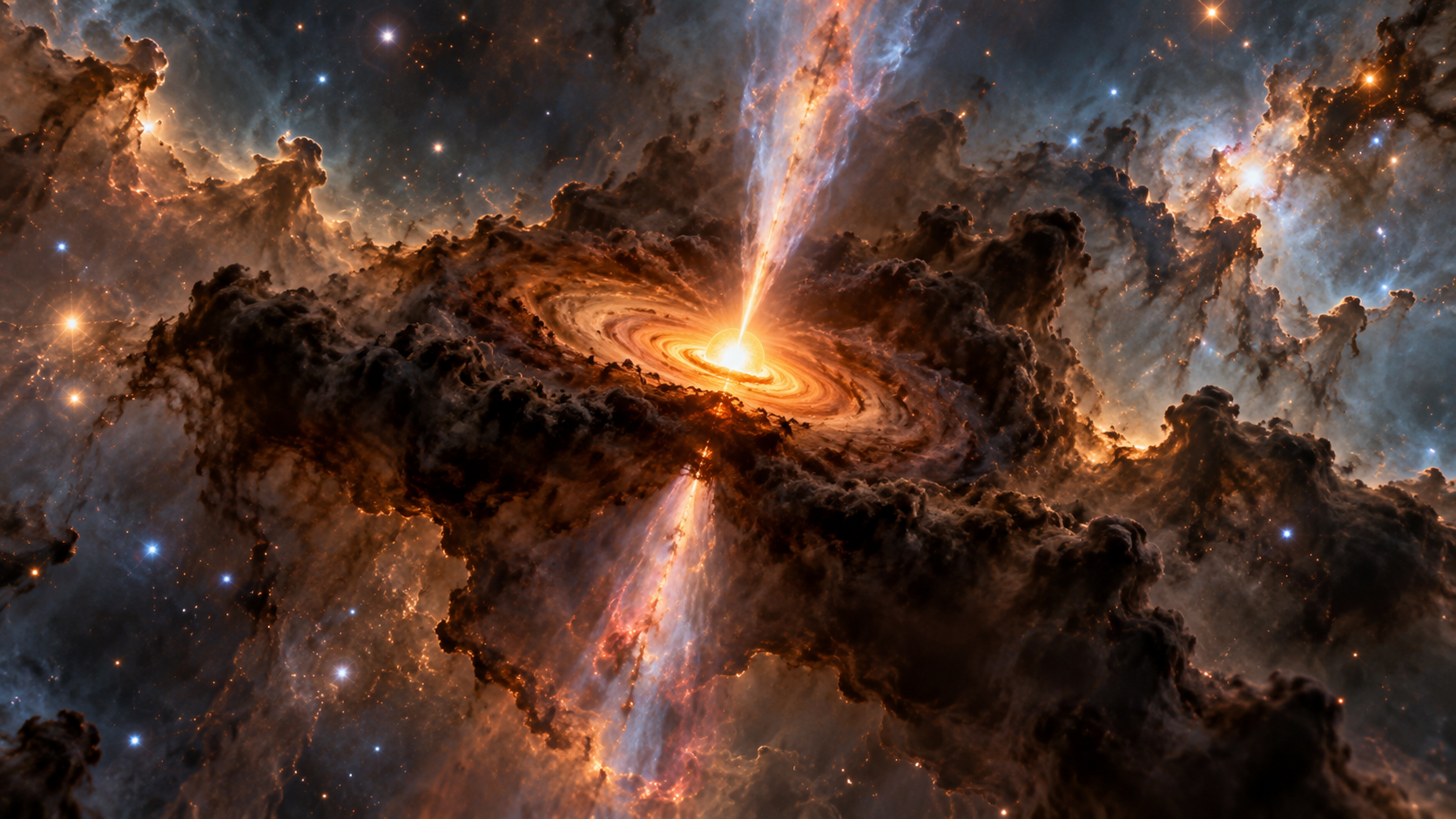
The collapsing material usually has some rotation. As its radius shrinks, conservation of angular momentum makes it spin faster and flatten into an accretion disk. Gas and dust in the disk lose angular momentum through magnetic and turbulent processes and spiral inward. At the same time, magnetic fields help launch narrow jets and broader outflows from near the young star.
Accretion raises the protostar’s mass, pressure, and central temperature. Before sustained hydrogen fusion begins, contraction is the main energy source. The surrounding envelope thins as material falls inward, is swept away by outflows, or is heated and dispersed by radiation. Planets may later assemble from the leftover disk around some young stars.
When the core becomes hot and dense enough, hydrogen nuclei fuse and release energy. The new pressure produced by the hot gas and radiation balances gravity, establishing a main-sequence star. Its mass determines the final structure and lifetime. A low-mass object that never reaches the necessary conditions becomes a brown dwarf rather than a normal star.
Astronomers study different stages with radio, infrared, optical, and X-ray observations. Infrared and radio wavelengths can penetrate dust that hides the youngest objects from visible-light telescopes. No single image follows one star for millions of years; the formation sequence is reconstructed by comparing many clouds, protostars, disks, jets, and young clusters at different ages.
Cold molecular clouds contain dense filaments and knots where gravity can begin to overcome pressure and turbulence.
Collapse concentrates mass into a protostar while gravitational energy heats the growing center.
Rotation flattens infalling material into an accretion disk, and magnetic processes help move angular momentum.
Jets and outflows remove material and reshape the envelope while accretion continues.
Sustained hydrogen fusion begins when the core becomes sufficiently hot and dense, establishing a main-sequence star.
Infrared and radio observations reveal dusty early stages that visible light cannot easily penetrate.
Explore more "Explainers"
Discover additional explainers across politics, science, business, technology, and other fields. Each explainer breaks down a complex idea into clear, everyday language—helping you better understand how major concepts, systems, and debates shape the world around us.