

How Osmosis Moves Water Across Membranes Explainer
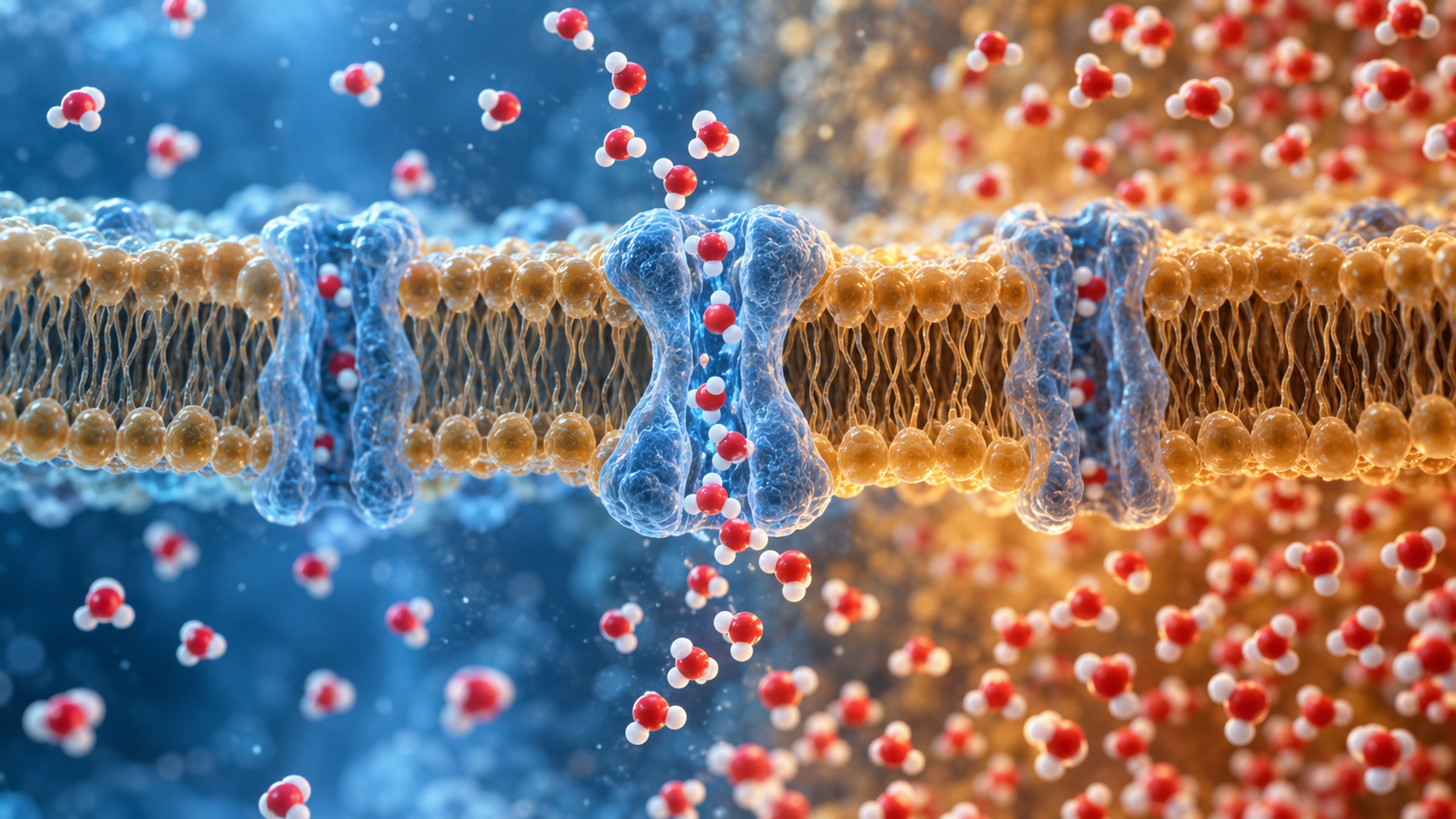
Water molecules move randomly in both directions across many biological membranes, either through the lipid bilayer or through channels called aquaporins. Osmosis describes the resulting net movement when the two sides have different water activity or water potential. Dissolved particles reduce the fraction of water able to move freely, so water tends to shift toward the side with more effective solute.
A selectively permeable membrane is essential. If both water and every solute crossed equally fast, the concentration difference would simply dissipate without a sustained osmotic effect. A solute that cannot readily cross exerts a stronger influence than one that rapidly equilibrates. This is why tonicity depends on nonpenetrating solutes rather than on total concentration alone.
As water enters a compartment, pressure can build. Osmotic pressure is the pressure that would be needed to stop the net water flow under defined conditions. In a rigid plant cell, the wall resists expansion and creates turgor pressure. In an animal cell without a wall, excessive water entry can swell and rupture the cell, while water loss causes shrinkage.
An isotonic solution produces no sustained change in cell volume, a hypertonic solution draws water out, and a hypotonic solution drives water in. Those terms are relative to the cell and depend on membrane permeability. Urea, for example, may contribute to measured osmolarity but can cross some membranes, so its lasting effect can differ from that of an equally concentrated nonpenetrating solute.
Cells and organs regulate osmotic conditions by moving ions and other solutes. Kidneys adjust water and salt excretion, plant roots manage solute gradients, and membrane pumps establish concentrations that indirectly guide water. Aquaporins can greatly speed equilibration, but they do not pump water against its potential; they provide a lower-resistance pathway.
Osmosis is sometimes described as water trying to dilute a solution, but no molecule has that intention. Random molecular motion plus a difference in chemical potential produces the net result. Temperature, pressure, solute properties, and membrane selectivity all matter. The same physical principle supports medical fluid therapy, food preservation, dialysis, and water purification.
Water moves both ways across a membrane, but a potential difference creates a net osmotic flow.
Nonpenetrating solutes lower effective water activity and have the strongest lasting effect on cell volume.
Osmotic pressure is the opposing pressure required to halt net water movement under specified conditions.
Hypertonic surroundings shrink cells, hypotonic surroundings swell them, and isotonic conditions maintain volume.
Aquaporins speed passive water movement while pumps regulate the solute gradients that drive it.
Osmosis follows thermodynamics and membrane selectivity, not a purposeful attempt by water to dilute solute.
Explore more "Explainers"
Discover additional explainers across politics, science, business, technology, and other fields. Each explainer breaks down a complex idea into clear, everyday language—helping you better understand how major concepts, systems, and debates shape the world around us.