

How Chromatography Separates Mixtures Explainer
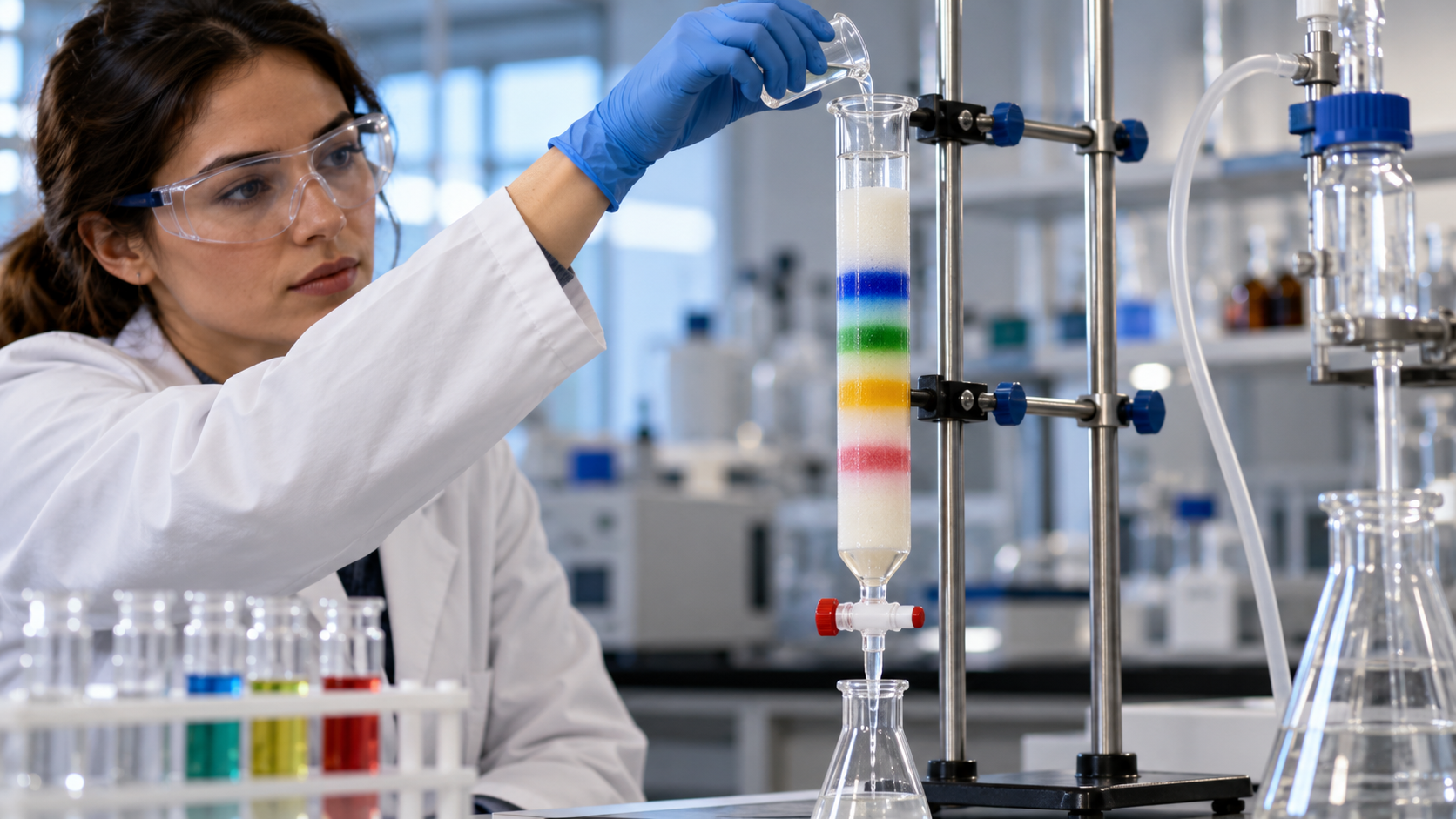
Chromatography begins by placing a mixture into a mobile phase that flows past or through a stationary phase. Each component repeatedly interacts with both. A molecule that spends more time in the mobile phase travels faster, while one that binds or dissolves more strongly in the stationary phase lags behind. Many tiny differences accumulate into separated bands or peaks.
The stationary phase may be a solid surface, a liquid coating on particles, paper fibers, a gel, or a chemically modified material inside a column. The mobile phase may be a gas or liquid. Separation can depend on polarity, charge, size, volatility, hydrophobicity, affinity for a biological partner, or a combination of properties.
In column chromatography, the sample enters as a narrow zone. As solvent or gas carries it forward, that zone spreads and its components move at different average speeds. The time a substance takes to reach a detector is its retention time. A chromatogram plots detector response against time, with each resolved component appearing as a peak.
Good resolution requires more than different retention. Peaks must remain narrow enough not to overlap. Column length, particle size, flow rate, temperature, mobile-phase composition, and sample amount all matter. Changing solvent strength or temperature during a run can help elute compounds that span a wide range of interactions.
Paper and thin-layer chromatography provide simple visual separations. Gas chromatography is useful for volatile compounds, while high-performance liquid chromatography handles many nonvolatile or heat-sensitive substances. Size-exclusion, ion-exchange, and affinity methods exploit particular molecular properties. Chromatography is often paired with mass spectrometry or spectroscopy for identification.
A peak at a familiar retention time is not automatically proof of identity, because different compounds may coelute. Standards, multiple separation conditions, selective detectors, and spectral evidence strengthen the conclusion. Chromatography separates and measures components; reliable interpretation comes from combining that separation with calibration and independent chemical information.
A mobile phase carries the sample past a stationary phase, and components distribute differently between them.
Stronger interaction with the stationary phase slows a component, while stronger preference for the mobile phase speeds it.
Repeated microscopic exchanges create macroscopic separation into bands or detector peaks.
Retention time and peak area help describe identity and amount, but both require calibration.
Flow, temperature, solvent, particle size, and column chemistry determine resolution and run time.
Standards and a second analytical signal are often needed because two compounds can share a retention time.
Explore more "Explainers"
Discover additional explainers across politics, science, business, technology, and other fields. Each explainer breaks down a complex idea into clear, everyday language—helping you better understand how major concepts, systems, and debates shape the world around us.