

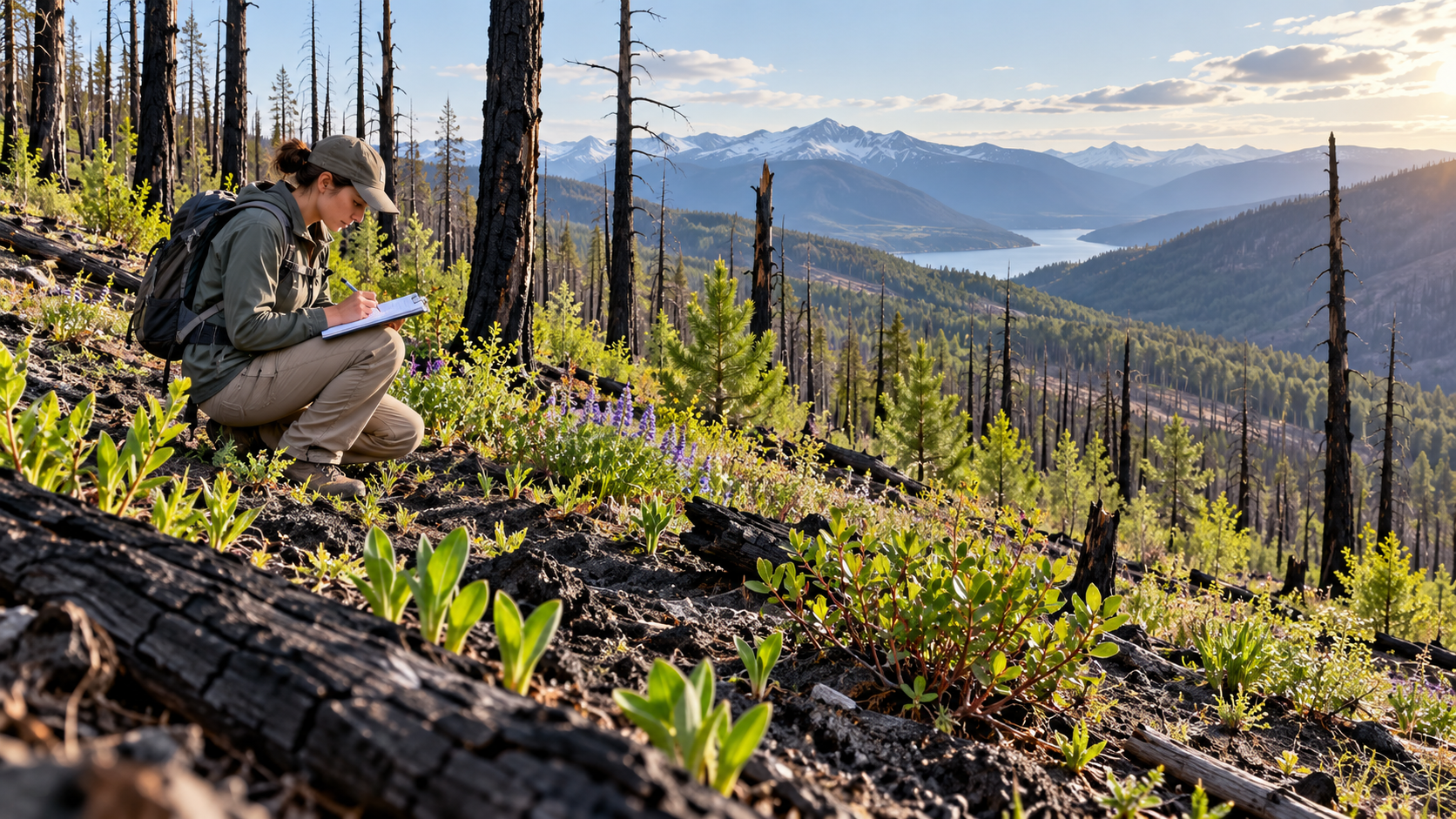
How Ecosystems Recover After Wildfire Explainer
Wildfire changes an ecosystem rather than resetting it to a blank surface. Even in a burned area, underground roots, seeds, microbes, unburned patches, standing dead trees, and surviving animals may remain. Recovery begins from that biological legacy. The amount left depends strongly on fire severity, which describes effects on vegetation and soil rather than simply flame height.
Some plants resprout from protected buds or roots within weeks. Others release seeds after heat, depend on a soil seed bank, or disperse from nearby unburned habitat. Fast-growing herbs can cover open ground before shrubs and tree seedlings establish. This sequence is secondary succession because soil and some living material remain, although the path is not fixed.
Fire can release nutrients from vegetation, but intense heating may also consume organic matter, alter soil structure, and kill roots and microbes near the surface. Without cover, rain can detach soil and send ash and sediment into streams. Mulch, contour barriers, or other emergency treatments are sometimes used where erosion threatens water, roads, or communities.
Climate after the fire often determines whether seedlings survive. Drought and heat can kill young trees even when seeds are abundant. Distance from living seed sources limits recolonization in large high-severity patches. Browsing, insects, invasive plants, and competition also change outcomes. A forest may recover slowly, or it may shift toward shrubland or grassland.
Repeated fire at shorter intervals can prevent plants from reaching reproductive age and deplete seed banks or stored carbohydrates. Conversely, excluding the frequent low-severity fires to which some ecosystems are adapted can allow fuels to build and change later fire behavior. Recovery should therefore be judged against the ecology of a particular place, not a universal ideal.
Scientists track vegetation, soil, wildlife, stream chemistry, and remote-sensing signals over years to decades. Management may protect natural regeneration, control invasive species, reduce erosion, or plant carefully selected stock where seed sources are absent. The central lesson is that recovery is a branching process shaped by legacies, weather, landscape position, and future disturbance.
Roots, seeds, microbes, unburned islands, dead wood, and surviving animals provide the biological legacy for recovery.
Resprouting and germination begin quickly, while dispersal supplies species from surrounding habitat.
Severe soil heating and loss of cover can increase erosion and alter nutrients, structure, and microbial communities.
Drought, heat, seed distance, herbivory, invasive plants, and competition determine which seedlings survive.
Repeated burns can interrupt reproduction and push forests toward shrubland or grassland.
Monitoring guides selective restoration, but recovery trajectories remain place-specific and can take decades.
Explore more "Explainers"
Discover additional explainers across politics, science, business, technology, and other fields. Each explainer breaks down a complex idea into clear, everyday language—helping you better understand how major concepts, systems, and debates shape the world around us.